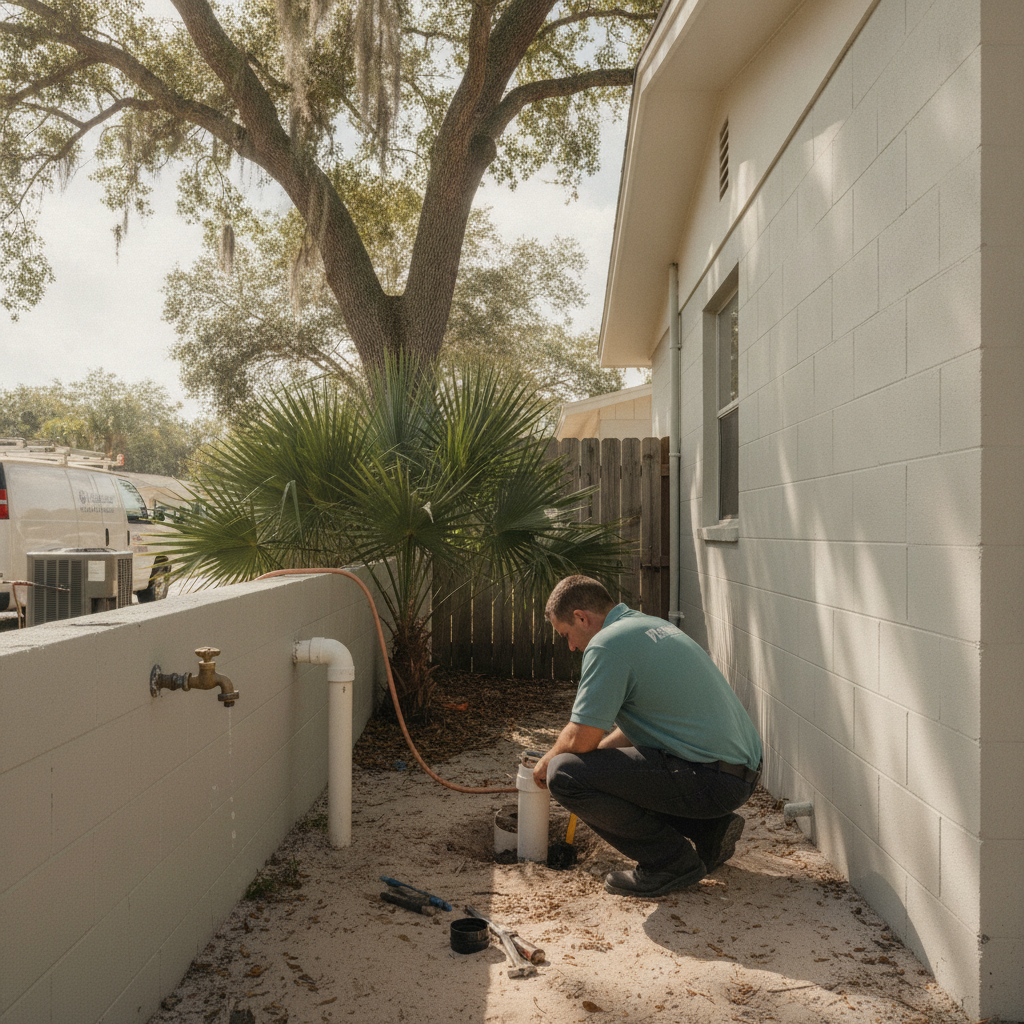
Park Boulevard ranches in Seminole sit on city water and city sewer, a few miles inland of the Gulf. The call that brings a Seminole plumber is usually a slow kitchen drain, a salt-pitted hose bib on the side wall, or a main line that backs up after a heavy rain. We match you with licensed local plumbers for plumbing in Seminole, from the lots between Largo and the beaches to the streets around Lake Seminole. Those are city-sewer problems on mid-century Pinellas stock, not well or septic work.
What a Seminole plumber is usually called for
The typical Seminole job starts at a 1960s or 1970s block ranch on a tight lot. Someone’s kitchen sink is standing full after the dishwasher runs. The washing machine is coughing water back onto the laundry-room floor. The hose bib on the west wall weeps when you unscrew the hose. Or the toilet gurgles when the shower drains, which is the house telling you the main is already holding water.
That pattern belongs to original drains under a slab, outdoor brass that has lived in salt air, and a city sewer lateral that has been in the ground since the neighborhood went in. It does not belong to a Pasco well, a Land O’ Lakes drain field, or a Seminole Heights bungalow in Tampa. Same name, different metro, different pipes.
The plumbers we send spend most of these calls on three systems. Slow fixture drains and main-line backups get drain cleaning through a cleanout, a pulled toilet, or a roof vent, then a camera if the clog keeps coming back. A line that is cracked, bellied, or root-cut needs sewer line repair, not another cable. Outdoor hose bibs, angle stops, and the last few feet of copper or galvanized at the wall fail from salt and age, not from a mystery in the street.
A leaking water heater in a humid garage shows up on the same streets. The tank sweats, the fittings rust, and the pan finally overflows onto a slab with nowhere for the water to go. Hurricane season, June through November, stacks rain on top of that: a surcharged city main, a yard that holds water, a garage unit that has been sitting in damp air all summer. The National Weather Service Tampa Bay office is the place for the storm itself. The plumbing question after the rain is whether the backup is in the house line or past the property line.
If the home is on a Citizens HO-3 policy, that worksheet does not cover water backup of sewers and drains, and it does not sell the endorsement. A clogged lateral and a flooded laundry room are still a plumbing problem. They may not be an insurance check. Read your own form’s Section I before you assume the carrier will step in.
Mid-century Pinellas stock on city water and sewer
Most of Seminole filled in between the 1950s and the early 1980s. Concrete-block ranches, slab on grade, original baths and kitchens still on the first set of pipes. City water at the meter. City sewer at the lateral. No tank in the backyard, no well head by the oak, no drain field to saturate in August the way a Land O’ Lakes lot does.
That housing era used the materials of its decade. Drain lines under the slab were often cast iron. Supply was galvanized steel or copper, with original stops and hose bibs still hanging on the exterior wall. Galvanized of that vintage is well past the 40 to 50 year lifespan this site already names for the same Pinellas belt. It corrodes from the inside. The interior diameter narrows. Pressure drops at the far bath or the second fixture in the chain. One leak is rarely the last one.
Tampa Bay water runs hard, in the 11 to 17 grain range depending on season and source. Scale crusts shower heads, cartridges, and the bottom of a tank the same way it does in a Brandon rental. In Seminole it shows up as a faucet that still drips after a fresh cartridge, a water heater that pops as sediment cooks on the element, and aerators that clog every few months. A filter on the fridge does not fix the pipe.
Because the waste side is municipal, a repeating backup is a house-line or lateral problem, not a full tank. A Florida home inspection is a limited visual look at readily accessible plumbing. It does not include a buried sewer lateral. If you are buying on Park Boulevard, or if a snake has already been through once this year, a camera is how you see the pipe you cannot see from the yard.
Cleanouts decide how that camera and cable get in. Florida’s plumbing code wants cleanouts at the building drain and sewer junction, at long runs, and at sharp changes of direction on new work. An older ranch that predates that rule often has one usable opening, or none you can find under the shrubs. The code is not a retroactive order on an existing house. It is why access, not the clog itself, is what changes the job once someone is on site.
Salt air on hose bibs and slow cast iron drains
Seminole is not on the sand. It is the next band inland, across the Intracoastal from Madeira Beach and Redington, with Park Boulevard as the east-west spine. Salt still rides the west wind. It does not hit a hose bib here as hard as it hits an outdoor shower on Pass-a-Grille. It hits harder than it hits a lot in Pinellas Park. The brass on the west wall tells you that. White crust, frozen handles, a stem that weeps the minute you put a hose on it.
Florida’s residential code requires a vacuum breaker on sillcocks, hose bibs, wall hydrants, and other hose connections: an atmospheric or pressure-type breaker, a pressure vacuum breaker assembly, or a permanently attached hose-connection breaker. The point is backflow. A hose left in a bucket, a pool, or a sprayer can push whatever is in that water back toward the house. The two code exceptions are water-heater and boiler drains meant only to empty a tank, and washer supplies that already have backflow protection. A garden bib is not either of those.
Cast iron under these slabs fails the quiet way. The interior rusts. Scale flakes. The pipe sags into a belly where grease and paper sit. A cable clears the soft blockage and the line runs for a week. Then the same fixture backs up, because the belly is still there. That is the same cast iron failure pattern we already walk through on older St. Petersburg bungalows. Seminole’s ranches are a little newer and a little farther from the bay, and the material is the same.
Roots find the joints. Live oaks and laurel oaks along these lots send them toward any leak of air or moisture at a hub. A camera shows whether you are looking at a paper clog, a root mass, a crack, or a collapse. Guessing from the kitchen sink is how a homeowner pays for the wrong fix. Hydro-jetting scours grease and soap off a line that is still round. A section that has lost its shape needs repair or replacement, including trenchless lining where the pipe and the access allow it.
Outdoor fittings are the other weekly call. Salt, UV, and hard water chew the hose bib, the boiler drain on the heater, and the cheap hose-thread vacuum breaker that was never meant to last a decade in this air. Repairing a leaking valve can sit inside the code’s plumbing repair exemption. Replacing the fixture is the moment that exemption’s own proviso takes the job back out. Confirm the permit question with the building department that actually has your address, City of Seminole or Pinellas County, before anyone cuts the wall.
How Seminole differs from Largo and Pinellas Park
Largo, Seminole, and Pinellas Park share city water, city sewer, and the same mid-county ranch belt. The plumbing is not identical. Salt, lot size, and which material fails first all shift as you move west toward the Gulf or east toward the overpass.
| Seminole | Largo | Pinellas Park | |
|---|---|---|---|
| Water and waste | City water and city sewer on mid-century lots | City water and city sewer, a step closer to the Gulf | City water and city sewer, farther inland |
| Housing | 1950s to early-1980s block ranches, tight lots on Park Boulevard | Similar ranch stock, more of the west-county salt fetch | 1950s to 1980s slab homes in the same galvanized-supply years |
| What shows up first | Slow cast iron under the slab, salt-pitted hose bibs | Salt on exposed fittings and slow drains | Galvanized supply that has outlived a 40 to 50 year span |
| What this is not | Not Seminole Heights in Tampa, not Pasco well country | Not a beach cottage on the sand | Not a new East Hillsborough polybutylene subdivision |
Largo’s salt-air drain pattern is the closest sibling. Same Gulf fetch, slightly more of it. Pinellas Park’s common failures lean harder on galvanized supply from homes built 1950 to 1985. Seminole sits between those two: beach-adjacent enough for outdoor brass to pit, inland enough that the weekly call is still a city lateral and a slab drain, not a well pump.
A page written for Dunedin or Wimauma would miss this. Dunedin is older North Pinellas suburban stock on city lines. Wimauma is rural Hillsborough, well and septic, sandy soil, a high water table. Seminole’s problem is a 1960s ranch on municipal sewer, a hose bib that has been tasting the Gulf since the house was painted last, and a cast iron run that has been thinning under the slab for decades.
That is also why a phone quote before anyone sees the cleanout is a guess. A cable through an open cleanout is one job. A camera plus a section of bellied iron under a garage is another. Access, material, and how much surface has to open and close are what move the number. We do not post a flat rate, and we do not pretend a search result can price a buried line.
Common Seminole plumbing questions
Is Seminole, Florida on city sewer or on a septic tank?
Seminole in Pinellas is city water and city sewer. The tank-and-drain-field belt in this metro is Pasco and rural Hillsborough: Land O’ Lakes, Odessa, Wesley Chapel, Thonotosassa, Dover, Wimauma, Balm. If your address is a Park Boulevard ranch, a repeating backup is a house drain or a city lateral, not a full septic tank. Seminole Heights is a different place entirely, inside Tampa, with its own older cast iron and galvanized.
How do I confirm a plumber is licensed in Florida?
Search the contractor on the Florida DBPR license portal before anyone opens a line. The plumbers we send are licensed and insured. This brand matches you with them. It is not the licensed contractor and it holds no license number of its own. A license you can look up beats a promise you cannot. Ask what they saw in the cleanout or on the camera, in writing, before the work starts.
Why does a drain quote change once someone sees the house?
A kitchen sink that will not drain might be a trapped P-trap, a belly in the original cast iron, roots at a hub, or a city main that is already full after a storm. Those four jobs do not share a method. Cleanout location, slab versus yard, and whether the pipe is still round are what the pro on site is actually pricing. If two people quoted you from the same phone description, they were not quoting the same pipe.
When to call us
Call when a Seminole drain backs up at more than one fixture, a hose bib will not shut, or a camera has already shown a cracked or bellied city-sewer lateral. Those jobs need a licensed plumber, not another bottle of crystal and not a guess from the street. Call us at (813) 590-0625.