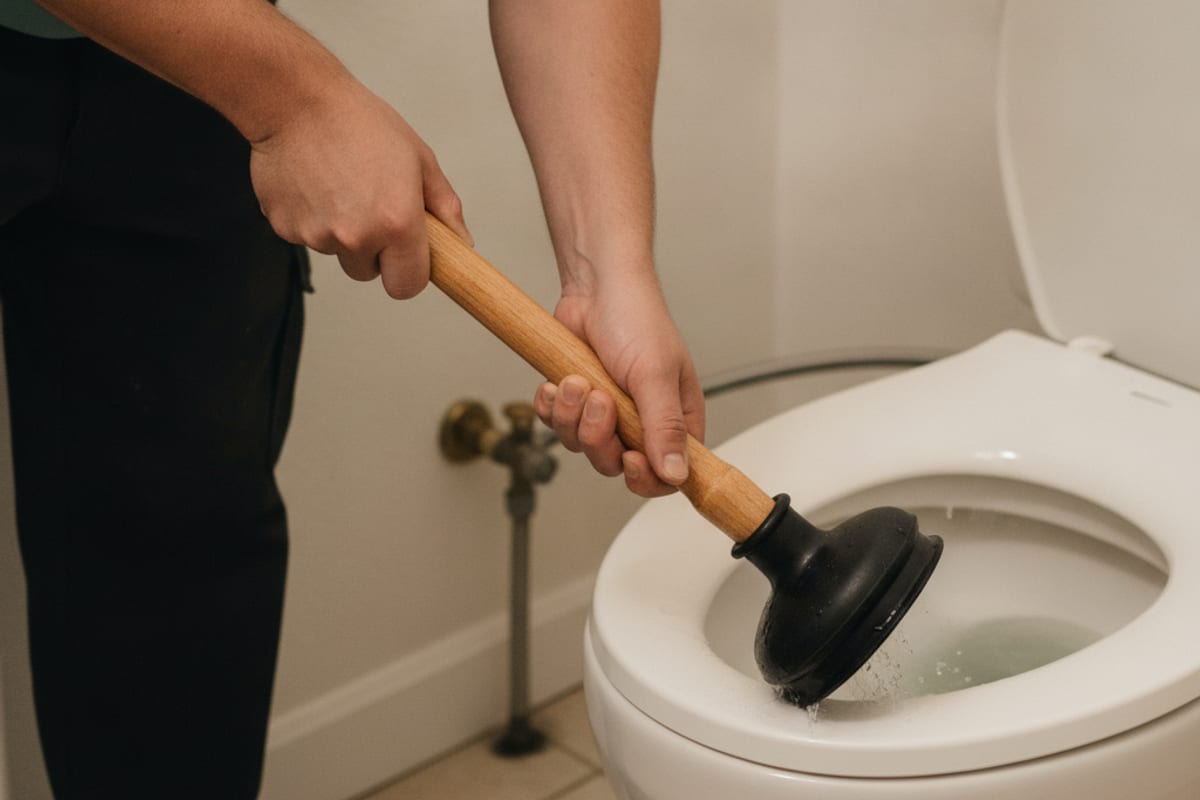
Most toilet clogs clear in about five minutes with a plunger you probably already own. The trouble is that the common instinct, pouring in a bottle of chemical cleaner and waiting, is the one move that can turn a ten dollar problem into a repipe estimate. Here’s the order to work through, and the point where a clog stops being a toilet problem and starts being a sewer problem.
Stop the bowl from overflowing first
Before anything else, take the lid off the tank and push the flapper down. That’s the rubber seal at the bottom. Closing it cuts water to the bowl immediately and buys you time.
If the water is still rising, reach behind the toilet and turn the oval shutoff valve clockwise until it’s snug. In a lot of Tampa homes those valves haven’t moved in fifteen years and can be stiff. Turn firmly, but if the stem feels like it’s about to snap, stop and go find the main shutoff instead.
Use a flange plunger, not the cheap red one
This is the single biggest reason plunging fails. The shallow red cup plunger is designed for flat sink drains. It cannot seal a toilet’s curved outlet, so most of your effort pushes air around the rim instead of water down the trap.
You want a flange plunger, the kind with a soft rubber sleeve that folds out of the cup. It costs about eight dollars at any hardware store on Dale Mabry or US-19.
Technique matters more than force:
- Run the plunger under hot tap water for thirty seconds. Warm rubber seals better than stiff rubber.
- Seat the flange fully into the drain opening and press down slowly to push out trapped air. A first hard shove just splashes dirty water on your floor.
- Make sure there’s enough water in the bowl to cover the plunger cup. Plunging air does nothing. Add water from a bucket if you have to.
- Now pump vertically, fifteen to twenty strokes, keeping the seal the whole time. The pull stroke does as much work as the push.
- Break the seal and see if the bowl drains. Repeat the cycle two or three times before giving up.
Roughly four out of five clogs give up right here.
If plunging fails, use a closet auger
A closet auger, sometimes sold as a toilet auger, is a short cable in a protective sleeve with a curved end. Around thirty dollars and worth owning if you’re in an older house.
Feed the end into the drain and crank the handle clockwise while pushing gently. When you feel it bite, keep cranking and pull back slowly. You’re either breaking the obstruction apart or hooking it to drag it out.
Use the sleeve. It’s there to keep the metal cable from dragging across the porcelain, and a scratched trap collects paper and clogs faster from then on.
Do not substitute a wire coat hanger. It scratches the glaze, rarely reaches the actual blockage, and has cracked more than a few bowls.
Skip the chemical drain cleaner entirely
Sulfuric acid and lye based cleaners are a bad idea in any toilet, and they’re a genuinely expensive idea in Tampa.
Homes here built before roughly 1975, which covers a lot of Seminole Heights, Ybor City, Sulphur Springs, and St. Petersburg’s older blocks, were plumbed with cast iron drain lines. Those pipes are now fifty years old and already thinned by corrosion from the inside. Caustic cleaner sits against that weakened iron and accelerates it. Pour it into a pipe that’s already scaled down to half its diameter and you can turn a soft clog into a hole in the lateral.
There’s a safety issue too. If the chemical doesn’t clear the clog, it’s now sitting in a full bowl. Anyone plunging after that is splashing caustic liquid at their own face, and any plumber who opens that line is walking into it blind. If you’ve already poured some in, say so when you call. It changes how the work gets done.
When it isn’t the toilet at all
If one toilet clogs and everything else in the house drains fine, it’s a local clog. Keep working on it.
Watch for these instead:
- Two or more fixtures backing up at the same time
- The tub or shower gurgling when you flush
- Water rising in a shower pan when the washing machine drains
- Sewage smell coming up through a floor drain
- Every toilet in the house draining slowly
Any of those means the blockage is downstream in your main line, and plunging accomplishes nothing. Worse, forcing it can push waste up through the lowest drain in the house, which is usually a guest shower or a garage floor drain.
That’s the point to stop and get a camera in the line. Sewer line repair work should always start with an inspection rather than a guess, especially in older Tampa Bay neighborhoods where the answer is often root intrusion from live oaks or a bellied section of cast iron where the sandy soil settled underneath it.
If you’re on septic, the rules change
Much of Pasco County runs on septic rather than city sewer. Land O’ Lakes, Odessa, Shady Hills, and plenty of rural Hillsborough sit on tanks and drainfields.
On septic, slow flushing throughout the house frequently isn’t a clog at all. It’s a tank that needs pumping, or a drainfield that’s saturated. Tampa Bay’s summer rain and high water table make the second one seasonal. After a stretch of heavy afternoon storms, a marginal drainfield stops accepting water and the whole system backs up toward the house.
Plunging and augering do nothing for that. If your fixtures slowed down gradually over a few weeks, or the yard over the drainfield is soggy or unusually green, you need septic service rather than a drain snake.
What to keep out of the bowl
Toilet paper and human waste. That’s the whole list.
The repeat offender is wipes labeled flushable. They clear the toilet, then snag on any rough spot in the line and collect everything behind them. In a scaled cast iron lateral there are rough spots every few inches. Paper towels, cotton pads, dental floss, and cat litter all behave the same way.
If your house was built in the eighties or early nineties, you may also have a first generation low-flow toilet. Those were mandated before the engineering caught up, and some models simply lack the water volume to clear the trap reliably. If you’re plunging the same toilet monthly, replacing the fixture usually costs less over a couple of years than the service calls. That’s a straightforward toilet repair or replacement conversation.
When to call someone
Call once any of these is true:
- Plunging and augering both failed
- More than one fixture is backing up
- Sewage is coming up through a shower or floor drain
- The same toilet has clogged three times in a month
- You’re on septic and the whole house slowed down at once
- You already poured chemical cleaner in and it didn’t work
A recurring clog in the same fixture is almost never about what got flushed. It’s the line telling you something about its condition, and a camera inspection answers it in about twenty minutes.
We connect Tampa Bay homeowners with experienced local drain crews, including after hours when a main line backs up on a Saturday night. Reach us at (813) 590-0625 for emergency plumbing, or read more about what causes recurring drain clogs in Florida homes.
Whoever you hire, verify their CFC plumbing license at myfloridalicense.com before work starts. It takes a minute and it’s public record.