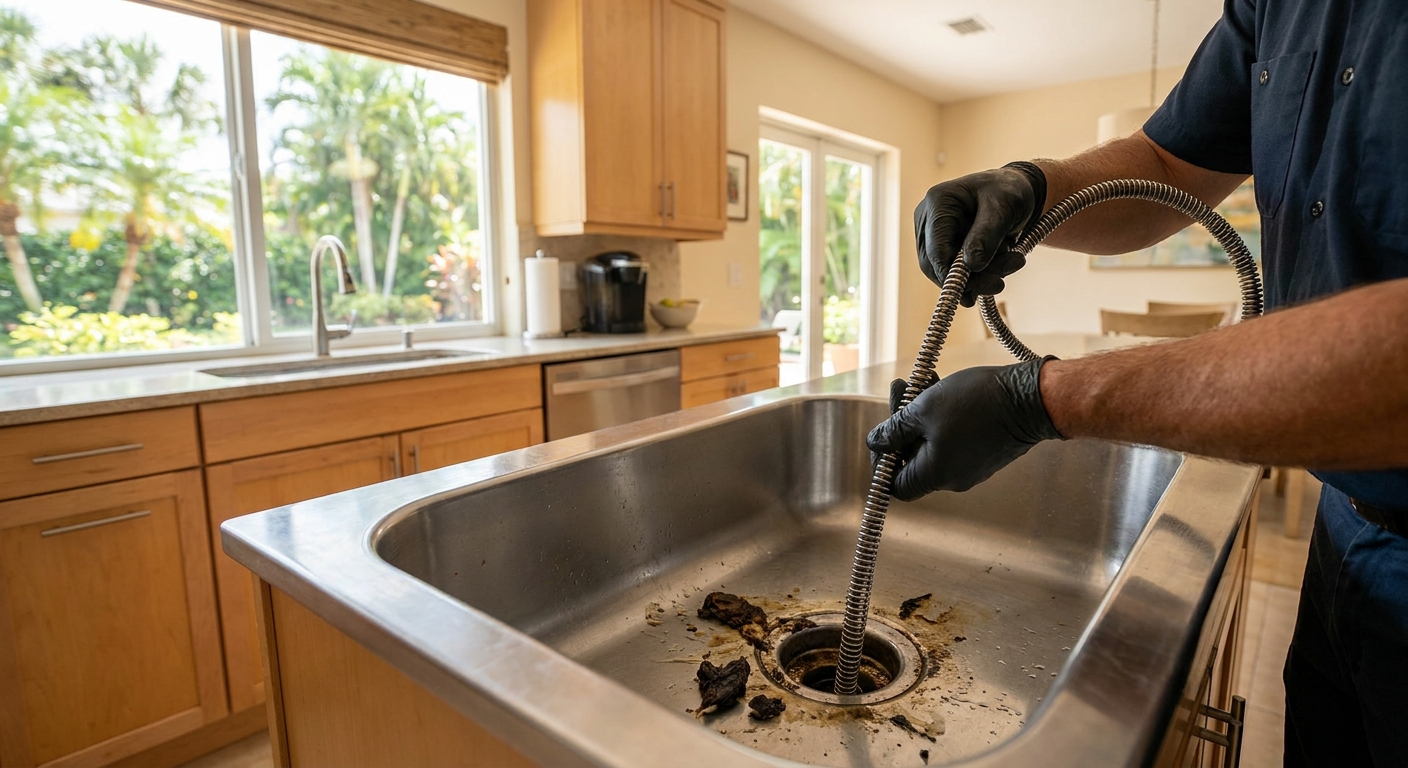
Drain clogs in Tampa Bay aren’t quite the same animal as drain clogs in a house up north. Our hard water, our sandy shifting soil, our slab-on-grade construction, and our year-round humidity all combine to create clog patterns that are specific to this part of Florida. Understanding why your drains clog here helps you actually prevent it instead of just reacting every time the kitchen sink backs up.
Hard water buildup inside the pipe
Tampa Bay water runs around 11.7 grains per gallon on average, solidly in “very hard” territory, and it climbs higher, sometimes 17 to 18 gpg, during dry season or on deep wells in Pasco and the rural fringes. Every time water runs through your pipes, it leaves behind trace mineral deposits. Over months and years, those deposits build up on the interior walls of your drain lines, narrowing the opening and giving hair, soap scum, and grease something to grab onto and stick.
This is different from a simple hair clog. Mineral buildup is why the same drain seems to clog more often over time even if your habits haven’t changed. A once-a-year snake job or hydro-jetting service clears mineral scale along with debris, and it’s genuinely more necessary here than it would be in a region with soft water or a home with a water softener already slowing the buildup.
Grease and the Florida kitchen
Grease is a universal clog culprit, but it’s a bigger problem in Florida kitchens specifically because of how our warm home temperatures interact with cooling grease. When hot grease hits a pipe and starts to cool, it solidifies faster and sticks harder in a warm indoor environment than people expect. The old advice to never pour grease down the drain holds everywhere, but here it’s worth being extra disciplined about it: let grease cool in a container and toss it, don’t chase it with hot water thinking that solves it, because it usually just pushes the problem further down the line where it’s harder to reach.
Sandy soil and shifting slab lines
Most Tampa Bay homes sit on slab foundations, and the sandy soil underneath shifts more than clay-heavy soil in other parts of the country. That shifting can put stress on the sewer lateral, the pipe running from your house out to the city main, causing bellies (low spots where the pipe sags) that collect waste and paper even when nothing’s technically clogging the line from misuse. If you’ve got a drain that backs up repeatedly no matter what you do upstream, especially a lower-level toilet or floor drain, a sagging lateral line from soil settlement is a common Tampa Bay-specific cause, and it usually needs a camera inspection to confirm.
Tree roots in older neighborhoods
In established neighborhoods with mature tree canopies, think Hyde Park, Seminole Heights, Old Northeast in St. Pete, Palma Ceia, and Safety Harbor, oak and other large root systems actively seek out sewer lines for moisture, especially older cast-iron or clay lines from pre-1975 construction. Roots find the smallest crack or joint gap and grow into it, eventually choking the line completely. If your home is in one of these older, tree-heavy neighborhoods and you’ve never had a camera inspection of your sewer lateral, that’s one of the more valuable preventive checks you can get done, particularly before you plant new landscaping near the line’s path.
What actually helps prevent clogs here
Run cold water with the garbage disposal, not hot. Cold water keeps grease and fats solid so the disposal chops them rather than letting them liquefy and coat the pipe walls.
Use drain strainers in every shower and bathroom sink. Hair combined with mineral-hardened soap scum is one of the single most common clog causes in Tampa Bay bathrooms, and a $5 strainer stops most of it before it enters the line.
Skip the chemical drain cleaners. They’re rough on older cast-iron and even PVC lines, and they don’t touch mineral scale buildup the way mechanical cleaning does. Repeated use can actually damage pipe walls, which becomes its own expensive problem.
Get an annual or biannual drain cleaning if your home is pre-1995. Older homes with galvanized, cast-iron, or aging poly lines benefit from a proactive hydro-jetting or snake service before a slow drain becomes a full backup, especially heading into hurricane season when heavy rain can overwhelm a partially clogged sewer lateral and back water up into the house.
Watch for slow drains across multiple fixtures at once. If your kitchen sink, bathroom sink, and tub are all draining slowly around the same time, that’s usually not four separate local clogs, it’s one clog further down the main line, and it needs a professional look before it becomes a backup.
When it’s more than a clog
If you’re dealing with recurring clogs in the same drain, gurgling sounds from other fixtures when you flush or run water, or a sewage smell anywhere in the house, those are signs of a bigger issue further down the line, possibly a root intrusion, a bellied lateral, or aging pipe material that’s collapsing internally and heading toward a sewer line repair. Don’t keep running a snake through the same drain every few months and hoping it holds. A camera inspection tells you exactly what’s happening and exactly where, and it’s a lot cheaper than an emergency backup during a Tampa Bay summer storm.
Let’s keep your drains actually clear
If you’re tired of the same drain clogging every few months, or you’ve never had your sewer lateral inspected and your home’s older than 1995, give Tampa Plumbing Pro a call at (813) 590-0625. We’ll figure out whether you’re dealing with mineral scale, roots, a soil-settled belly, or just bad habits, and get you a real fix instead of a temporary one.
One habit that pays off more than people expect
Running your garbage disposal for a few extra seconds after the food is gone, with cold water still running, clears residue that would otherwise sit and hold moisture against the pipe wall. It’s a small habit, but paired with strainers and an annual cleaning, it meaningfully extends the time between service calls.