A warm hallway tile in a slab ranch off James L. Redman Parkway is often the first clue. So is a well that lost pressure after a storm, or a shower head crusted white after a year on East Hillsborough water. Plant City plumbers who actually work this edge of the county start by asking which system you have: city water and sewer in town, or a well and septic on a farm lot toward Dover. We match you with a licensed plumber who already knows that split.
What Plant City plumbers get called for
The calls that come in from Plant City are not one job with a city name swapped on. In town, it is a scaled water heater, a fixture that will not shut off, or a drain that backs up on a short city lateral. On the agricultural lots, it is a well pump that quit, a pressure tank that will not hold, or a septic that sat fine in March and then backed up after an August afternoon storm.
A hidden leak is its own category here, and it is a common one on slab ranches. There is no puddle. The hallway just feels warm. The meter keeps moving with every tap closed. That is leak detection work, not a guess and a sledgehammer. The plumbers we send locate the line first, then talk through how to open and close the slab.
What a useful visit has to establish, before anyone quotes:
A licensed plumber who works Plant City asks whether the house is on city water or a well. The same visit should establish sewer versus septic before anyone prices a drain job. On a farm parcel, the length of the private run from the house to the meter, tank, or property line changes the job.
That last point is where a cheap quote falls apart. A number written for a downtown lot will not cover a strawberry-country parcel with a long private line, a well house out back, and irrigation tied into the same yard. The low bid is often a standard-lot assumption on a property that is not a standard lot.
Florida licenses plumbing contractors at the state level. You can confirm a license and insurance on the Florida DBPR licensee search before anyone opens a wall. How to choose a licensed plumber in Tampa Bay walks through that check. The plumbers we send are licensed and insured. We are the match, not the contractor on the permit.
Downtown Plant City still has older buildings where original metal supply lines have narrowed from the inside. The farm edge is a different toolbox. A plumber who only works tight Tampa lots will spend the first hour just finding the well, the tank, and the cleanout.
In-town city water versus wells on the agricultural edge
In-town Plant City sits on municipal water and sewer. The plumbing problems look like the rest of East Hillsborough on city service: mineral scale on shower heads and tea-stained dishwashers, sediment in a tank water heater, outdoor hose bibs that weep, and laterals that clog with grease and roots. The city owns the main in the street. You own the line from the meter to the house, and the drain from the house to the sewer connection.
A few miles out, toward Dover and Thonotosassa, the picture flips. Those lots are the rural Hillsborough well-and-septic belt: sandy soil, a high water table, and long private runs. A well that loses pressure after a storm is often the pump, the pressure switch, or the tank, not the hole in the ground. A new well is water-well-contractor work, and the Southwest Florida Water Management District requires a well construction permit before one goes in. The pump, pressure switch, and pressure tank sit above that line. Those parts are plumbing and electrical scope, which is why a licensed plumber can replace a failed pump without being the person who drilled the well. Well pump repair is the call for that equipment.
Well water also treats differently than city water. Iron, sulfur smell, and sediment show up at the tap and inside the heater. The chemistry on this Hillsborough edge is the same family as the Pasco well belt, which is why well water treatment in Pasco is the right read even if your lot sits on this side of the county line.
Septic on those rural lots is its own trade. Florida’s onsite sewage program sits with the Florida Department of Environmental Protection since July 1, 2021, and the Florida Department of Health in Hillsborough County still handles the permitting and inspection. If the tank or the drain field is the problem, we line you up with a licensed and registered septic contractor. Clearing a house drain does nothing if the field is saturated and passing solids through sandy soil. After a heavy rain, that is often exactly what is happening.
Do not hire a drain quote for a septic failure. The two jobs are not the same, and the credential is not the same.
Slab leaks, scale, and East Hillsborough housing mix
East Hillsborough is slab-on-grade country. Plant City’s ranches put supply lines in or under that slab, so a leak often announces itself as a symptom instead of a puddle. A warm strip of tile. A soft spot in the vinyl. A stain that keeps coming back. A water bill that jumped with no change in how you live. That is the scene behind a leak detection in Plant City search: something is wet, and you cannot see it.
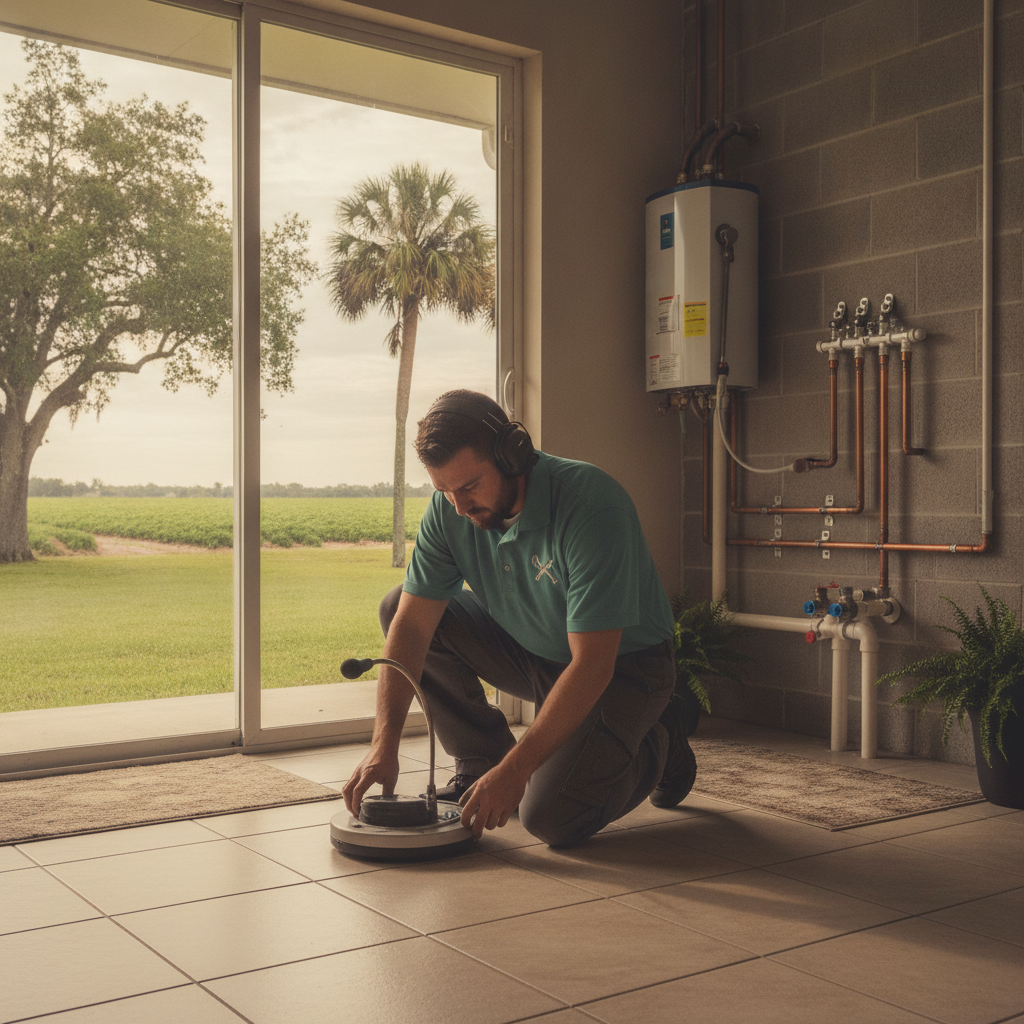
The plumbers we send do not start by cutting the floor. They listen. Acoustic gear, a camera where a line is reachable, and a pressure test tell you whether you are looking at one failed section or a system that is done. Slab leak repair then follows the access: a targeted opening if the leak is findable, or a reroute if the slab is the wrong place to keep fighting. Opening more concrete than you need is what drives a slab job. A longer run under a slab means more concrete to open and close. A short, clearly marked leak is a smaller opening.
Scale is the other East Hillsborough constant, on city water and on wells. Minerals leave a crust on the shower head in a rental after a year. The water heater pops and rumbles as sediment cooks on the bottom of the tank. Faucets that got a fresh cartridge still drip because the valve body is packed with scale. A softener or a filter does not fix a slab leak, and a slab repair does not stop the crust. They are two different jobs that often live in the same house.
The housing mix is what makes Plant City a poor copy of a generic suburb page. Downtown lots and older in-town houses are one stock. The slab ranches around them are another. Then the 1980s-to-2000s subdivision belt that runs through East Hillsborough, the polybutylene and slab-on-grade stretch, reaches into Plant City the same way it reaches Brandon and Valrico. Polybutylene supply lines from that era fail at fittings and in the slab. If a plumber does not ask when the house was built, they are guessing at the pipe.
Hurricane season from June through November adds a well-pump week and a sump-and-backflow week on the lower lots. The farm parcels sit farther from the road. A loaded truck on a long driveway is not a downtown alley call. Sort out who covers this edge before you have water on the floor.
How Plant City differs from Brandon and from rural Balm
Brandon is the denser East Hillsborough suburb. Plant City is the agricultural edge of the same county. Balm, Dover, and Thonotosassa are the rural lots still farther from any municipal line. The plumbing is not interchangeable.
| In-town Plant City | Brandon subdivisions | Rural lots toward Balm, Dover, Thonotosassa | |
|---|---|---|---|
| Water | Municipal water at the meter | Municipal water on tighter lots | Private well, pump, and pressure tank |
| Waste | City sewer | City sewer | Septic, handled by a licensed and registered contractor |
| Housing | Older downtown mixed with slab ranches | 1980s-to-2000s slab homes, the polybutylene belt | Farm parcels with long private lines |
| Typical call | Scale, a hidden slab leak, a tired water heater | Polybutylene, slab leaks, subdivision laterals | Well pressure loss, a tank that backs up after an August storm |
Common plumbing problems in Brandon are the subdivision story: polybutylene, slab leaks, and city laterals on lots that all look alike. Take that page’s punch list and drop it on a Plant City farm parcel, and you will miss the well, the septic, and the length of the run. Take a Balm well-and-septic playbook and drop it on a downtown Plant City bungalow, and you will look for a tank that is not there.
The honest local test is simple. A plumber who knows Plant City asks what the property actually has before diagnosing anything. A plumber who does not will quote the house next door.
We cover Plant City along with the rest of Hillsborough, Pinellas, and Pasco. The match still has to fit the lot. In-town city water is one dispatch. A well house behind a strawberry field is another.
How do I verify a plumber is licensed in Florida?
Search the contractor on the Florida DBPR licensee search at myfloridalicense.com and confirm the license is current before work starts. Ask for proof of insurance in the same conversation. A license is what lets a contractor pull a plumbing permit. If the job is septic, you need a licensed and registered septic contractor, which is a separate credential from a plumbing license.
Why does a Plant City plumber need to know well versus city water?
The equipment is different, and so is the failure. City water points at scale, a municipal lateral, and a meter at the street. Well water points at a pump, a pressure tank, sediment, and a private line that can run a long way from the house. A quote that does not name which system it assumes is a quote for a different property.
Who handles a septic problem on a rural Plant City lot?
A licensed and registered septic contractor. We will get one of those pros out for a tank or drain field issue. County health still permits and inspects onsite systems in Hillsborough, and DEP sets the state program. A house-drain clearing will not repair a saturated field.
When to call us
Call when a floor is warm and you cannot find the water, when a well has lost pressure, when scale has a heater or a shower fighting you, or when you are not sure if the lot is on city sewer or a septic tank. Those are licensed plumber jobs, and on a septic lot they are licensed and registered septic-contractor jobs. Call us at (813) 590-0625.