Odessa, Dade City, San Antonio, and the rural stretches of Land O’ Lakes and Thonotosassa still run largely on private wells, and Pasco County well water tends to come with a specific, recognizable set of problems: heavy hardness, iron, and sulfur, often all three at once. If you’ve moved into a well-water home out here and noticed orange staining, a rotten-egg smell, or crusty buildup on every fixture, you’re dealing with one or more of these, and each one needs its own kind of treatment.
Why Pasco wells run this way
Pasco County sits over a mix of limestone aquifer and sandy soil that’s naturally rich in dissolved minerals, particularly calcium, magnesium, and iron, along with organic material that produces hydrogen sulfide gas under certain groundwater conditions. Unlike municipal water, which is treated before it ever reaches your tap, well water comes straight out of the ground exactly as the aquifer delivers it. Whatever’s naturally in the local geology ends up in your glass, your washing machine, and your water heater unless you treat it yourself.
Iron: the orange stain problem
Iron in well water usually shows up as reddish-orange or rust-colored staining on sinks, tubs, toilets, and laundry, plus a metallic taste in drinking water. It comes in two forms that matter for treatment. Clear-water iron is dissolved and invisible until it hits air and oxidizes, turning orange as it comes out of the faucet or shortly after. Red-water iron has already oxidized underground and comes out of the tap visibly discolored.
Iron staining isn’t just cosmetic. It builds up inside pipes and water heater tanks the same way hardness scale does, and it can host iron bacteria, a slimy, reddish-brown buildup that clogs plumbing fixtures and well pump equipment over time. That buildup is one of the reasons pumps out here wear out early, which we cover in well pump repair in Tampa Bay. Treatment typically means an iron filter, sized to the specific iron concentration and form, installed ahead of the rest of the household plumbing.
Sulfur: the rotten-egg smell
Hydrogen sulfide gas is what produces that unmistakable rotten-egg smell in well water, and it’s one of the most common complaints we hear from new well-water homeowners in Pasco. It’s typically strongest in hot water, since heat releases more of the dissolved gas, which is why people often notice it in the shower before they notice it at the kitchen sink. If the smell shows up only in the hot water, the source may be the water heater itself rather than the well, which we cover in why hot water smells like rotten eggs.
Sulfur isn’t usually a health hazard at typical well concentrations, but it makes water genuinely unpleasant to use and can corrode certain plumbing components over time, including the anode rod in your water heater faster than normal. Treatment options range from an oxidizing filter system to a chlorination-and-filtration setup for higher concentrations, depending on how strong the sulfur smell tests at your specific well.
Hardness: the same problem as municipal water, usually worse
Pasco well water frequently tests harder than Tampa’s already-hard municipal supply, sometimes significantly so, because groundwater in this geology picks up more dissolved calcium and magnesium the longer it sits in the aquifer. Combined with iron and sulfur, hardness compounds the strain on plumbing and water-using appliances. A water softener is still the right tool for hardness specifically, but on a well system it usually needs to be sequenced correctly with iron and sulfur treatment, or the iron and sulfur will foul the softener’s resin bed and shorten its working life. A softener-only Pasco price lives on water softener cost in Tampa, not on this page.
Pasco wells also get tested for manganese, tannins, and low pH. Those are test-for-these items. They are not a reason to buy a gadget off a stain or a smell, and this page does not put a dollar figure on treating them.
Why treating one problem without the others backfires
We see this mistake a lot: a homeowner installs a standard water softener expecting it to fix everything, and within a few months the softener’s resin is fouled with iron and performing poorly, or the sulfur smell is still there because a softener doesn’t remove hydrogen sulfide gas at all. Each of these three problems, iron, sulfur, and hardness, needs its own treatment stage, sequenced correctly, usually iron and sulfur removal ahead of the softener so the softener isn’t doing double duty it wasn’t designed for.
What a real well water treatment setup looks like
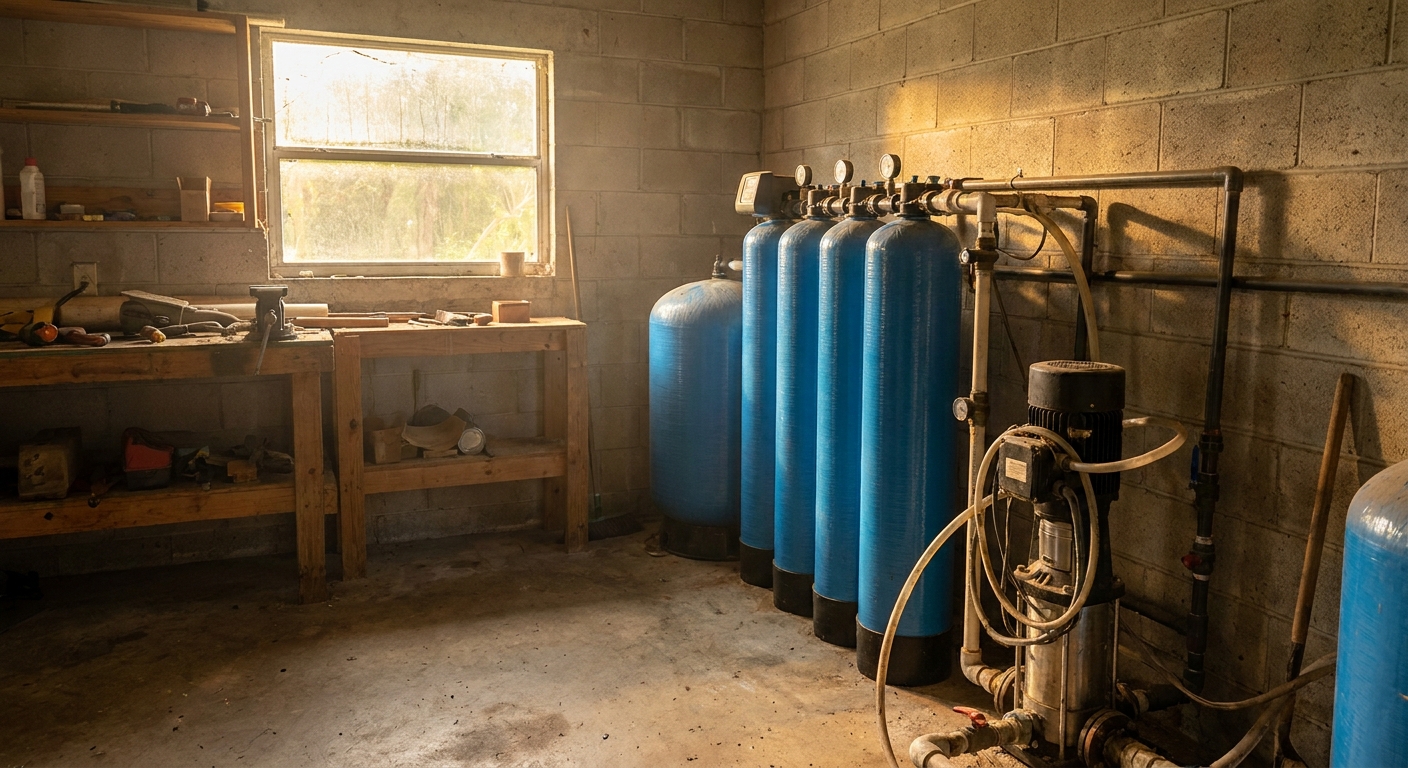
For a typical Pasco County well with all three issues present, a full treatment train usually includes a sediment pre-filter to catch sand and particulate common in this area’s aquifer, an iron and sulfur treatment stage sized to your specific concentrations, and a water softener downstream to handle hardness on water that’s already had the iron and sulfur pulled out. Depending on well output and household size, this can run from around $3,000 for a straightforward setup to $6,000 or more for higher-concentration wells needing more aggressive treatment stages.
Getting the diagnosis right first
Before we recommend equipment, we test the actual water, not guess based on symptoms. Iron concentration, sulfur level, hardness in grains per gallon, and pH all matter for correctly sizing a system. Undersizing treatment equipment for well water that tests harder or higher-iron than expected is the most common reason homeowners end up disappointed with a system that should have worked.
Wells in the Odessa, San Antonio, and Dade City areas often test differently even from a well down the road, since local aquifer conditions can vary block to block, so a system that worked great for a neighbor isn’t automatically the right spec for your well.
Maintenance matters more out here
Well water treatment systems need more regular attention than municipal-water softeners. Iron filters typically need periodic backwashing or media replacement, and sulfur systems need their oxidizing media checked and replenished on a schedule. Staying on top of that maintenance is what keeps a well-water system working the way it did the day it was installed instead of slowly losing effectiveness.
Straight answers on your well
We’ll test your actual water, walk you through exactly what’s in it, and spec a treatment system sized for your real numbers instead of a one-size-fits-all package.
Call Tampa Plumbing Pro at (813) 590-0625 and we’ll get your well water tested right.