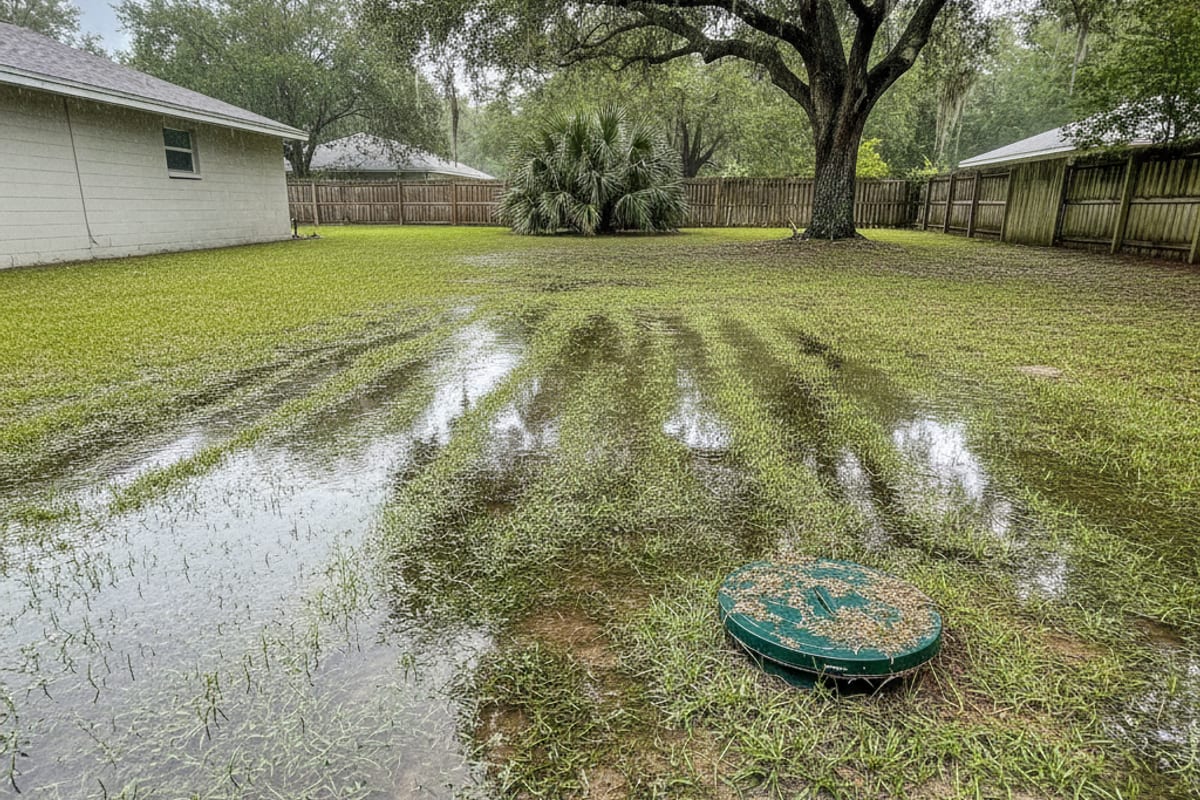
A septic backup right after heavy rain is usually a saturated field, not a broken system, and the wrong first move is calling for an emergency pump-out. Both the Florida Department of Health and the EPA warn against pumping a tank while the ground around it is still soaked. Wait for the soil to dry, cut back on water use in the house, and get it looked at once the ground firms up.
Is a septic backup after heavy rain a broken system or a saturated one?
Most of the time it’s saturation, not failure. When the ground around the drain field is soaked, the field has nowhere to send more water, so wastewater backs up toward the house instead.
That’s a different problem than a failed tank or a collapsed field. The system itself can still be sound. It’s just sitting in soil that’s already full.
The Florida Department of Health’s own storm-recovery guidance says as much:
“Do not have your septic system repaired until the ground has dried up. Septic systems are generally functional once flood waters go down.”
In plain English: a system that backs up during a downpour and clears up once the ground dries wasn’t necessarily broken. It was overwhelmed. That’s worth knowing before anyone starts digging or scheduling a repair crew.
Why pumping the tank is the wrong first move
Calling for an emergency pump-out feels like the obvious fix. It isn’t, and two federal and state sources both say so, for two different reasons. First, the Florida Department of Health:
“DO NOT have your septic tank pumped until the soil surrounding the tank is dry. When the ground is saturated with water, the tank might collapse if it is pumped dry.”
The U.S. EPA gives a different reason to hold off:
“Pumping out a tank that is in saturated soil may cause it to ‘pop out’ of the ground.”
Notice those aren’t the same warning. Florida’s health department is describing a collapse risk: an empty tank in saturated ground can lose the structural support the surrounding soil normally gives it. The EPA is describing something closer to buoyancy: a lightweight, empty tank sitting in soaked soil can float and shift out of position. Both are documented by their own sources.
There’s a second reason pumping doesn’t help, and it has nothing to do with the tank itself. The Florida Department of Health again:
“If the problem is the high water table, pumping the tank will not help.”
If the drain field is sitting in ground that’s already saturated, an empty tank fills right back up. The bottleneck was never the tank. It’s the field having nowhere to put water. The EPA’s flood guidance backs up the same point from the field side:
“Do not open the septic tank for pumping while the soil is still saturated. Mud and silt may enter the tank and end up in the drainfield.”
Opening the tank while the ground is wet risks pulling mud and silt into the very field that’s already struggling. That can turn a temporary saturation problem into a real one.
What to do in the house while the ground is still wet
There are things worth doing right now, and they’re mostly about the house, not the yard. The Florida Department of Health’s guidance:
“If your plumbing is functioning slowly, you should conserve water as much as possible. Minimize the use of washing machines and flush toilets only as necessary.”
That means holding off on laundry, running the dishwasher less, and taking shorter showers until the field has a chance to drain. Every gallon that goes down a drain right now is a gallon the saturated field has to absorb on top of the rain it’s already holding.
The EPA adds a caution about the system’s own equipment:
“Locate any electrical or mechanical devices the system may have that could be flooded to avoid contact with them until they are dry and clean.”
If your system has an effluent pump, an alarm panel, or any electrical component near the tank or field, stay away from it until it’s visibly dry. And if the field itself is standing in water, the EPA is direct about using the system at all:
“If possible, don’t use the system if the soil is saturated and flooded. The wastewater will not be treated and will become a source of pollution.”
None of this requires a service call. It’s what you do while you wait for the ground to dry enough for someone to look at it safely.
Rain can also get into the tank and onto the field
Saturation isn’t only from groundwater rising under the field. Stormwater can enter the system itself. An unsealed tank lid or riser lets rain drop straight into the tank, so the field has to absorb that extra volume on top of household wastewater. Downspouts and roof runoff that dump onto the drain field do the same from above: they keep the soil wet after the storm has moved on.
UF/IFAS explains the same storm-overload pattern in What to Do When Septic Systems Are Impacted by Flooding from Storms or Groundwater Rise: cut water use, do not dump floodwater into sinks or toilets, and do not open or pump the tank while the soil is still saturated.
What Florida’s code says about drain fields and the wet season water table
Here’s the part almost nobody explains, and it’s the reason a rainy-season backup is a code question, not just bad luck.
Florida’s own septic rules are written against a wet-season benchmark, not a dry-season one. Chapter 62-6 F.A.C. sets a required separation between the bottom of a drain field’s absorption surface and the wet season high water table: 24 inches, for systems permitted from January 1, 1983 forward. That’s not a suggestion. It’s the design standard the state uses to decide whether a field can even be built where it sits.
And there’s a line where the code stops allowing a repair at all. Rule 62-6.015(4), F.A.C.:
“Where the absorption surface of the drainfield is within 6 inches of the wet season high water table, an alternative repair method addressed in subsection 62-6.015(3), F.A.C., shall not be used. The existing drainfield shall be removed and a replacement drainfield shall be installed.”
Read that plainly: if a field sits too close to where the water table rises during the wet season, the rule doesn’t let anyone patch it. The whole field has to come out and get replaced. That’s the mechanical reason a system that ran fine in the dry months backs up every summer. It may not have much room between the field and the water table to begin with, and the wet season is exactly when that gap disappears.
That’s also why a repair permit exists as its own step, separate from a pump-out. Rule 62-6.015 requires “prior knowledge and written approval from the Department having jurisdiction” before any repair happens, and the same rule sets a target: the department “shall make every effort to issue a permit within 2 working days after receiving the application for system repair.” A repair permit, once issued, is valid for 90 days.
If you want the full breakdown of what drives a drain field replacement number in this metro, including the sizing tables that set the square footage, our drain field replacement cost guide covers that ground in detail. This page is about the moment you’re standing in a backed-up bathroom, not the repair math.
When does it stop being saturation and start being a failure?
Saturation from heavy rain and a genuinely failing system can look identical from inside the house. The difference usually shows up in how the system behaves once the ground has had time to dry.
The Florida DOH’s own guidance draws that line directly:
“Do not have your septic system repaired until the ground has dried up. Septic systems are generally functional once flood waters go down.”
That sentence carries two useful signals. First, repairs shouldn’t be attempted while the ground is wet, so a quick fix during the storm isn’t the goal. Second, “generally functional” is doing real work: most systems recover on their own once the water table drops back down. If yours doesn’t, that’s worth paying attention to.
The EPA points to the same kind of evidence:
“Have your septic tank professionally inspected and serviced if you suspect damage. Signs of damage include settling or an inability to accept water.”
Visible settling around the tank or field, or a system that still won’t accept water once the ground has firmly dried out, points toward something beyond ordinary saturation. That’s the point to get an inspection rather than wait out another storm. Our septic tank inspection guide covers what that visit actually checks.
And if a repair does turn out to be necessary, remember the earlier rule: it has to be permitted and inspected by the county health department. There’s no shortcut around that step, even once the ground is dry.
What a repair actually involves in Hillsborough, Pinellas and Pasco
If the ground has dried out and the system is still backing up, the process runs through the county health department, not straight to a shovel.
A repair permit application goes to the health department in the county where the property sits, on the state’s own forms. In Hillsborough County, that office publishes a distinct Repair Permit application package, separate from new construction, and can be reached at 813-307-8059. The department aims to turn a repair application around within two working days, and the permit is good for 90 days once it’s issued.
The state fee schedule covers the paperwork side of that process: a $115 site evaluation, a $55 repair permit, a $5 research and training surcharge, and a $75 initial inspection. Add those up and you’re looking at $250 in state fees before any construction work begins. Those amounts are set in rule; the county health department collects them.
What the repair actually involves, and what it costs beyond the state fees, depends on what’s found once the ground is dry enough to evaluate. Sandy soil across the Pasco and rural Hillsborough septic belt drains fast most of the year, which is part of why a tank that ran fine in March can back up in August once the wet season saturates the field. Our septic service page walks through how a registered contractor figures out whether you’re looking at a straightforward pump-out or a field that needs permitted repair work.
Frequently asked questions
Is it safe to have my septic tank pumped right after a heavy rain?
Not while the ground around the tank is still saturated. Florida’s health department warns the tank might collapse if it’s pumped dry in wet soil, and the EPA warns a pumped tank in saturated ground may pop out of position. Wait until the soil around the tank is dry.
Why does pumping not fix a septic backup during the rainy season?
If the backup is coming from a high water table rather than a full tank, pumping doesn’t change anything. The Florida DOH says it plainly: “If the problem is the high water table, pumping the tank will not help.” The field still has nowhere to send water until the ground drains.
How long should I wait before calling someone about a septic backup after rain?
There’s no set number of days in the guidance, and this page doesn’t invent one. The consistent instruction from both the Florida DOH and the EPA is to wait until the soil around the tank and field is visibly dry before pumping or repair work happens, and to conserve water in the meantime.
What should I do inside the house while I wait for the ground to dry?
Cut back on water use. Run fewer loads of laundry, space out dishwasher cycles, and flush toilets only when needed. Every gallon sent down a drain adds to what the saturated field is already trying to absorb.
Does a Tampa Bay septic backup after rain always mean the system is failing?
No. Florida’s own guidance says systems are “generally functional once flood waters go down,” meaning most recover once the water table drops. A field that stays saturated well after the ground has dried, or shows visible settling, is the case worth having inspected.
What does a routine pump-out cost if the tank turns out to need one?
A routine septic tank pump-out runs $350 to $550. That’s separate from any drain field repair, which isn’t priced until a registered contractor evaluates the site and the county issues a permit.
When to call us
If your septic system is backing up after heavy rain, the first move is patience, not a pump-out. Once the ground has dried out and you want someone to confirm whether you’re looking at ordinary saturation or an actual repair, call Tampa Plumbing Pro at (813) 590-0625. We’ll match you with the registered septic contractor we send, and that contractor is the one who inspects the tank and reads the field. We match homeowners across Hillsborough, Pinellas and Pasco County with a licensed and registered septic contractor for any permitted repair work, and if what you’re dealing with turns out to be a house-side clog rather than a field problem, we’ll route you to the drain cleaning pros we send instead.