A pre-sale septic tank inspection in Tampa Bay runs $150 to $300. A pump-out is a separate $350 to $550 job, quoted by the registered septic contractor we send. And here’s the part that surprises almost every buyer: no government agency in Florida can make you get one. State law says so directly. Section 381.0065 of the Florida Statutes reads, “An inspection of a system may not be mandated by a governmental entity at the point of sale in a real estate transaction.”
So the county won’t require it. Your lender might. Your buyer probably should. Those are three different things, and knowing which one is asking changes who you need to hire.
What a septic tank inspection actually looks at
An inspection isn’t someone glancing at a lid. It’s a condition report on a buried treatment plant, and there are five things worth checking.
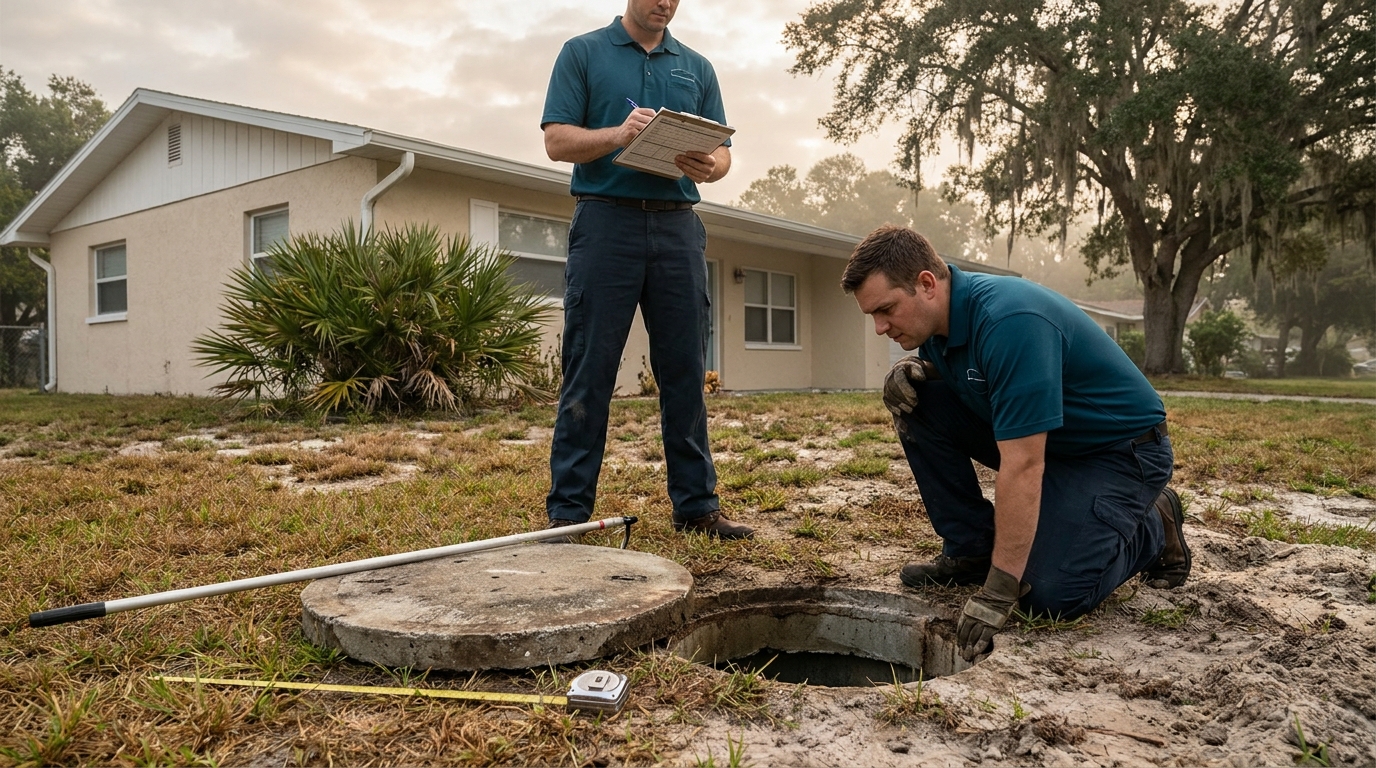
The tank itself gets opened and read. That means finding the lid, measuring the sludge and scum layers to tell how overdue a pumping is, and looking for cracks in the concrete or a lid that’s starting to collapse.
The baffles and the inlet and outlet tees come next. These are the internal walls that keep solids in the tank instead of letting them wash out to the drain field. A cracked baffle is cheap to fix and expensive to ignore, because solids in a drain field are what kills a drain field.
Then the drain field gets walked. Standing water over the field after a dry stretch, or grass that’s noticeably greener and taller in one strip of yard, both point the same direction. In low-lying sandy soil around Wimauma and Balm, soggy ground after a storm is often the first thing a homeowner notices.
Setbacks get measured on well-and-septic properties, and this is where a lot of older rural parcels get interesting. More on the exact distances below.
Finally, the paper trail gets pulled. Permit history tells you when the system was built, what it was sized for, and whether anyone ever pulled a repair permit. A system with no records isn’t automatically bad, but it means everything has to be verified in the field instead of on paper.
Who’s legally allowed to inspect a septic system in Florida
This is the question that trips up the most transactions, and the answer is narrower than people expect. Your home inspector is almost certainly not on the list.
Florida moved its septic program from the Department of Health to the Department of Environmental Protection on July 1, 2021, under the Clean Waterways Act. County health departments still handle the permitting and the field inspections, but the rules now live in Chapter 62-6 of the Florida Administrative Code.
Since July 1, 2022, under Senate Bill 856, a property owner can hire a private provider to inspect an onsite sewage system instead of waiting on the county. Section 381.0065(8) limits that work to four kinds of people:
- A certified environmental health professional under section 381.0101
- A master septic tank contractor registered under part III of Chapter 489
- A licensed professional engineer under Chapter 471 who has passed every part of the state’s OSTDS Accelerated Certification Training
- An employee working under the supervision of such an engineer, who has also passed that training
Those private providers have to get the owner’s authorization first, photograph the system, and submit results within 7 calendar days. The amended rule governing all of this took effect July 9, 2025.
The two different things people call a septic inspection
Worth being straight about, because the words get used interchangeably and they aren’t the same job.
A statutory OSTDS inspection is the regulated one described above. It’s what you want when a permit, a code compliance question, or a formal record is on the line, and it has to come from one of those four categories of provider.
A pre-sale condition evaluation is what most buyers and sellers actually book. The licensed and registered septic contractors we send open the tank, measure the sludge, check the baffles and tees, read the drain field, and write it all up so a buyer, seller, or lender can see what shape the system is in. That’s the $150 to $300 line item. It’s a condition report, not a regulatory sign-off.
If a lender or a title company hands you a requirement in writing, read it closely and ask which one they mean before you book anybody. Getting the wrong one done twice costs more than asking once.
What a septic tank inspection costs in Tampa Bay
Here’s how the numbers usually stack up on a well-and-septic property here.
| Work | Typical cost | Notes |
|---|---|---|
| Pre-sale condition evaluation | $150 to $300 | Condition report only. Pump-out is a separate $350 to $550 line |
| Routine pump-out | $350 to $550 | Tanks buried under landscaping run high |
| Baffle or tee repair | Quoted after the tank is opened | Cheap now, expensive later |
| Drain field repair or replacement | Quoted after diagnosis | Needs a county permit first |
County permit and application fees are separate, and none of the three local health departments publishes a fee schedule on its septic page. Call the office and ask for the current number rather than trusting a range you read online.
One cost worth planning for: a tank that hasn’t been pumped in more than five years, or one buried under a flower bed and a decade of mulch, lands at the top of that pump-out range because somebody has to dig before anybody can work.
Which county office holds your system’s records
Three counties, three different phone trees. The office that permitted your system is the office that has its file.
| County | Environmental health phone | |
|---|---|---|
| Hillsborough | 813-307-8059 | [email protected] |
| Pasco | 727-841-4425 option 3, or 352-521-1450 option 3 | [email protected] |
| Pinellas | 727-538-7277 | [email protected] |
Hillsborough is the easiest of the three to research from your couch. The health department publishes permit and inspection records through a system called e-Bridge, searchable by street address, permit number, or property ID, with most records going back at least three years. Pull the file before you write an offer on a septic property in Thonotosassa or Dover. Hillsborough also has a specific application package for a voluntary inspection, which tells you plainly how the state treats this: voluntary.
Pasco splits its applications in a way that matters if you’re planning a renovation. There’s an “existing system, no bedroom added” packet and a separate “existing system, add bedroom” packet. A tank and drain field sized for three bedrooms doesn’t legally serve four, so converting a den or bonus room into a bedroom in Wesley Chapel or Land O’ Lakes can trigger a system upgrade you didn’t budget for. Find that out during due diligence, not after closing.
The code numbers that decide whether a system passes
Setbacks are where old rural parcels fail, and the numbers come straight out of Florida Administrative Code 62-6.005.
A system has to sit at least 75 feet from a private potable well. Make that 100 feet from a public drinking water well serving a facility at 2,000 gallons per day or less, and 200 feet if that facility exceeds 2,000 gallons per day. Systems can’t be within 75 feet laterally of the boundary of a surface water body. They also can’t sit under a building, within 5 feet of a building foundation, or within 5 feet of a property line.
Any repair, modification, or abandonment needs a permit before the work starts. The statute is blunt about it: a person may not construct, repair, modify, abandon, or operate an onsite system without first obtaining an approved permit. If someone offers to fix your drain field without pulling one, that’s your answer about that contractor.
Aerobic treatment units, performance-based treatment systems, and commercial or industrial-zoned systems also carry an ongoing operating permit. If the seller has one of those, ask to see the current permit and the maintenance contract.
If your home is on a private well, that 75-foot figure lines up with mortgage underwriting too. FHA’s rules under HUD Handbook 4000.1 want a well at least 100 feet from any septic drain field, and will accept a state or local standard as long as it’s no less than 75 feet. An existing onsite system is acceptable to FHA when it’s functioning properly and meets the local health department’s requirements, so a system that fails a condition evaluation can genuinely hold up a loan even though no county rule required the check. Our guide to well water treatment in Pasco covers the water side of a well-and-septic property, and a failing well pump changes the pressure picture on both.
Before you assume you’re even on septic
Plenty of buyers in this metro find out at inspection. Roughly 30 percent of Florida’s population is on an onsite system, and this metro’s growth ring is where the septic-to-sewer line keeps moving. Our septic versus sewer guide walks through which neighborhoods still run on tanks and how conversions work.
Signs the system, not the plumbing, is the problem: slow drains in several fixtures at once rather than one, gurgling toilets, and sewage odor near the tank or field. One slow sink is usually a drain cleaning call. All of them at once, on a septic property, is a tank or field call. Sewage backing up through the lowest fixture in the house can be either, which is why a camera on the main sewer line sometimes comes first.
Frequently asked questions
Is a septic inspection required when you sell a house in Florida?
No. Section 381.0065 of the Florida Statutes states that an inspection of a system may not be mandated by a governmental entity at the point of sale in a real estate transaction. Florida passed a statewide five-year inspection mandate in 2010 and repealed it in 2012 before it took effect. Lenders and buyers can still require one as a condition of their deal, and FHA-backed loans effectively do by requiring the system to function properly.
How much does a septic tank inspection cost in Tampa Bay?
A pre-sale condition evaluation typically runs $150 to $300. Pump-out is a separate $350 to $550 line from the registered septic contractor we send. County permit and application fees are separate and aren’t published on the health departments’ septic pages, so call the office for the current amount.
Who can legally inspect a septic system in Florida?
Under section 381.0065(8), a private provider inspection has to be performed by a certified environmental health professional, a master septic tank contractor registered under part III of Chapter 489, a licensed professional engineer who has completed the state’s OSTDS Accelerated Certification Training, or an employee working under that engineer’s supervision who has completed the same training. A general home inspector doesn’t qualify.
How often should a septic tank be pumped in Hillsborough or Pasco County?
Every 3 to 5 years for most homes, and closer to every 2 to 3 years for larger households, homes with a garbage disposal, or older tanks. Sandy soil and heavy summer rain stress a Tampa Bay drain field faster than in drier climates, so if it’s been more than three years and you have no records, it’s worth a look.
How far does a septic drain field have to be from a well?
At least 75 feet from a private potable well under Florida Administrative Code 62-6.005. The distance grows to 100 feet from a public drinking water well serving 2,000 gallons per day or less, and 200 feet above that flow. Systems also have to stay 75 feet from surface water and 5 feet from foundations and property lines.
Can I look up my septic system’s permit history myself?
In Hillsborough County, yes. The health department publishes permit and inspection records through e-Bridge, searchable by street address, permit number, or property ID, with most records going back at least three years. In Pasco and Pinellas, call the environmental health office and request the file for the address.
Get the system read before the contract clock runs out
The worst time to learn a drain field is failing is nine days before closing. Due diligence windows in this market are short, and a septic surprise is one of the few findings that can genuinely kill a deal instead of just repricing it.
Tampa Plumbing Pro matches homeowners across Hillsborough, Pinellas, and Pasco with licensed and registered septic contractors in the well-and-septic belt. We answer the phone 24 hours a day. If you’re buying a septic property, selling one, or you just inherited a house and have no idea when the tank was last touched, call (813) 590-0625 and we’ll tell you what the evaluation covers and what it costs before we match you with someone. If you’re still deciding who to hire, our guide to choosing a licensed plumber in Tampa covers what to verify first, and our septic tank service page lists exactly what a visit includes.
Sources: Florida Statutes 381.0065, Florida DEP Onsite Sewage Program, Florida DEP private provider OSTDS inspections, Chapter 62-6 F.A.C., Florida Department of Health in Hillsborough County septic systems, Florida Department of Health in Pasco County OSTDS, Florida Department of Health in Pinellas County onsite sewage, and HUD Handbook 4000.1.