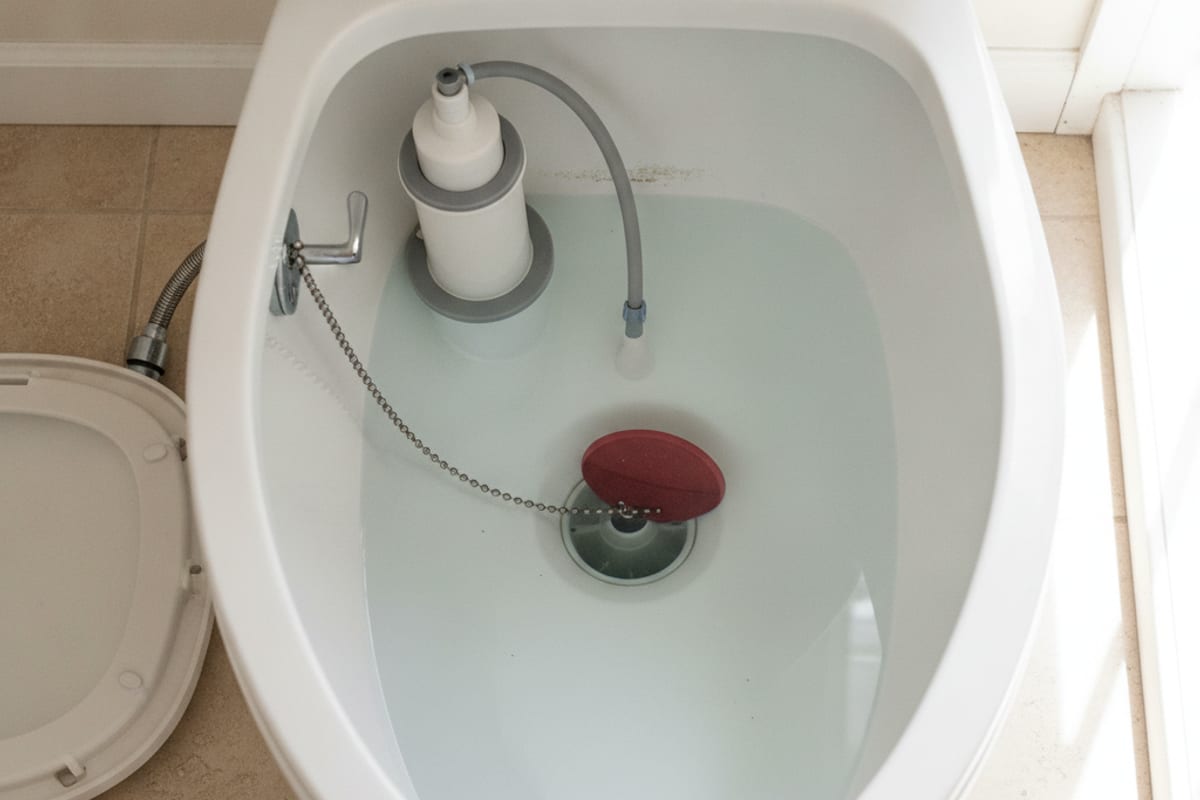
A toilet won’t stop running for one of two reasons, and both are cheap parts. Either the rubber flapper at the bottom of the tank isn’t sealing, so water slides into the bowl and the tank keeps topping itself up, or the fill valve never decides it’s full, so it keeps feeding the tank. Neither is an emergency. Both cost you twice on a Tampa bill, once as water and once as sewer, because your wastewater charge is calculated from the same metered water. Ten minutes and a few drops of food coloring will tell you which part failed.
What’s actually happening inside the tank
A toilet tank has two jobs and two separate water paths, and a running toilet means one of them has stopped closing.
The first path runs out of the tank and into the bowl through a hole in the bottom, capped by a rubber flapper on a hinge. Flushing lifts the flapper, the tank dumps, and the flapper drops back onto its seat. When that seal fails, water trickles down into the bowl continuously. The tank level drops, the fill valve senses it and refills, and around it goes. This is the quiet version, and it’s the one people live with for months because there’s nothing dramatic to hear.
The second path runs from your supply line into the tank through the fill valve, with a float that’s supposed to shut it off at the right level. When a fill valve sticks or its float is set wrong, water pours in past the line and straight down the overflow tube. That’s the loud version. You hear a hiss or a cycle that starts up every few minutes for no reason.
The EPA is blunt about which one is more likely. On its residential toilets page, WaterSense puts it this way: “Most toilet leaks are due to old or worn-out toilet flappers (e.g., valve seal). A flapper is an inexpensive part, typically made from rubber, plastic, or silicone, that controls the flow of water to the toilet bowl.”
How to tell which part failed in ten minutes
Take the lid off and look at the water line first. If the water has risen to the top of the overflow tube, or you can see it spilling into the tube, the fill valve is the problem and you can stop there.
If the level looks normal, run the dye test the EPA publishes in its WaterSense labeled toilets fact sheet for exactly this: “Place a few drops of food coloring in your toilet’s tank and wait 10 minutes. If the dye shows up in the bowl, you have a leak that can probably be fixed by replacing a worn toilet flapper.” Hillsborough County’s own leak tips put the wait at about 15 minutes, so give it the longer window if you want to be sure. Don’t flush while you wait, and do flush afterward so the dye doesn’t stain the bowl.
Color in the bowl means the flapper. Clear bowl and a toilet that still cycles means the valve. That single test is the difference between buying the right part and guessing at the hardware store.
| Flapper failing | Fill valve failing | |
|---|---|---|
| What you hear | Usually nothing, then a refill that starts on its own | A hiss, or a refill cycle with nobody in the room |
| Water line in the tank | Sits at the normal mark | Rides high, often spilling into the overflow tube |
| Dye test result | Color bleeds into the bowl | Bowl stays clear |
| What it feels like to the homeowner | A bill that crept up with no explanation | A noise that started overnight |
What a running toilet costs on a Tampa water bill
A running toilet gets billed to you twice in Tampa, once as water and once as sewer.
The City of Tampa bills water in ccf units, and its residential rate schedule spells out the conversion: “Each ccf unit is equal to 100 cubic feet, which is the same as 748 gallons.” Water is tiered, so the more you use in a month the more each unit costs. Under the schedule effective October 1, 2025, an inside-city single-family home pays $3.55 per ccf in the lowest tier and $6.96 per ccf once monthly use reaches 14 ccf.
Then wastewater lands on top. Tampa’s residential wastewater rate is $5.79 per ccf inside the city and $7.23 per ccf for its own customers outside the city limits, and that charge is figured from the water that went through your meter. Those are Tampa’s retail rates, not Hillsborough, Pinellas or Pasco county rates, so check your own utility’s schedule if Tampa isn’t the name on your bill. Either way, the water your toilet quietly sent to the bowl gets billed as water on the way in and as sewer on the way out.
Put a number on it. The EPA publishes this: “Household leaks can waste 180 gallons per week. Toilets are often the culprit.” That’s a whole-house leak figure rather than a measurement of one toilet, so treat what follows as the shape of the cost, not your toilet’s total. At 748 gallons per ccf, 180 gallons a week works out to roughly 780 gallons a month, just over one ccf. One ccf at the inside-city tier 2 water rate of $6.96 plus the $5.79 wastewater rate is $12.75. That’s arithmetic from two published figures, not a reading off anyone’s bill, and the tier depends on what the rest of your house used. A fill valve spilling into the overflow tube keeps running the whole time nobody is using the bathroom, and every extra unit pushes you further up the tier ladder.
If your bill has already jumped and you haven’t found the source, our guide to a high water bill in Tampa walks the meter-reading steps and what each Tampa Bay utility asks for before it will look at an adjustment.
Why hard water is rough on the parts inside a tank
Flappers and valve seats fail everywhere. Mineral-heavy water just gets there sooner.
A flapper seals because soft rubber presses flat against a smooth plastic seat. Hard water leaves scale on both surfaces, and scale is exactly the wrong texture for a watertight seal. To put a figure on the local water, Tampa’s 2025 Water Quality Report, published in 2026, put the average total hardness of the city’s finished water at 211 mg/L or 12.3 grains per gallon. That’s a City of Tampa number for City of Tampa customers, and the county utilities publish their own. Wherever your water comes from, that mineral load builds a crust on the flapper seat, roughens the rubber, and eventually holds the flapper a hair off the seat. Same story on a fill valve’s internal seal.
It’s the same mechanism that shortens tank life on water heaters, which is why hard water and Tampa water heaters is a live topic on this coast and not on softer ones. If you’re back inside the tank replacing the same part again, the water is telling you something about the rest of your fixtures.
Repair the toilet, or replace it
A flapper or a fill valve is a part swap, and swapping one on a toilet that’s otherwise solid is the right call. The toilet repair pros we send will check the flush valve seat while the tank is open, rather than fitting a new flapper onto a pitted one.
Replacement makes more sense once the toilet itself is the problem. A cracked tank, a corroded flush valve, or a bowl that needs two flushes is not a parts issue. Age matters too. The current federal standard is 1.6 gallons per flush, and the EPA notes that design improvements now let toilets “use 1.28 gallons per flush or less while still providing equal or superior performance.” An old high-volume toilet with a chronic leak is wasting water twice over. Our breakdown of the toilet rebate in Tampa Bay covers which utilities offer a rebate on a replacement and what decides the amount.
When the toilet isn’t the leak at all
Shut off the toilet’s supply valve, use no water anywhere in the house for two hours, and read your meter at the start and the end. If the meter moved, the toilet was never your problem.
That’s the point where guessing gets expensive, because the next candidates are buried: a supply line under the slab, an irrigation line, a water softener stuck in backwash. Leak detection exists for that exact situation, and finding the leak before anyone opens concrete is the cheap half of the job. If water is actively coming up through a floor or a wall, that’s an emergency plumbing call, not a Monday-morning one.
Frequently asked questions
Why does my toilet refill by itself every few minutes?
That’s called phantom flushing, and it means water is escaping the tank slowly enough that the refill only triggers occasionally. The flapper is the usual cause. The dye test will confirm it in ten minutes.
Is a running toilet an emergency?
No. A running toilet wastes water and money, but it isn’t going to flood your house, so it can wait for a normal appointment. What shouldn’t wait is a toilet that’s overflowing at the rim or backing up, since that points at a drain problem rather than a tank problem.
How much water does a running toilet waste?
The EPA publishes that household leaks can waste 180 gallons per week and that toilets are often the culprit. That’s a household figure rather than a per-toilet measurement. A flapper that seeps loses a little water continuously, while a fill valve spilling into the overflow tube runs the entire time the bathroom sits unused.
Will the water utility take the extra charges off my bill?
Sometimes, and every Tampa Bay utility runs its own process with its own paperwork and its own proof-of-repair requirement. Fix it first, keep the receipt, then ask. The steps for each utility are in our high water bill guide.
Does a flapper have to match the toilet brand?
It has to match the flush valve it seals against, which is not the same thing as the brand on the tank. Flapper sizes and shapes vary, and a near-fit is why some toilets start running again a week after a homeowner replaces one.
When to call us
A flapper on an accessible toilet is genuinely a homeowner job. Call a licensed plumber when the tank keeps running after you’ve changed the flapper, when the flush valve seat is pitted or corroded, when the shutoff valve behind the toilet won’t turn, or when your meter says the leak is somewhere other than the toilet. We’ll match you with a licensed local plumber who covers your part of Hillsborough, Pinellas or Pasco.
Call us at (813) 590-0625.