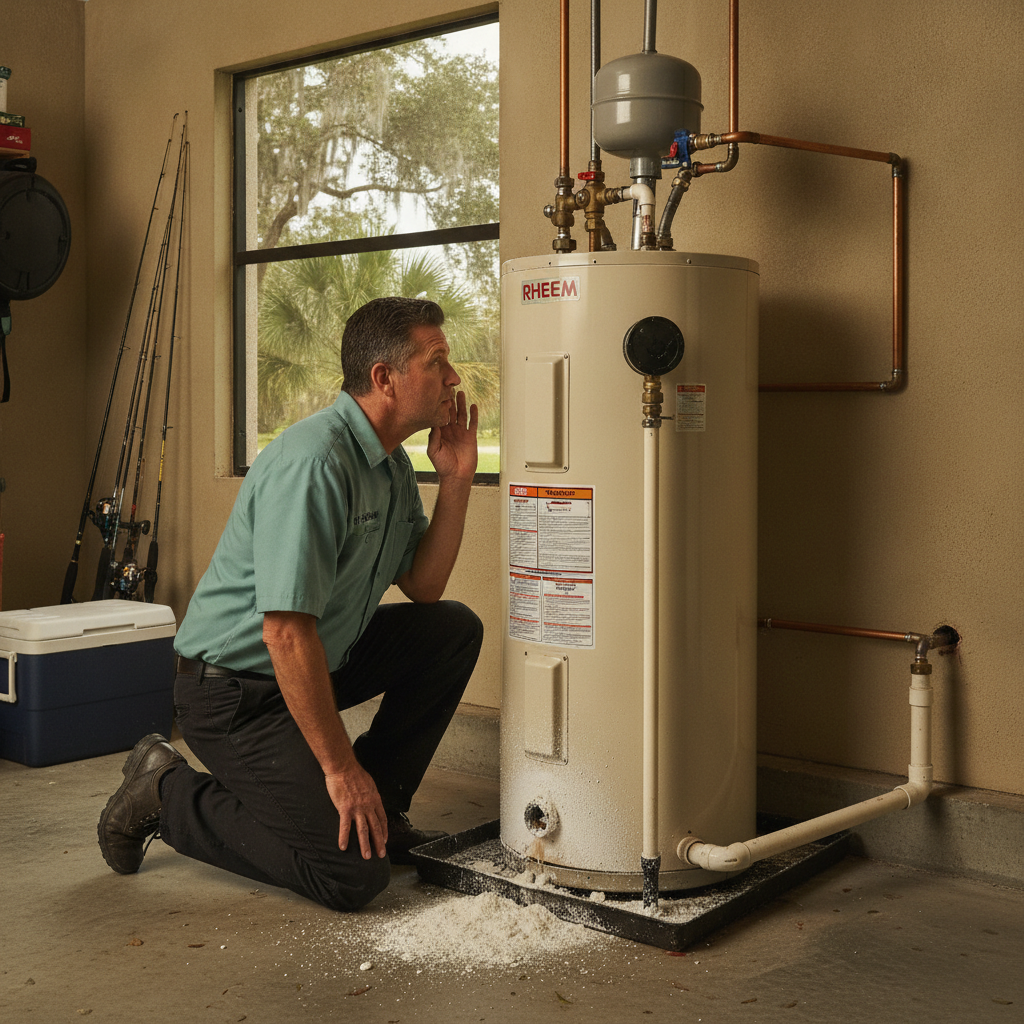
Late at night in a quiet Seminole Heights bungalow, the tank in the garage ticks, then pops like corn in a dry pan. That water heater popping noise is sediment. Tampa Bay water carries a heavy mineral load, and those minerals settle on the bottom of the tank. Water trapped under the crust flashes to steam and bursts through the scale.
What the water heater popping noise is
The pop is steam punching through mineral crust, not the tank splitting open. Heat lives at the bottom of a storage tank. A gas burner sits under the steel. An electric heater puts a lower element in the water, near that same floor. Calcium and magnesium drop out as the water heats and form a layer of scale on that floor. Pockets of water get trapped under the crust, against metal hotter than the rest of the tank. Those pockets boil in an instant. Steam takes more space than liquid, so the bubble slaps the steel. That slap is the pop, the rumble, the kettle sound.
The same physics shows up in a Brandon rental and a FishHawk garage. New tanks do it. Old tanks in a 1950s St. Pete bungalow do it. Gas and electric both do it. Gas often rumbles from below. Electric can tick around the lower element, then go quiet when that element dies and only the upper one still heats.
A failed pressure-reducing valve can make a tank noisy too, and that noise is a different problem. Florida’s plumbing code requires a pressure-reducing valve where static pressure inside the building exceeds 80 psi. Hose bibs, outside hydrants, and mains already reduced at the fixtures sit outside that rule. A valve that fails open lets street pressure into the house. Pipes bang. The heater sounds suddenly loud. Sediment popping is rhythmic and tied to the heating cycle. It starts a few minutes after the burner or element kicks on, then eases when the tank is satisfied.
The temperature-and-pressure relief valve is the safety that opens if heat or pressure climbs too far. A. O. Smith’s residential gas manual (document 326940-001) tells owners to check that valve at least once a year so it still moves. Popping is not that valve doing its job. Popping is scale cooking on the floor. Leave the T&P lever alone unless a licensed plumber is standing there. Scalding water comes out of that discharge, and a valve that does not reseat will keep dumping.
Water hammer is a single bang when a washer or dishwasher valve slams shut. The plumbing code wants a water-hammer arrestor on those quick-closing valves. If the bang happens at a fixture, not during a heat cycle, that is water hammer, not a tank full of scale.
Hard water and Tampa Bay sediment
Tampa Bay water is hard, and hardness is why this noise shows up so fast here. The City of Tampa’s 2025 Water Quality Report, published in 2026, puts average finished-water hardness at 211 mg/L, or 12.3 grains per gallon, leaving the plant. Pinellas County Utilities’ 2024 report lists 210 ppm total hardness, a range of 168 to 252, which that report itself converts to 9.8 to 14.7 grains. Pinellas notes those samples are from 2023 and still representative. Around the metro, hardness often sits in the 11 to 17 grain range.
That mineral load drops inside a storage tank every time the burner fires. A shower head in a Brandon rental crusts in a year. The tank floor crusts the same way, only you cannot see it. East Hillsborough subdivisions from the 1980s through the 2000s sit on city water and slab-on-grade, so the heater in the garage takes the full hardness. North Pinellas homes in Dunedin and Palm Harbor do too. Pasco well homes in Land O’ Lakes, Odessa, and Wesley Chapel run a different mix. Pasco does not publish a countywide hardness figure, so well water there still needs a test at the tap rather than a number borrowed from Tampa’s plant.
A water softener cuts the calcium and magnesium that form the crust. A. O. Smith’s same gas-tank manual is blunt about the trade-off. Artificially softened water is exceedingly corrosive because the softener swaps sodium for those minerals, and the use of a water softener may decrease the life of the water heater tank. That is a reason to keep the anode rod on a schedule, not a reason to skip the softener. The anode is the sacrificial metal that takes the corrosion so the steel does not. The hard-water case for a softener already lives on our Tampa hard water and water heaters page.
Tankless units collect scale on the heat exchanger instead of a tank floor. They rarely pop like a storage tank. They still need descaling. Rinnai’s N Series residential manual lists a total-hardness guideline of 200 mg/L. Tampa’s 2025 plant average sat at 211 mg/L. That comparison is a guideline versus an average, not a ban. Rinnai says hard water must be treated and may need a more frequent flushing schedule, and that lime damage is not covered by that brand’s warranty on those models. It does not say a tankless heater cannot be installed here.
The same minerals that crust a tank also roughen fixtures and slow a tub. If the kitchen sink is backing up while the tank pops, those are two jobs. A flush will not open a line. Drain cleaning handles the clog. The heater still needs its own service.
Galvanized supply in Hyde Park and Seminole Heights can add rust to the picture. Brown water on hot and cold usually points at the pipes. Brown water on the hot side only usually means the tank lining is failing. That is when a repipe conversation and a tank conversation happen on the same visit.
Flush vs replace
A flush is the right first move when the tank is otherwise sound and the only complaint is noise. The licensed plumbers we send drain the tank, stir the sediment, and run clean water until the discharge runs clear. Given Tampa’s hard water, we recommend flushing the tank every 6 months instead of the typical annual habit elsewhere. That visit usually runs 30 to 45 minutes when the drain valve still opens. A. O. Smith’s manual 326940-001 independently recommends draining and flushing its residential gas tanks every 6 months to remove sediment. That is one manufacturer’s interval for its own product. It lines up with what this water actually does to a tank.
A clogged drain valve is common once the crust is thick. The plastic valve on many residential tanks plugs with scale and then leaks if you force it. That is a reason to have a licensed plumber on the job. Most water heater repairs run $150 to $450 depending on the part. That range covers thermostats, elements, and similar parts. It is not a standalone flush price. For how a flush is quoted on its own, see water heater flush cost in Tampa.
Replacement is the honest next step when the tank is already sacrificing itself. Rusty hot water with clear cold water means the lining is gone and the steel is rusting from the inside. Water at the base of the tank, a damp pan, or a T&P that weeps are leak signs. A tank that still pops after a thorough flush has scale bonded to the steel, or the lower element is buried and dying. Age plus those signs is when you stop pouring money into the same shell. Standard 40 to 50-gallon tank replacement on this site is $1,400 to $2,600 installed. Tankless replacement is $3,500 to $6,500 installed. The longer comparison lives on water heater repair vs replace in Tampa.
| Symptom | Flush still makes sense | The tank is done |
|---|---|---|
| Heat-cycle popping, dry pan, clear hot water | Sediment on the floor of a sound tank | Popping that comes right back after a real flush |
| Water color | Stays clear on the hot side | Rusty on the hot side, clear on the cold |
| Floor and pan | Dry | Wet, rust-stained, or weeping at the shell |
| Rest of the house | Quiet pipes, normal pressure | Street pressure in the pipes, or galvanized adding rust |
High pressure belongs in that conversation too. Where a storage water heater sits downstream of a pressure-reducing valve, check valve, or backflow preventer, the code wants thermal expansion control on the cold supply, downstream of those valves. A noisy tank plus hammering pipes is not always sediment. Sometimes the street is pushing too hard, and the heater needs an expansion tank more than another flush. That path is on our expansion tank page.
Other sounds and first failure signs
The first signs a storage tank is done are usually not dramatic. Hot water takes longer. The tank runs longer into the night. Then the pop starts. Then the hot side runs rusty while the cold side stays clear. That last one is the tank itself corroding, which we already flag in how long water heaters last. A leak at the tank body is the end of the argument. You cannot patch the shell.
A rotten-egg smell on the hot side only is a different chemical story. Hydrogen sulfide can form at the anode, especially on a tank that sat unused. That fix is a flush plus an anode of a different metal, not a new tank by default. The chemistry is on hot water that smells like rotten eggs.
If water is already on the floor, shut the supply to the heater and the power or gas, then treat it as a leak. Our leaking water heater page covers that path. Keep the tank off until a licensed plumber has looked at the shell.
How do I stop my water heater from popping?
Flush the sediment. A licensed plumber drains the tank, breaks up the crust, and refills it. In Tampa Bay that is a twice-a-year habit on city water, not a rainy-day chore. A softener slows the next crust from forming. If the pop is still there after a real flush, the tank or the lower element is the next conversation.
Is a popping sound from a water heater a cause for concern?
Yes, for the tank. The pop means scale is insulating the floor and trapping steam. Left alone, that extra heat cooks the steel and the glass lining. It is a maintenance alarm. Pair it with rust on the hot side, a wet pan, or no hot water, and it is a replacement alarm.
What are the first signs a water heater is going bad?
Longer recovery, a heat-cycle rumble, rusty water on the hot side only, and moisture at the base. A T&P that drips, a rotten-egg smell that a new anode does not kill, and a tank that will not hold temperature after the element or thermostat has been replaced are later signs. Any one of those is enough to have a licensed plumber look at it.
When to call us
Call when the tank pops through a heating cycle, when hot water turns rusty, or when the pan is wet. The licensed plumbers we send flush sediment, test the T&P, and tell you if the shell is still worth keeping. Call us at (813) 590-0625.