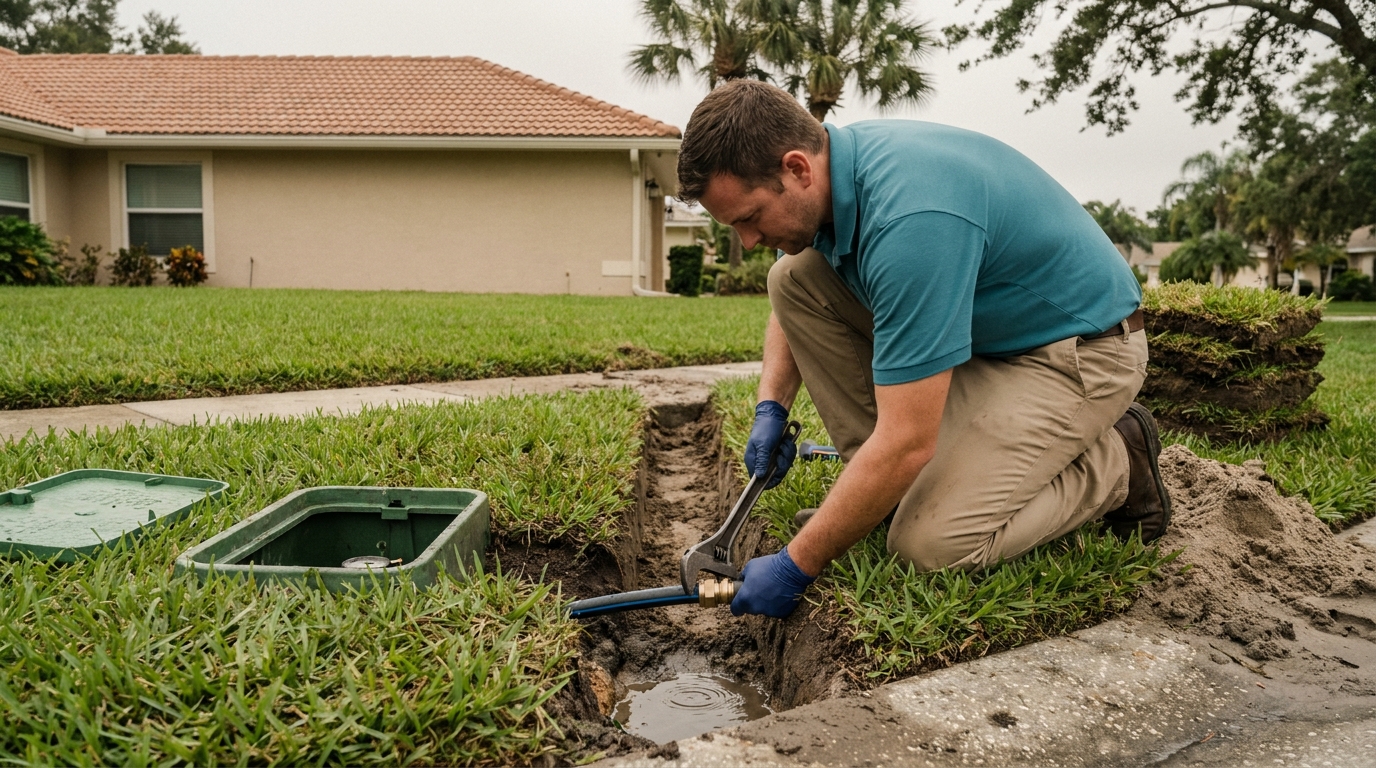
In Tampa Bay, the buried water line running from your meter to your house belongs to you. The utility owns the main in the street and the run up to the meter box. Everything past the meter is yours to maintain, repair, and pay for. That boundary decides who digs up your front yard and who eats the water bill the leak ran up before anyone noticed.
This isn’t a matter of interpretation. The City of Tampa’s own leak adjustment form draws it as a diagram: the water main feeds a section labeled “Utility Owned Service Line,” that hits the “Meter Box,” and what continues to the house is labeled “Customer Owned Service Line.” Pinellas Park says the same thing in plain sentences. So does every other utility in the metro, in one form or another.
What almost nobody explains locally is the second half of the problem. Once you’ve paid to fix a leak on your side, the utility may credit back part of the water it metered while the leak ran. Four different rulebooks apply across this metro, they disagree with each other on almost every point, and one of them won’t forgive the water at all.
Who is responsible for the water line in Tampa Bay?
You are, from the meter box to the house.
The City of Tampa splits it at the meter box on its Water/Wastewater Leak Adjustment Request Form, and lists “Service Line” as one of the five leak types a homeowner can file a claim for. The City of Pinellas Park puts it in a sentence: “The customer is responsible for maintaining the water service from the house side of the water meter to the home.” Pinellas Park also warns that “excessive water loss resulting from poor maintenance could cause a discontinuance of service until necessary repairs are made,” which is worth reading twice. Ignoring a known leak is not a neutral choice there.
Practically, that means a wet patch between the curb and the front door is your problem, not the city’s. A wet patch between the curb and the street may well be theirs. The meter box is the dividing line, and it’s usually near the curb in a plastic box, in line with the main outside spigot.
Two things follow from that. First, call the utility before you call anyone else if the water is surfacing on the street side of the meter. Second, if it’s on your side, the clock is already running on your bill, because the meter has been counting every gallon since the leak started.
How do you know the leak is in the water line?
Run the meter test. It takes two hours of not touching the water, and Hillsborough County publishes the exact procedure.
Make sure nobody’s using water in the house and the irrigation system is off. Check that the meter number engraved on the meter matches the number on your bill, so you’re reading your own meter and not a neighbor’s. Write down the reading and the position of the red sweep hand. Wait two hours without using any water indoors or out, then read it again. The two readings should be identical. If the number climbed or the sweep hand moved, water is going somewhere.
Pasco County describes the same test with one extra step for its meters. Lift the meter box lid off, flip up the lens cap to expose the meter face, and look for the flow indicator first. If it sits still while no water is running, that’s normal. If it’s turning, you have flow with everything shut off.
The test tells you that you’re losing water. It doesn’t tell you where. That’s the next question, and it’s the one that decides which trade and which repair you’re actually looking at.
Worth doing overnight rather than during the day if you can manage it. A longer window makes a slow leak obvious on the register, and it rules out the possibility that an ice maker or a water softener regeneration cycle fired mid-test and muddied the result.
Is it a water line leak or a slab leak?
Different problems, different repairs, and people mix them up constantly.
A water service line leak is outside the house, buried in the yard between the meter and the point where the line enters the building. The tells are outdoors: a patch of grass that stays green and spongy in a dry stretch, standing water or a soft muddy spot along the run from the meter toward the house, a sinkhole-ish depression in the sod, or water surfacing at the edge of the driveway. Pressure at the fixtures may drop, but the house itself stays dry.
A slab leak is under the house, in the pipe running through or beneath the concrete foundation. The tells are indoors: a warm spot on tile or hardwood, the sound of running water with everything off, mildew smell without visible moisture, or a section of flooring that’s damp for no reason. On a Florida slab-on-grade home this is common enough that we’ve written about the warning signs and what the repair costs separately.
A third possibility catches people out. If pressure is low everywhere but the meter test comes back clean, nothing is leaking and the problem is restriction rather than loss. Old galvanized pipe, a failed pressure-reducing valve, and mineral scale all cause that, and we’ve covered why water pressure drops in Tampa Bay homes in detail.
Getting this right before anyone digs matters, because the repairs share almost nothing. That’s what leak detection is for. Acoustic and pressure equipment locates the leak before a shovel touches the yard, and in this market it runs $250 to $450, applied toward the repair if you move forward. Against the cost of trenching the wrong thirty feet of yard, that’s the cheap part of the job.
What will your utility credit back after a water line repair?
Something, usually, but the rules are wildly different depending on which side of the bay you’re on and which government bills you. Every one of these programs requires the leak to be fixed first, with proof, before anyone looks at your bill.
| Utility | The rule that catches people |
|---|---|
| City of Tampa | One adjustment per consecutive 12-month period, counted from the date of your last one. Paid receipts or invoices only. Estimates are not eligible. |
| Hillsborough County | Your usage has to be at least twice your average for the past year to qualify at all. No adjustment if you got one in the past year. |
| Pasco County | The water is never forgiven. You pay for it at Tampa Bay Water’s unitary rate. Only the sewer portion can be credited. |
| City of St. Petersburg | Separate claim categories. An involuntary leak repair needs the repair date plus the invoice or photos of the parts. |
The City of Tampa’s terms are the most generous and the most bureaucratic. One adjustment inside any rolling 12 months, starting from the date the city issued your last one. Proof of repair is mandatory: a licensed plumber’s invoice showing the address, date, and description of the work, or, if you did it yourself, receipts for the parts you bought. The city calculates your baseline from your average use over the previous 12 months, which means a household without a full year of history may not be reviewable yet. Reviews can take up to 90 days, because the city wants to see your usage return to normal across a couple of billing cycles first, and meters are read monthly. Keep paying your average bill while you wait. The form says outright that submitting it is not a guarantee of a credit.
Hillsborough County adds a threshold nobody expects. Your usage must be at least twice your average consumption for the last year before the county will even consider an adjustment. You also need at least three months of service at the address, a current account, no adjustment in the past year, and usage back to normal on the monthly read after the repair. The county excludes a long list of causes outright: landscaping including new or replacement sod, garden hose and spigot leaks, cross connections from an irrigation well or on-site pond, and anything to do with a swimming pool. Expect written confirmation within 60 days.
Pasco County is the one that surprises homeowners, and it’s worth understanding before you budget. The county’s form is explicit that the high water use “will not be forgiven, but shall be paid at Tampa Bay Water’s current unitary rate.” What the county can credit is the sewer portion, if your documentation shows the leaked water never reached the sewer system, which is exactly the case for a buried supply line dumping into the yard. The adjustment applies only to the period of the leak and cannot exceed three consecutive months. You’ll need original repair bills and receipts, or a notarized statement of repair with the date and nature of the work. And you have to keep paying the bill in full, or arrange payment, while the decision is pending.
St. Petersburg runs a single form with numbered categories, and picking the right one matters. A repaired leak is category one and needs the repair date plus a plumber invoice or receipts and photos of the supplies. There’s a separate category for a high bill with no leak found, which applies to mechanical meters and requires certification from a licensed plumber or leak detection company showing there’s no leak on the property. The city also monitors for extreme consumption and says it tries to contact customers about a possible leak as a courtesy, so a call from them is worth taking seriously.
One rule crosses all of them. Nobody credits anything without documentation, and estimates don’t count. Whoever does the repair, keep the paid invoice.
What water line repair actually involves
Two paths, and the leak’s location and the pipe’s condition decide which one you’re on.
A spot repair is the smaller job. Once the leak is located, a plumber opens a short trench at that point, cuts out the failed section, and joins in new pipe with couplings. It’s the right call when the rest of the line is sound and the failure is a single point, like a rock-punctured section or a bad old fitting.
A full service line replacement runs new pipe the whole way from the meter to the house. That becomes the sensible option when the existing line has already failed more than once, when it’s an old material at the end of its life, or when the run passes under a driveway or walkway where reopening the trench later would be expensive. If you’re not sure what the existing line is made of, here’s how to check whether you have lead pipes in a Tampa Bay home with a magnet and a coin. Some of that distance can often be pulled through rather than fully trenched, which saves the hardscape.
There’s no honest flat price to quote for either one, and any number you see online without a site visit is a guess. Length of run, depth, what’s on top of it, and whether a driveway or mature root system is in the way move the cost more than anything else. What can be quoted up front is the diagnosis. Locating the leak runs $250 to $450 and applies toward the repair, so the number you get before digging is the real number.
If the line is being replaced anyway and the house still has original interior pipe, that’s worth raising in the same conversation. Doing a service line and a whole-home repipe as separate jobs a year apart costs more than doing them together, and Tampa Bay has a lot of housing stock where both are due at once.
And if water is actively surfacing and you can’t stop it, shutting the house down is the first move. The main shutoff and the meter shutoff are the two valves to know before you need them. A line failing hard enough to flood a yard is an emergency plumbing call, not a Monday-morning one.
Frequently asked questions
Who is responsible for the water line from the meter to the house in Tampa?
The homeowner. The City of Tampa’s leak adjustment form labels the pipe on the street side of the meter box “Utility Owned Service Line” and the pipe running to the house “Customer Owned Service Line.” Pinellas Park states it directly: the customer maintains the water service from the house side of the meter to the home.
How do I check my water meter for a leak?
Turn off all water in the house and shut off the irrigation, then write down the meter reading and the position of the red sweep hand. Wait two hours without using any water and read it again. If the number went up or the sweep hand moved, you likely have a leak. Hillsborough County publishes this exact procedure.
Will my utility pay me back for the water a leak wasted?
Partly, and only after the leak is repaired and documented. The City of Tampa allows one adjustment per rolling 12 months. Hillsborough County requires your usage to be at least double your yearly average. Pasco County won’t forgive the water at all and can only credit the sewer portion. St. Petersburg takes a claim form with the repair date and proof.
Can I get a leak adjustment if I fix the line myself?
In some places, yes. The City of Tampa accepts receipts for the parts you bought if the repair wasn’t done by a licensed professional. Pasco County will accept a notarized statement of repair when original bills aren’t available. Either way, estimates are never accepted, so keep every paid receipt from the job.
How do I tell a water line leak from a slab leak?
Look at where the symptoms show up. A service line leak is outdoors, between the meter and the house: soggy ground, grass that stays green in a dry spell, or water surfacing near the driveway. A slab leak is indoors: a warm spot on the floor, running water you can hear with everything off, or musty smell without visible moisture.
How much does it cost to find the leak before repairing it?
Leak detection runs $250 to $450 in this market, and that cost applies toward the repair if you move forward. It uses acoustic and pressure equipment to pinpoint the leak so the trench is dug once in the right place, rather than opening the yard to search for it.
Think you’ve got a leak between the meter and the house?
If the meter test came back moving, the next step is finding out exactly where the line failed before anyone digs. Tampa Plumbing Pro is a referral network that connects homeowners with local plumbers across Hillsborough, Pinellas, and Pasco, with someone reachable around the clock. We don’t process utility adjustments and we don’t decide who gets one. Your utility does. What a plumber on this network can do is locate the leak, fix it once, and leave you the paid invoice every one of these programs asks for.
Call (813) 590-0625 for leak detection or a service line repair. The network covers the older neighborhoods in Carrollwood and New Port Richey where these lines are oldest, along with the newer builds in Wesley Chapel and Land O’ Lakes.