Your water service line in Tampa Bay is very unlikely to be lead. The City of Tampa says it “has not used lead as a standard piping material.” Hillsborough County states there “are no lead lines within the Hillsborough County water service area.” St. Petersburg says its “records indicate that the City does not have lead service lines.” Three separate utilities, three separate statements, all on the record.
That is not what the headlines said. For about eighteen months, national coverage reported that Florida had more lead pipes than any state in the country. That number was wrong, and the EPA has since corrected it. The pipe worth worrying about in this metro is usually not the one buried in your yard. It’s the one inside your walls.
Do you have lead pipes in a Tampa Bay home?
Start with what your own utility has published about its service lines.
| Utility | What its inventory says |
|---|---|
| City of Tampa | ”The Tampa Water Department has not used lead as a standard piping material.” Lead “has not been historically detected in the treated water that leaves the City of Tampa water production plant.” |
| Hillsborough County | ”There are no lead lines within the Hillsborough County water service area,” confirmed against tap records, material records, home age, and year built. |
| City of St. Petersburg | ”While records indicate that the City does not have lead service lines, if the City were to come across any lead service lines during maintenance and repairs, our protocol is to replace them.” |
Hillsborough backed its statement with fieldwork, not just paperwork. A county agent opened meter boxes at “over 1400 randomly selected addresses of properties built before 1982” to identify what the service lines were actually made of. The county adds that properties built after May 1, 1980 are unlikely to have lead, per its own building codes, and that its goal is to visually inspect every service line through routine maintenance over the next 10 years.
None of that means every pipe touching your water is lead-free. It means the specific pipe that runs from the water main to your meter almost certainly isn’t the problem.
Why Florida’s lead pipe count fell from 1,159,000 to 64,000
This is the part worth understanding, because it explains why you may have read something much scarier.
The EPA’s 7th Drinking Water Infrastructure Needs Survey and Assessment asked states to report lead service lines for the first time. Florida’s reported figure put it at the top of the national list, and federal lead-pipe replacement money was handed out on the strength of it. Then the EPA checked the work.
In a signed regional memorandum, the agency wrote that “the EPA is taking corrective action because of the concerns that Florida did not reliably report data to the EPA under the 7th Drinking Water Infrastructure Needs Survey and Assessment (DWINSA).” Florida was required to go back and submit actual initial inventory data from the surveyed systems. The result, in the EPA’s own words: the allotment had been based on “a projected lead service line count of 1,159,000,” but “based on Florida’s December 2024 submission of surveyed systems’ Lead and Copper Rule Revisions initial inventory data, Florida’s projected lead service line count is instead 64,000.”
The money moved with the correction. Out of a $254,788,000 grant, the EPA determined it would “de-obligate $226,138,000” from Florida’s fiscal 2023 lead service line replacement funding.
So the state’s real count came in at roughly 5% of the number that made national news. If you read that Florida led the country in lead pipes and it has been sitting in the back of your mind since, that’s the update.
What that letter from your water utility actually means
Plenty of Tampa Bay homeowners have received a letter about their service line and read it as an accusation. It usually isn’t one.
Utilities have to sort every service line into a category, and one of those categories is “lead status unknown.” Unknown is not a soft way of saying lead. Florida’s Department of Environmental Protection addresses this directly in its guidance for water systems: “Unknown service lines should NOT be reported as Lead.” The state explains why the letter goes out anyway: “Public notice is required because when systems have ‘Lead Status Unknown’ service lines, they have not determined that the service line is ‘non-lead’.”
Read that carefully. The notice is triggered by the absence of a confirmed answer, not by the presence of lead. Florida’s guidance requires systems to notify affected customers within 30 days of submitting their inventory, and the City of Tampa warns that “residents and businesses with service lines that need to be identified will receive letters every year until their service line status is updated.” That’s why the same letter keeps arriving: nobody has confirmed what your pipe is made of yet.
The federal rule behind all of this, the Lead and Copper Rule Improvements, carries a compliance date of November 1, 2027, and requires systems to replace lead and galvanized-requiring-replacement lines over a ten-year period. Water utilities have challenged the rule in court and argument was still pending as this was written, so treat the timeline as the current requirement rather than a settled one.
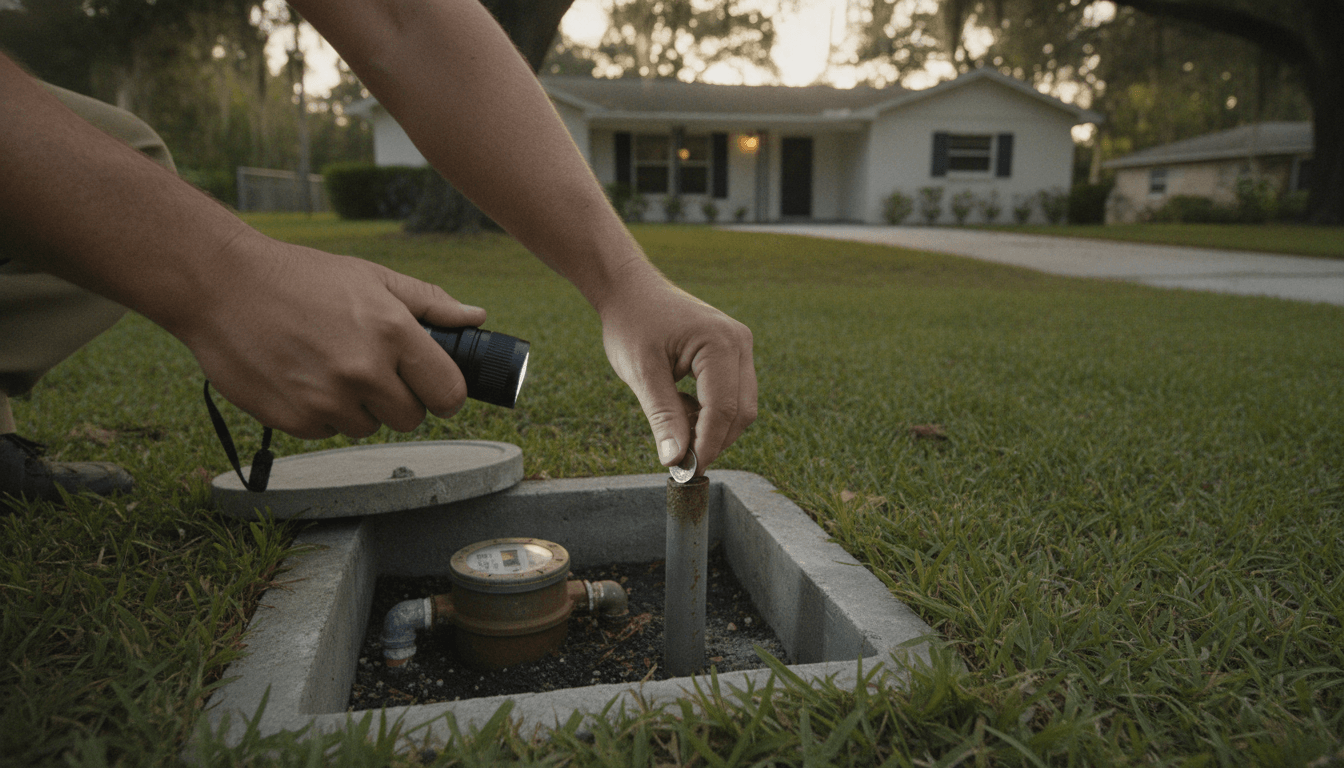
How to check your own service line in about two minutes
You can end the annual letter by identifying the pipe yourself. The City of Tampa offers a self-assessment survey where you submit photos, and it suggests a magnet or a coin scratch test. Florida DEP confirms the same methods are legitimate, noting that “meter pit investigations with scratch and magnet tests are acceptable field investigation techniques.”
Find where the water line enters your house, typically at the wall nearest the meter, and test the bare pipe with a flashlight, a refrigerator magnet, and a coin or key.
| What you observe | What the pipe is |
|---|---|
| Magnet does not stick; scratch reveals a soft, shiny silver mark | Lead |
| Magnet sticks firmly; surface is hard and resists scratching | Galvanized steel |
| Scratch reveals copper-orange metal underneath | Copper |
| White or colored, non-metallic, no magnetic response | Plastic (PVC, CPVC, or PEX) |
The scratch is the decisive test. Lead is soft enough that a coin marks it easily, and the fresh mark is noticeably brighter than the dull gray oxide on the outside of the pipe.
One thing to be clear about before you go looking. Ownership of the line is split. Tampa puts it plainly: “Utility-owned service lines are from the water treatment plant to the meter; whereas, customer-owned service lines starts after the meter and into their private property.” St. Petersburg draws the same line at the meter. The section you can reach at the house is the part you own, and the part you’d pay to replace. We’ve covered who pays for what on a Tampa Bay water line in detail.
Where lead actually shows up in a Tampa Bay house
If the service lines here aren’t lead, the reasonable question is why anyone is testing anything. St. Petersburg answers it in its own project FAQ: “The most common source of lead in drinking water is from household plumbing. Lead can also be found in certain brass fixtures, copper piping joined with lead-based solder, and lead service lines.”
Note the order. Household plumbing first, service lines last.
Congress amended the Safe Drinking Water Act in 1986 to prohibit pipes, solder, and flux that weren’t lead free, capping solder and flux at 0.2% lead and pipes at 8%. That 8% allowance stood for another quarter century, until the Reduction of Lead in Drinking Water Act lowered the limit on wetted surfaces to a weighted average of 0.25%. A brass fixture installed legally in 1998 could still contain far more lead than one sold today.
Hillsborough County’s own recommendation follows from that, and it’s the most concrete instruction any local utility gives: “Inspect and replace inside plumbing and fixtures if installed prior to 1989. Consult with a licensed plumber.”
Galvanized pipe deserves its own mention, because Tampa Bay has a lot of it, and it’s the usual culprit behind brown tap water in older Tampa Bay homes. St. Petersburg’s FAQ explains the mechanism: lead particles attach to the interior surface of galvanized pipe, and as that pipe corrodes and rusts from the inside, accumulated lead can release into the water. Galvanized doesn’t contain lead itself. It collects it. If your house still has original galvanized supply lines, that’s a plumbing-age problem regardless of what the meter box says, and it sits alongside the cast iron failures in older St. Petersburg homes and the polybutylene runs this metro is still working through.
Housing age is the real predictor here, not geography. The pre-1989 stock in Hyde Park, Seminole Heights, and older St. Petersburg neighborhoods is where the interior-plumbing question is worth asking. A 2004 build in Wesley Chapel was plumbed well after every one of these rules took effect.
What to do this week, and what it costs
Hillsborough County publishes four steps that cost nothing, and two of them correct beliefs a lot of people hold:
- Clean out your faucet aerators, where particles collect.
- Use an NSF/ANSI-certified filter for drinking, cooking, and baby formula.
- Run cold water for three to five minutes before using it if the water has been sitting several hours.
- “Boiling water does not remove lead.” Boiling concentrates it as water evaporates.
The county also answers the question people are most anxious about: “Skin does not absorb lead from water, so filtration is not needed before bathing and showering.”
On cost, here’s what we can state honestly. Replacing lead-bearing fixtures is the cheap end of this, and at Tampa Plumbing Pro the fixture work runs $150 to $300 in labor plus the cost of the fixture itself. If the finding is aging supply pipe throughout the house rather than one fixture, a whole-home repipe runs $4,000 to $10,000 for a standard single-story home.
What we won’t do is quote you a flat price to replace a service line sight unseen. That number depends on the run length, the depth, and whether the line passes under a driveway or a mature oak, and anyone giving you a figure over the phone is guessing. If the concern is a suspected leak rather than pipe material, leak detection is $250 to $450 and gets applied toward the repair if you move forward.
Frequently asked questions
Does Tampa have lead pipes in its water system?
The City of Tampa states it has not used lead as a standard piping material, and that lead has not historically been detected in treated water leaving its production plant. Hillsborough County reports no lead lines in its service area, and St. Petersburg’s records indicate no lead service lines. Individual customer-owned segments can still be unverified, which is what the inventory letters are about.
My utility says my service line is “unknown.” Does that mean it’s lead?
No. Florida DEP guidance states that “unknown service lines should NOT be reported as Lead.” Unknown is its own category, and the notice goes out because the utility has not yet confirmed the line is non-lead, not because it found lead. Identifying your pipe and reporting it is what stops the annual letters.
Why did the news say Florida had the most lead pipes in the country?
Florida’s figure in the EPA’s 7th Drinking Water Infrastructure Needs Survey was 1,159,000 lead service lines. The EPA later found the state had not reliably reported that data, required actual inventory submissions, and put the corrected count at 64,000. The agency de-obligated $226,138,000 of Florida’s lead service line replacement grant as a result.
Does boiling water remove lead?
No. Hillsborough County states plainly that boiling water does not remove lead. Because boiling evaporates water while the lead stays behind, it can slightly raise the concentration. Use an NSF/ANSI-certified filter instead.
Is it safe to shower if I’m worried about lead in my water?
Yes. Hillsborough County’s guidance is that skin does not absorb lead from water, so filtration is not needed for bathing or showering. The exposure route that matters is swallowing it, which is why the recommendations focus on drinking, cooking, and formula.
How do I tell lead pipe from galvanized steel?
Use a magnet and a coin. A magnet sticks to galvanized steel and will not stick to lead. Lead is soft, so a coin leaves a bright silver scratch, while galvanized is hard and resists scratching. If the scratch shows orange underneath, it’s copper.
Who pays to replace the customer-owned part of the service line?
The property owner. Both Tampa and St. Petersburg split ownership at the meter, with the utility responsible up to the meter and the customer responsible from the meter into the property. If a utility program covers a confirmed lead line on your side, your utility will tell you directly, so ask before you pay for anything.
Get an answer on what your pipes are actually made of
If you’ve had one of those letters, or your house predates 1989 and nobody has ever looked, the plumbers in the Tampa Plumbing Pro network can identify what you have and tell you whether it’s worth doing anything about. We cover Hillsborough, Pinellas, and Pasco, with someone reachable around the clock.
Call (813) 590-0625. We’d rather tell you your pipes are fine than sell you a repipe you don’t need.