Most homeowners only think about what a plumbing repair visit actually looks like once one is already on the calendar. The phone call, the diagnostic, the price, and the actual fix all happen in a fairly predictable order, but almost nobody explains that order in advance. Here’s what to expect at each stage, using two of the most common Tampa Bay repair calls, a toilet repair and a sewer line repair, as real examples of how a symptom turns into a diagnosis and a diagnosis turns into a price.
What the phone call actually covers
A repair call starts with a handful of quick questions: what’s happening, how long it’s been happening, and whether water is actively running somewhere it shouldn’t be. That last question matters most. A toilet that’s been running quietly for a week gets scheduled normally. A sewer line backing up into a tub, or a supply line spraying water into a wall, gets treated as same-day. Tampa Bay’s older housing stock, cast iron drain lines in Seminole Heights bungalows, original galvanized supply lines in a 1960s Hyde Park home, polybutylene in a Carrollwood ranch built in the 1980s, means the person answering the phone is already thinking through likely causes before a technician ever pulls into the driveway.
The diagnostic visit: what actually gets checked first
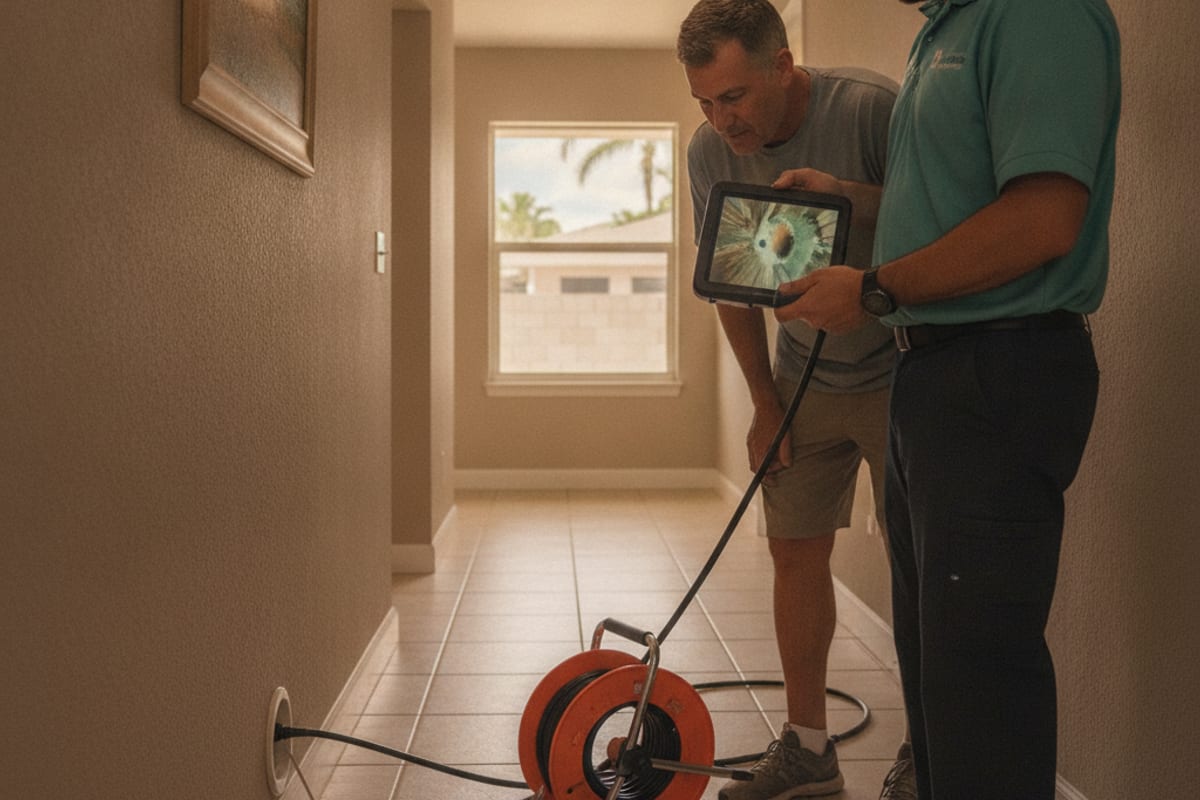
Every repair visit starts with confirming the actual problem before touching a wrench. For a running toilet, that means checking the flapper seal, the fill valve, and the water level in the tank, since Tampa’s hard water, averaging 11.7 grains per gallon and climbing past 17 during dry season, coats these parts with mineral scale faster than it would in a softer-water market. For a suspected sewer line problem, diagnosis usually means running a camera down the line to see exactly what’s happening: a root that’s worked into a joint, a section that’s corroded through, or a low spot, called a belly, where the pipe has settled into Tampa Bay’s sandy soil and waste keeps collecting in the same place.
This step is where a good repair visit separates itself from a rushed one. Guessing at a fix without confirming the actual cause usually means paying for a repair that doesn’t hold, then paying again a few months later for the real problem.
How pricing works before any work starts
Diagnostic work that needs a camera, leak detection, or opening a wall typically carries a fee of $89 to $150, often credited toward the job.
Once the diagnosis is confirmed, the next step is a written price, not a verbal estimate that changes once the invoice shows up. A toilet repair job, for example, breaks down clearly by what’s actually failing: a flapper or fill valve swap runs $125 to $250 including parts and labor, while a cracked tank or bowl means a full replacement instead, usually $300 to $550. A sewer line repair has a wider range because the fix depends entirely on what the camera showed. A localized trenchless repair for one bad joint typically runs $2,500 to $6,000, while a full replacement on a line with corrosion or bellies in multiple spots runs considerably more, often $6,000 to $15,000 depending on length and access. Either way, the price should be set before any work starts, based on what the diagnostic actually found, not adjusted mid-job.
What a toilet repair visit looks like start to finish
A toilet repair is usually the shortest visit on the list. After confirming whether the problem is the flapper, the fill valve, or the flush valve, most jobs finish inside an hour, parts and testing included. If the tank or bowl itself is cracked, the conversation shifts to a full replacement instead, since a cracked fixture isn’t something a repair fixes. Homes across Brandon, Riverview, and Town ‘n’ Country with original 1970s and 1980s fixtures see this more often than newer builds, simply because porcelain and internal components both have a shelf life that Tampa’s water hardness shortens.
What a sewer line repair visit looks like start to finish
A sewer line repair takes longer to diagnose and longer to complete, since the camera inspection itself is a real step, not a formality. In Palma Ceia, Hyde Park, and other oak-canopy neighborhoods, root intrusion at an aging cast iron or clay joint is close to a certainty over a long enough timeline, and the camera footage usually shows it clearly once the equipment is in the line. From there, the visit turns into a conversation about options: a localized trenchless lining if the damage is contained to one section, or a longer replacement if the line shows wear along most of its length. Homeowners get to see the footage themselves before agreeing to anything, which is the difference between trusting a description and seeing the actual problem.
How long a repair actually takes once work begins
Most single-fixture repairs, toilets, faucets, single drain clogs, finish the same day, often within an hour or two once a technician is on site. Water heater repairs run similarly fast unless a full tank replacement is needed. Sewer line work is the outlier: a localized trenchless repair usually wraps in a single day, but a full replacement can run one to several days depending on length and whether the yard needs any digging at all. During hurricane season, June through November, expect same-day repairs to book up faster than usual, since storm surge and heavy rain push a wave of emergency calls through the whole metro at once.
How to vet who’s actually showing up at your house
Florida requires a CFC plumbing license for anyone performing plumbing work in the state, and that’s worth confirming before work starts, not after. You can verify any plumber’s license status directly at myfloridalicense.com in a couple of minutes, and it’s worth doing regardless of who you call. Ask for the written price before work begins, and treat any quote that undercuts the ranges above by a wide margin as a reason to ask more questions, not a reason to celebrate. A price that low on a sewer line or toilet job usually means a step in the diagnostic got skipped.
How long does a typical plumbing repair visit take?
Most single-fixture repairs like a toilet or faucet finish in an hour or two once a technician arrives. Sewer line repairs take longer because of the camera diagnostic, with a localized repair usually wrapping in a single day and a full replacement sometimes running several days.
Do I get a price before the repair starts, or after?
Before. A real repair visit confirms the diagnosis first, whether that’s a worn flapper or a camera showing root intrusion in a sewer line, then gives a written price based on what was actually found. Work shouldn’t start on an estimate that changes once the job is already underway.
Why does my toilet or sewer line keep having the same problem?
Usually because the earlier fix addressed the symptom instead of the cause. A flapper replaced without checking why it wore out, or a sewer line snaked without a camera confirming the root cause, tends to bring the same problem back within months, especially in Tampa Bay’s hard water and shifting sandy soil.
What should I ask before I let someone start work in my home?
Ask what the diagnostic actually found, ask for the price in writing before anything starts, and confirm the technician’s CFC plumbing license at myfloridalicense.com. Anyone doing honest work should have no issue with any of those three questions.
If you’re dealing with a toilet that won’t stop running or a sewer line that keeps backing up anywhere in Tampa, St. Petersburg, or the surrounding suburbs, call Tampa Plumbing Pro at (813) 590-0625. We’ll walk you through the diagnosis and the price before anyone touches a tool.