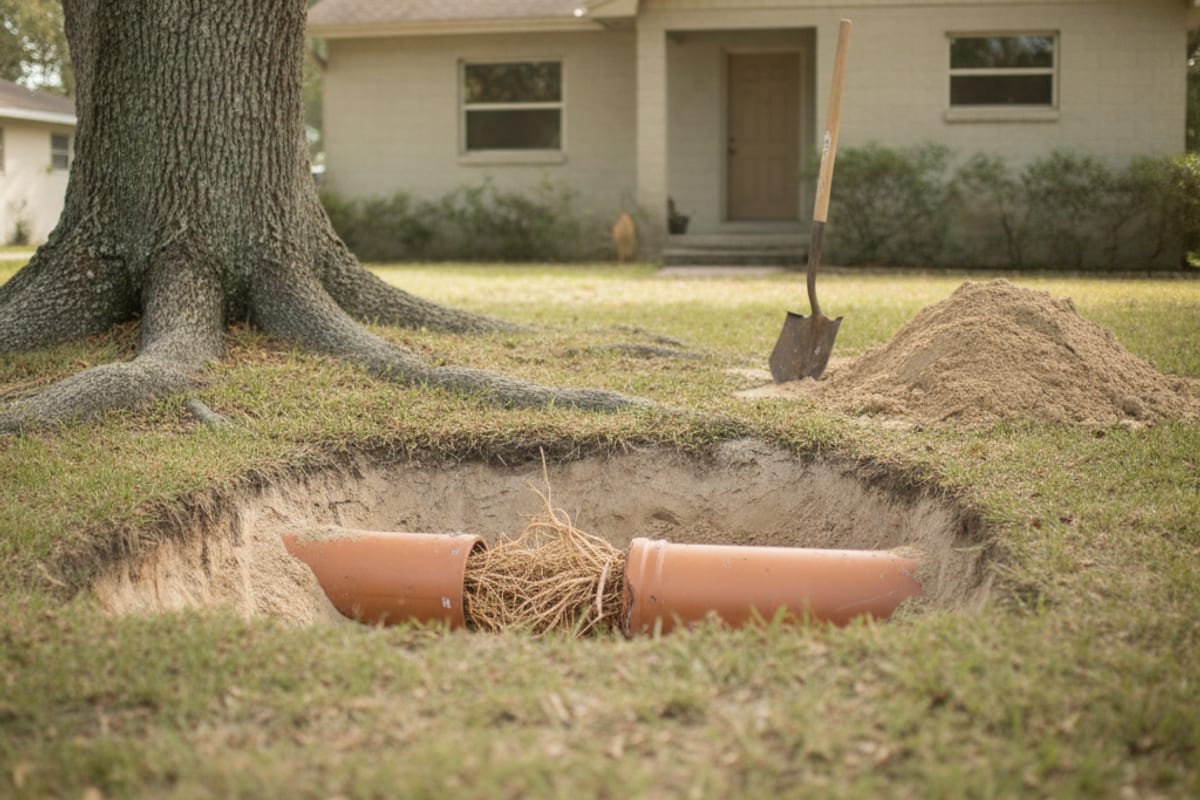
Tree roots in sewer line trouble almost always starts at a joint, not in the middle of a length of pipe. A hairline gap leaks a little moisture into dry sand, the nearest live oak finds it, and fine roots thread through and fan out inside the pipe where the water is. Cutting them out clears the line for a while. It does nothing to the gap they came through, which is why the same house backs up again on roughly the same schedule. And if your first instinct is to take the tree down, inside Tampa city limits that tree is protected and the roots in your pipe are not, on their own, a reason the city has to let it go.
What tree roots in a sewer line actually do to the pipe
Roots do not drill through sound pipe. They exploit something that is already open: a separated joint on an old clay lateral, a corroded gap in cast iron, a crack from soil settlement. Once a fine root tip gets inside, it sits in a warm nutrient bath and thickens. A root that entered as a hair becomes a woody mass that both blocks flow and levers the opening wider every season it grows.
That second part is the one homeowners miss. The blockage is the symptom you notice. The widening is the damage you pay for later. By the time a line backs up twice in a year, the joint is usually larger than it was when the first root arrived, and sand and soil are washing in alongside the waste.
Tampa Bay stacks the odds here. Much of Seminole Heights, Tampa Heights and the older parts of Hyde Park sits on pre-1960s clay and cast iron laid in sandy soil, under a canopy of live oaks, ficus and camphor that has had sixty years of root growth to work with. Sand drains fast, so the only dependable moisture during a dry April is whatever is seeping out of a sewer joint. The roots go where the water is.
Taking the tree out does not fix the pipe
This is the part worth understanding before anyone calls a tree service. Removing a tree stops new root growth. It does not remove the root mass already inside the pipe, and it does not close the joint that let it in. A dead root ball in a lateral still blocks flow, and decaying roots can actually break loose in pieces and pack tighter downstream.
There is a second-order problem too. Large roots under a slab or a driveway often help hold saturated sand in place. When they die and decompose over several seasons, that soil can settle, and a line already sitting on a marginal slope can sag into a belly. You can end up trading a root problem for a grade problem, which is worse, because a belly holds standing water permanently and no amount of cleaning changes that.
So the sequence that works is the opposite of the instinct. Clear and inspect the line first, decide what the pipe needs, and treat the tree as a separate question about the next twenty years.
Inside Tampa city limits, the tree is protected
The City of Tampa protects trees under section 27-284 of the city code, and its own guidance is blunt about what that means. No person shall “cut down, remove, relocate, damage, destroy, or in any manner abuse any protected tree in the city, until such work is authorized by a permit issued by the Development & Growth Management Department,” and the City calls an unpermitted removal “an irreparable or irreversible violation which can be subject to fines.”
The thresholds are low enough that most of the trees causing sewer trouble are covered. The City’s tree information page describes protected species including oaks, pines and elms greater than 5 inches in diameter measured at 4.5 feet from the ground. Pruning has its own trigger: at 24 inches or greater in diameter at that height, you need a permit before anyone prunes, and a forester from Natural Resources inspects the permit before it is released. Applications run through the City’s Accela portal.
Two practical notes. “In any manner abuse” is broad language, and it is worth keeping in mind when an excavation runs through a root plate. And if the tree sits in the public right of way rather than on your lot, it is the City’s tree and the City’s Forestry Division prunes it, so that is a call to them rather than a job you hire out.
Everything in this section is City of Tampa only. Unincorporated Hillsborough, Pinellas County, St. Petersburg, Clearwater and Pasco County each run their own tree rules with their own thresholds, so confirm with the jurisdiction your address actually sits in before assuming any of it transfers.
The one way around the permit, and what it really requires
Florida has a statewide exemption, and it is narrower than its reputation. Fla. Stat. 163.045 says a local government “may not require a notice, application, approval, permit, fee, or mitigation” for pruning, trimming or removing a tree on residential property if the owner holds documentation from an ISA certified arborist or a Florida licensed landscape architect that the tree “poses an unacceptable risk to persons or property.” The city also cannot make you replant.
Three conditions have to hold at once, and the City of Tampa’s July 20, 2022 city attorney memorandum spells out how it reads them.
The documentation has to be real and specific. It means an onsite assessment performed under the procedures in Best Management Practices, Tree Risk Assessment, Second Edition (2017), signed by the arborist or landscape architect. The City requires it for each and every tree removed, and states that if the paperwork lacks either the onsite assessment or the signature, “a notice of violation may be issued.”
The risk finding has to clear a defined bar. A tree poses an unacceptable risk only “if removal is the only means of practically mitigating its risk below moderate” under that same assessment standard. This is where the sewer argument falls apart. The standard is about risk to persons and property from the tree itself, failure, falling limbs, structural defects. Roots in a buried pipe are not what that assessment measures, and the City says it will accept the arborist’s determination rather than substituting its own idea of a hazardous tree. Whether your tree qualifies is the arborist’s call on site, and nobody should tell you the answer in advance.
The property has to be the right kind. The statute defines residential property as a single-family detached building on a lot actively used for single-family residential purposes. The City’s memo lists what that excludes: property zoned commercial, property in commercial use, a residential lot with no residential structure, and lots containing a duplex, townhomes or any other multi-family building. A condo or a townhouse does not get this exemption at all.
One more detail that catches people. Even when the exemption genuinely applies, the City points out that the only way it can tell a legal removal from an illegal one is if you hand over the documentation, so giving it to them is how you avoid a violation notice rather than an optional courtesy.
What actually fixes the line
Start with eyes on the pipe. A camera run tells you whether you are looking at one intruded joint, a long run of failing clay, or a belly that roots simply found first. Our write-up on sewer scope inspection costs in Tampa covers what that looks like and what the footage should show you.
From there the choice is about how long you want the fix to last.
| Approach | What it does | Where it falls short |
|---|---|---|
| Cable machine, or snake | Cuts a channel through the root mass fast, which is the right emergency move when the house is backing up tonight | Leaves root stubs at the joint and the pipe wall uncleaned, so regrowth starts immediately |
| Hydro-jetting | Scours the full circumference back to bare pipe wall and clears the root mat rather than boring through it | The joint is still open, so this resets the clock rather than ending the cycle |
| Spot repair or lining at the joint | Closes the actual entry point, which is the only thing that stops recurrence at that spot | Only worth it when the rest of the line is sound, which the camera has to confirm |
| Full or trenchless replacement | Replaces the aging clay or cast iron that will keep producing new entry points | The larger commitment, and the right call mainly on lines failing in more than one place |
The honest framing is that cleaning is maintenance and the joint is the repair. If a plumber is back at your house every six months, you are renting a solution. Hydro-jetting versus snaking goes deeper on the cleaning side, and how often sewer lines should be cleaned explains why a line with confirmed root intrusion runs on a much shorter interval than the national average. When the camera points toward replacing the run, trenchless sewer repair in Tampa covers what rules a line in or out of that method.
The plumbers we send handle the camera work, the clearing and the sewer line repair itself, and if the problem turns out to be limited to one fixture rather than the main line, drain cleaning is the smaller job.
Where your responsibility stops
For an address on City of Tampa sewer, the City states plainly that it “maintains the sanitary sewer system from your property line toward the street, easement or alley where the main sewer line is located.” Read that the way it is written. The run from your house out to the property line is yours, and a root-packed joint fifteen feet from the foundation is your bill even though the tree that fed it may be growing in the parkway.
Other utilities around the bay draw that line in their own places, so if you are not inside Tampa, confirm the boundary with whoever sends your sewer bill before you assume anything about who pays.
Frequently asked questions
Will a root killer poured down the toilet solve this?
It will not close the joint, which is the actual defect. Foaming and chemical products are marketed for root control and homeowners use them, but nothing in that approach repairs an open pipe joint, and anything you flush eventually reaches a drain field or a treatment plant. Get the line on camera first so you know whether you are treating a nuisance or postponing a repair.
How do I know the roots are in the main line and not just one drain?
The giveaway is more than one fixture misbehaving at once. A single slow sink is usually a local clog. A toilet that gurgles when the washing machine drains, a tub that backs up when a toilet is flushed, or slow drains across several rooms points at the shared line everything empties into.
Does homeowners insurance pay to remove roots from a sewer line?
Treat it as a no until your own policy and carrier say otherwise. Root intrusion is typically read as a maintenance and wear issue rather than a sudden accidental loss, and the pipe repair itself is a different question from any resulting water damage. Ask your carrier about your specific policy rather than relying on a general answer.
Can I remove a tree in Tampa because its roots broke my sewer pipe?
Not on that basis by itself. Inside the city you need a permit for a protected tree, and the statewide exemption in Fla. Stat. 163.045 turns on a certified arborist finding that the tree poses an unacceptable risk to persons or property, assessed on site under a published risk-assessment standard. Damage to a buried pipe is not what that assessment measures. An ISA certified arborist decides whether your particular tree qualifies.
When to call us
Call when the backups are repeating, when more than one fixture is draining slowly at the same time, or when a plumber has cleared the same line twice and nobody has put a camera in it. Root intrusion in an older clay or cast iron lateral is licensed plumbing work, and the diagnosis matters more than the clearing. We will get a licensed local plumber out to look at the actual pipe before anyone talks about replacing it.
Call us at (813) 590-0625.