If your Tampa home sits on a concrete slab, the water and sewer lines running underneath it are about to become the most expensive problem you can’t see coming. Slab-on-grade construction is the standard here, and it’s efficient for builders. For homeowners, it means every plumbing line is either buried directly in the concrete, running underneath it, or channeled through the slab itself. When those lines fail, you’re not just fixing a pipe. You’re dealing with concrete cutting, potential foundation damage, and a repair path that should wait until the leak is located.
This page is about why Tampa slab plumbing fails and what to check before anyone cuts concrete. If the question is what happens after a pipe under the slab fails, that sequence lives on when under-slab plumbing fails.
Why Tampa slab plumbing fails
Three environmental factors conspire against underground plumbing in a Florida slab foundation.
The first is soil. Hillsborough and Pinellas counties have sandy, shifting soil that moves more than clay-based ground. That movement creates stress on pipes running through the concrete over years. A pipe that’s fine on year five starts flexing and cracking on year fifteen as the earth beneath the slab settles unevenly.
The second is water chemistry. Tampa’s hard water, averaging around 11.7 grains per gallon, accelerates corrosion inside copper and other metal pipes the same way it furs up water heaters. Scale builds inside the pipe wall, narrowing the diameter and weakening the metal over time.
The third is age and material. A massive share of Tampa Bay’s housing stock was built between 1978 and 1995 when polybutylene (poly-b) was the plastic of choice for water lines. Poly-b degrades underground, especially in Florida heat and under UV stress if exposed. Homes older than that often have cast iron drain lines under the slab, and cast iron corrodes from the inside out, eventually collapsing into fragments inside the pipe.
Any one of these is manageable. Combined, they explain why under-slab failures show up so often on Tampa slab homes.
The problems that hide under concrete
Slab leaks get all the attention because they’re dramatic. Water escapes the supply line, saturates the soil under the foundation, and cracks flooring or shows up as a warm spot on the floor. But leaks are just the most obvious failure mode.
Polybutylene breakdown is worse because it’s silent. The pipe degrades, becomes brittle, and then cracks or pinholes. You don’t always get a visible leak right away. You get low pressure at fixtures, or suddenly one morning your water tastes or smells off. By the time you notice, the line is compromised and will fail completely within months. And because poly-b runs through the slab, you can’t just replace it without cutting concrete.
Cast iron deterioration happens in the drain lines. Cast iron lasts longer than you’d think, but not forever. Once corrosion reaches a certain point, the inside of the pipe flakes and collapses. You’ll first notice slow drains in multiple fixtures, then backups, then sewage smell in the house. The pipe hasn’t fully failed yet, but it’s failing, and it’s getting worse every day.
Corrosion and scale buildup in copper and galvanized lines reduces water pressure over time. This shows up as weak showers or faucets running slower than they used to. It’s not dramatic, so people live with it for years. Then the homeowner tries to sell and the inspection turns up internal corrosion that means a full repipe is coming.
Settling and ground movement can crack pipes that are otherwise fine. As soil under the slab shifts, pipes get pulled, flexed, and sometimes kinked. A kinked line doesn’t leak all at once. It restricts flow, creates blockages downstream, and eventually cracks.
The expensive part: how you find out
Most people find out about slab plumbing problems in three ways, all of them costly.
First, your water bill spikes and keeps climbing. A hidden leak can keep running while fixtures are off, so an unexplained bill jump is a reason to watch the meter. By the time you notice the bill, water may already have been moving for weeks.
Second, you sell the house. A home inspection picks up the low water pressure, does a slab-leak detection scan, and finds the problem in the report. Now it’s a line item in negotiations, and you’re fixing it under deadline.
Third, the problem becomes impossible to ignore. Mold shows up under flooring because water is wicking up through the concrete. Cracks spider through the tile. Doors stop closing right. Carpet smells like mildew. These are end-stage problems, and they cost way more to fix because you’re not just replacing the pipe anymore. You’re replacing flooring, treating mold, and dealing with structural settling.
What you can actually do
You can’t see under the concrete, so prevention is limited to awareness. Watch your water bill. If it climbs without explanation, something’s moving through that line that shouldn’t be.
If you know your home was built with poly-b, have it inspected by a licensed plumber. Poly-b under a slab is a ticking clock. If the builder used it, it’s likely compromised by now, and the risk of sudden failure is real. Leak detection applied toward repair is published on this site at $250 to $450. Waiting until the line fails is how flooring, mold, and a larger repair get stacked on top of the pipe work.
If the house is old enough that original cast-iron drains may still sit under the slab, slow drains are a reason to inspect, not proof the line has failed. Catch it while it’s still a choice, not an emergency.
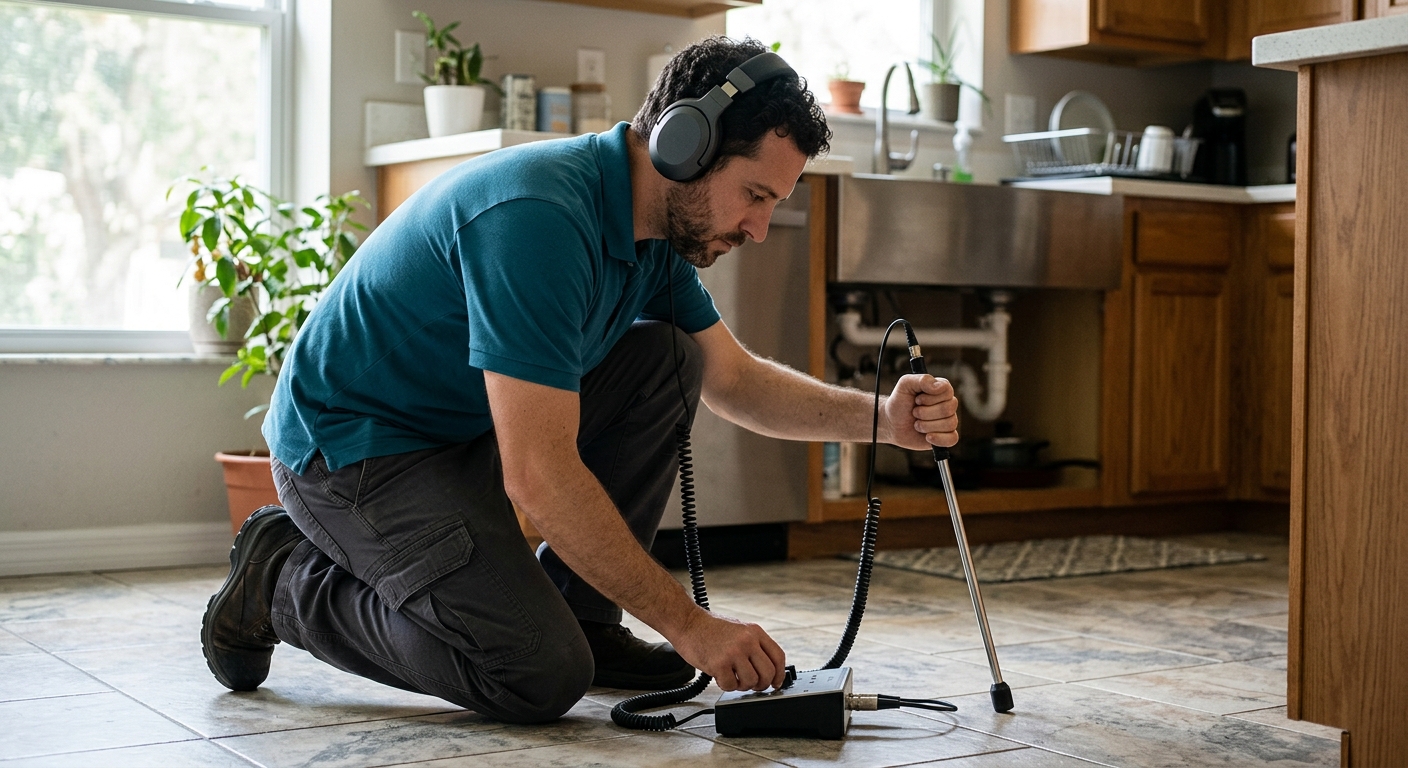
When you do need slab leak repair or suspect one, detection matters. Acoustic and thermal imaging lets the plumbers we send find the leak location before anyone touches a jackhammer. That accuracy means a smaller access hole, lower cost, and less damage to your flooring.
For homes where the under-slab plumbing is genuinely aged, a partial repipe that bypasses the slab entirely often costs less over five years than a series of one-off emergency repairs. The plumbers we send pull new lines through the attic and down through walls. It’s more money upfront, but it solves the problem permanently instead of buying time.
FAQ
How can I tell if I have polybutylene pipes under my slab? Your home’s age is the first clue. If it was built between 1978 and 1995, poly-b is a real possibility. A plumber can sometimes trace visible plumbing or check the original construction documents. The definitive answer is a camera inspection or detection scan.
Does homeowners insurance cover slab leak repair? Sometimes. It depends on your policy and the cause. Most policies don’t cover slab leaks, but some cover them if they’re sudden and accidental rather than from corrosion or age. Verify with your insurance company before assuming they will.
What’s the difference between spot repair and rerouting a slab leak? Spot repair cuts a small section of concrete, replaces the damaged line, and seals the slab back up. Rerouting runs a new line through the attic and down through walls to completely bypass the damaged section under the slab. Spot repair costs less now. Rerouting prevents the next failure but costs more upfront.
Can I ignore low water pressure if it’s just one fixture? For a while, yes. But if it’s getting worse or spreading to more fixtures, don’t wait. Low pressure can mean corrosion is narrowing your lines, and once it starts, it spreads. Have it checked.
How much does it cost to detect a slab leak? Slab leak detection typically runs $250 to $450 depending on the size of the home and how accessible your plumbing is. It’s money well spent because it prevents guessing and tearing up concrete unnecessarily.
Call Tampa Plumbing Pro at (813) 590-0625 if you’re worried about slab plumbing or need a detection scan. We’ll match you with a licensed plumber who can tell you what’s under there before you commit to any repair.