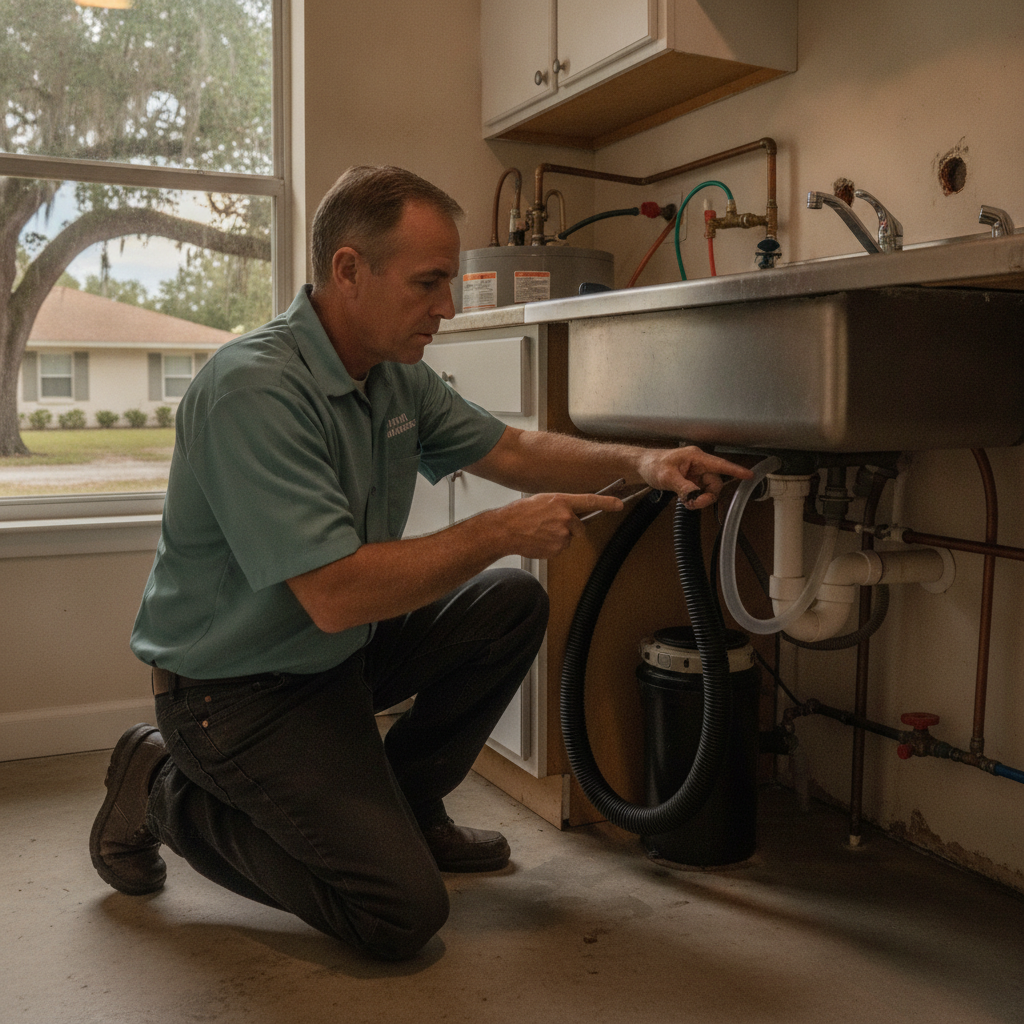
The cycle beeps, you crack the door, and dirty water is still sitting on the tub floor. That is a dishwasher not draining, and in Tampa Bay kitchens the water almost always stops at one of three places: the filter in the tub, the air gap or disposal under the sink, or the kitchen drain those parts dump into. A shallow film in the filter well is leftover from the last pump-out on a lot of machines. Water covering the whole tub after a cycle is not.
The three drains a Tampa dishwasher uses
Wash water leaves the tub through a screened sump, then a short hose, then either a chrome air gap on the sink deck or a high loop strapped under the counter. From there it dumps into the garbage disposal or the sink tailpiece and rides the kitchen waste line out of the house. Block any one of those and the pump runs, the tub stays wet, and the next load sits in last night’s rinse.
The first stop is the dishwasher’s own filter. Rice, glass, jar labels, and Tampa hard-water scale pack that screen until the pump is pulling against a paste. City of Tampa finished water averaged 12.3 grains per gallon in its 2025 water quality report, and the site’s own range for the metro is 11 to 17 grains. That same mineral crust that roughs up a Brandon shower head after a year on city water sits in the dishwasher sump. It also sits in the tank. If the hot side has been getting noisier or the water has been picking up a tint, the water heater is living on the same supply.
The second stop is the connection under the sink. Most Tampa dishwashers share a knockout on the side of the disposal. Run the disposal and you hear the dishwasher’s leftover water drop. Leave last night’s pasta in the disposal, or leave the factory knockout plug in after a new unit goes in, and the hose has nowhere to go. The tub fills from the bottom up. A disposal that will not grind is the same clog, seen from the other fixture.
The third stop is the kitchen drain itself. The dishwasher does not have its own path to the street. It borrows the sink line. In a 1950s Seminole Heights or Hyde Park bungalow that line is often original cast iron, the same era that left galvanized supply in the walls. Iron roughs up, grease from a Gulf dinner sticks, and a pump that worked in March cannot push August wash water through the scale. East Hillsborough slabs in Brandon, Valrico, and Seffner hide that run under the kitchen. A St. Pete Beach cottage adds salt air on the fittings that hold the hose. When the hose and air gap are clear and the sink is still slow, that is drain cleaning on the shared branch, not a new dishwasher.
A Land O’ Lakes or Odessa kitchen on a tank still sends that grease to the same sandy drain field that a summer storm saturates. The dishwasher is not a septic problem until the kitchen line is. Treat the line first.
Air gap vs high loop in Florida installs
An air gap is the chrome cylinder on the sink deck with a little cap. Dirty wash water comes up one side, falls across an open break, and goes down the other side into the disposal. Sink water cannot siphon back into the tub because there is a physical gap at the deck. A high loop skips the chrome fitting. The drain hose is strapped up under the counter, peaked above the flood line of the sink, then dropped into the disposal or tailpiece. Gravity and the peak do the same anti-siphon job without a hole in the sink.
| Setup | How it keeps sink water out of the tub | How it fails in Tampa Bay |
|---|---|---|
| Air gap on the sink deck | Open break at the counter so waste cannot siphon backward | Cap packs with grease and scale, or the chrome body seizes in salt air on the beaches |
| High loop under the counter | Hose peaked above the sink flood line, then dropped into the disposal | Loop sags, kinks behind a slab-mounted dishwasher, or never got strapped after a remodel |
Neither setup is a mystery fitting. They fail in ways you can see. An air gap that coughs gray water onto the sink during a drain cycle is telling you the downstream path is blocked. The dishwasher pump is working. The disposal knockout or the kitchen line is not. A high loop that has slipped off its strap and now droops in a U under the sink holds a standing column of grease. The pump fights that column every cycle until the tub quits emptying.
New dishwashers get the wrong hose more often than people think. A remodel in a 1990s Valrico subdivision will reuse a flattened old hose because it already reaches the disposal. That hose kinks the first time the machine is shoved back against a slab wall. The high loop also has to stay high. If it sags to the cabinet floor, it stops being a loop and starts being a trap.
The air gap cap on a Pass-a-Grille or St. Pete Beach sink takes salt and sun on the deck. The cap sticks, the inner tube coats with the same 11-to-17-grain scale that marks the rest of the house, and the next drain cycle sprays the counter. Pop the cap and look before anyone pulls the machine. Gray paste in that cylinder is the clog. A water softener does not unclog an air gap that is already packed, but it is the reason the next one packs slower.
If the kitchen waste line past the disposal is the weak point, a fixture clearing is the next move. A standard single-fixture drain clearing runs $150 to $350 depending on access and severity. That figure is the site’s published range for opening one fixture, not a dishwasher-pump price. Main-line jetting is a different job, $350 to $700, and it is the right call only when the backup is past the kitchen. What a Tampa drain cleaning costs walks the snaking versus jetting split. The City of Tampa’s own blocked-drain guidance names grease, food, and paper as the usual obstructions on the city side of a Tampa account. That page is for City of Tampa wastewater customers. Hillsborough, Pinellas, and Pasco each run their own collection systems.
What you can check before a plumber opens the line
Standing water in the whole tub after a cycle is the symptom. The filter, the air gap, the disposal, and the sink tell you which of the three drains is holding it. Work from the tub out. Do not pour drain cleaner into the dishwasher. It will not dissolve a packed hose, and it will sit in the sump against plastic and a pump seal.
- A filter packed with rice, glass, and mineral scale will hold a tub of water even when the hose is wide open.
- An air gap cap that lifts off and shows gray paste is a clog at the deck, not a dead pump.
- A disposal that will not spin, or a knockout plug left in after a new unit, blocks the only outlet the dishwasher has.
- A sink that already drains slowly will not accept a dishwasher dump, so the tub refills as the pump runs.
Run the disposal, then run a drain-only cycle if the machine has one. If the sink was the bottleneck, the tub will drop. If the sink was already slow before the dishwasher ran, read the clogged kitchen sink path next. That is the shared line, and it is the job drain cleaning is built for.
Wrong soap looks like a drain failure and is not one. Hand dish soap or too much detergent loads the tub with foam. Foam does not pump. The water sits, the foam sits, and the next morning the door still shows a tide line. Use dishwasher detergent, not the bottle by the sink.
A kink you can see at the hose barb under the sink is fair to straighten with the machine pulled out a few inches and the breaker off. Past that, stop. Sliding a dishwasher on an East Hillsborough slab pinches the hose against the wall. Opening the pump, cutting into the kitchen waste, or working a line under the slab is licensed plumbing. Confirm the plumber at Florida’s license search before anyone opens a cabinet you cannot see into. How to pick a licensed plumber in Tampa is the local walkthrough.
Older supply in Pinellas Park and South Tampa still runs galvanized in a lot of 1950-to-1985 houses. Rust flakes from those lines show up in aerators and in the dishwasher’s inlet screen. That is a fill problem, not a drain problem, and it is easy to mix the two when the tub looks dirty. Recurring rust at the far fixtures is the repipe conversation. The drain side of that same kitchen may still be iron. A camera pass on the waste line, published on this site at $150 to $500 depending on whether it is bundled or bought alone, is how the plumber we send tells a grease plug from a collapsing branch.
Why is there standing water at the bottom of my dishwasher?
A shallow film in the filter well is leftover from the last drain on many machines and does not mean the pump failed. Water covering the tub floor after a finished cycle means the filter, the air gap or high loop, the disposal knockout, or the kitchen drain did not take the load. If the kitchen sink is slow at the same time, start at the shared line, not at a new appliance.
Can you force a dishwasher to drain?
Clear the filter, run the disposal, and clean the air gap, then run the machine’s drain cycle. That is the test, not a workaround. Bailing the tub with a cup only gets the standing water out of the way so you can see the filter. Forcing chemicals, a wet-dry vac, or a coat hanger down the hose can split the line inside the cabinet and turn a clog into a leak under the sink.
How do I know if my dishwasher drain hose is clogged?
The pump hums, the air gap stays quiet or weakly sputters, the disposal is empty, and the sink still drains on its own. Food packed at the hose barb under the sink, a hose that has gone hot and oval, or a visible kink behind the machine are the usual tells. If the hose is buried behind a slab-mounted unit and you cannot see the run, that is the point to have a licensed plumber pull it rather than shoving the box back and folding the hose again.
What can I pour down my dishwasher to unclog it?
Nothing caustic. Drain cleaner does not belong in the tub, and vinegar will not open a grease plug in a hose or an air gap cylinder. Pull the filter and rinse it. Lift the air gap cap and flush that cylinder with water. Run the disposal. If those three steps do not drop the water, the clog is in the hose or the kitchen line, and pouring more liquid on top of it only fills the cabinet.
When to call us
Call when the tub is still full after the filter, air gap, and disposal are clear, when the kitchen sink backs up with the dishwasher, or when the hose is buried behind a machine you should not be sliding on a slab. The plumbers we send open the shared kitchen line and tell you whether a fixture clearing is enough. Call us at (813) 590-0625.