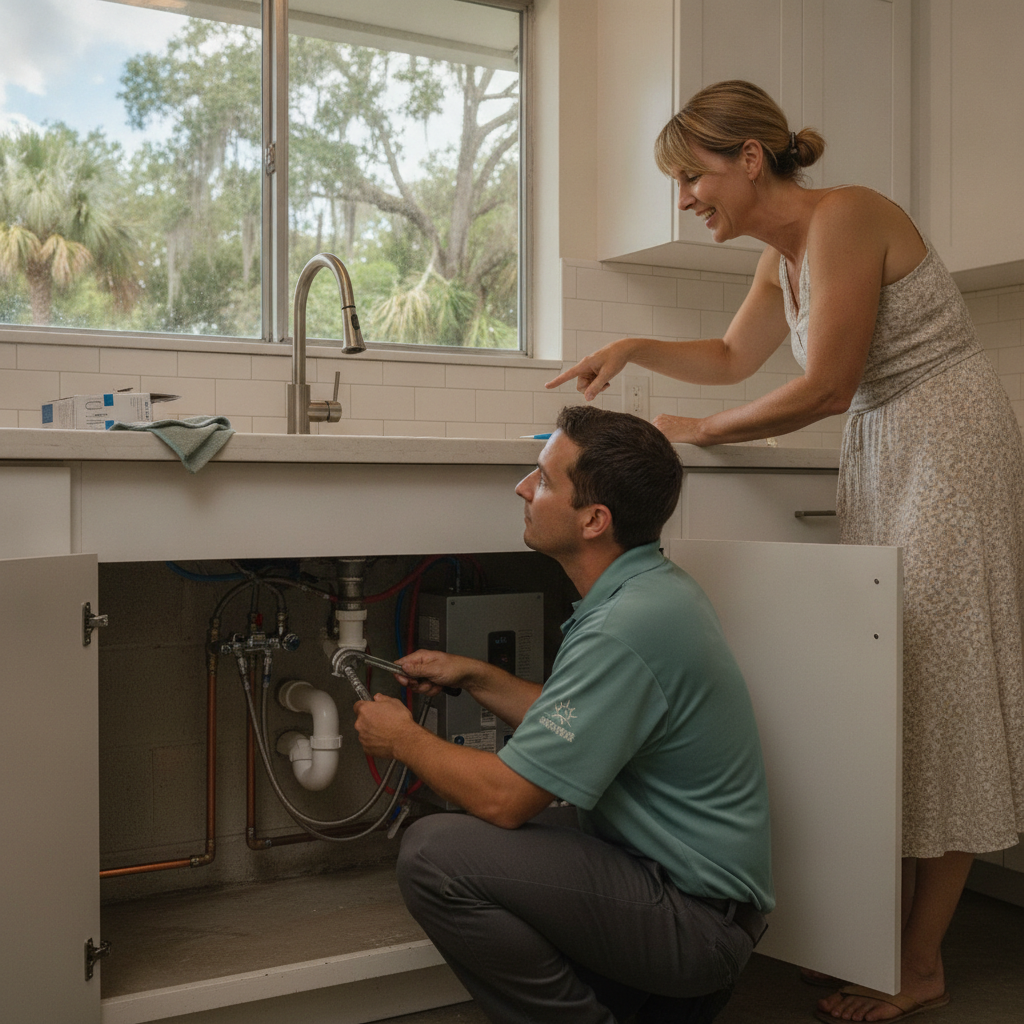
A dripping kitchen faucet on a Valrico island, or a pull-down sprayer that will not snap back in a Seminole Heights galley, is usually a swap, not a washer. Kitchen faucet installation in a Tampa Bay house is most often a same-hole replacement: shut the water, pull the old deck set, seat the new faucet, and reconnect the supply lines. Labor for a faucet or fixture install runs $150 to $300, plus the cost of the fixture. Seized shutoffs, extra holes, and scaled lines are what stretch that visit.
What kitchen faucet installation covers in a Tampa Bay house
A like-for-like swap is the whole job when the new faucet matches the holes already in the sink. The plumber the brand sends shuts the water at the angle stops under the bowl, disconnects the old supply lines, loosens the mounting nuts from below, and lifts the old faucet off the deck. Putty or a gasket goes under the new base. The faucet drops through the same hole or holes. The mounting hardware tightens from the cabinet, the lines go back on, and the water comes back so the joints can be checked.
That sequence is the same in a Hyde Park bungalow and a FishHawk subdivision. What sits under the sink is not. Central Tampa kitchens from the 1920s through the 1960s often still feed the faucet through galvanized steel that has been narrowing from the inside for decades. Pressure at the kitchen is the first place that shows up, because the run is long and the pipe is tired. East Hillsborough houses from the late 1970s through the mid-1990s, especially in Brandon and Valrico, still turn up polybutylene on the supply side. Touching those connections to swap a faucet can be the moment a brittle fitting finally weeps.
A new faucet does not fix a slow bowl. If the sink still stands after the sprayer has more punch, the restriction is in the drain, not the spout. That is a drain cleaning call, and on a pre-1975 St. Petersburg bungalow it can trace to thinning cast iron under the slab rather than a wad of grease in the trap. A brand-new faucet that pours rusty water on the hot side only is pointing at the tank, not the fixture. That pattern belongs with water heater repair, because the anode and the steel shell are shedding into the hot line.
The faucet itself is a small part of what you see. Finish, spout height, and a pull-down head are the catalog choices. The plumber is matching hole count, thread size, and shutoffs that actually close. Buy the fixture first if you care about the look. Bring the spec sheet so the hole pattern and the supply connections are known before anyone is on their back in the cabinet.
Tampa Bay water is hard, commonly 11 to 17 grains per gallon depending on the utility and the season. Scale that crusts a Brandon shower head also loads a kitchen aerator and the cartridge behind the handle. Ceramic disc cartridges handle that mineral load better than the old washer stacks, which is why they are the usual recommendation on a replacement here. A faucet that still drips after a fresh cartridge is often scale inside the valve body, not a bad part. At that point the body is the repair, which is how a “simple install” becomes a full swap.
Supply lines, shutoffs, and the leak points
The faucet is the part you see. The leak after a swap almost always starts at a joint you do not. Two angle stops sit on the wall under a typical kitchen sink, one hot and one cold. Braided supply lines run from those valves to the faucet shanks. A pull-down adds a hose, a weight, and a docking point under the deck. Each of those connections is a leak path if the old hardware is left in place past its useful life.
Hard-water scale is the local reason those joints fail. Mineral crust locks an angle stop that has not been turned in years. The handle moves and the stem does not. Or the handle shears. Either way, the kitchen cannot be isolated, so the house main has to come off before the old faucet will come free. That is a different visit than a faucet that was ready to swap. Replacing a supply line or a shutoff valve adds $50 to $100 per valve on top of the faucet labor. The add-on is the seized hardware, not a surprise fee for turning a wrench.
Galvanized stubs under a South Tampa or Seminole Heights sink corrode from the inside the same way the rest of the house does. The threads look fine until the nut comes off and the pipe wall is orange dust. Polybutylene in a 1980s Valrico cabinet has the opposite problem: the plastic has been sitting in a hot, damp box for decades, and the old acetal fittings crack when they are disturbed. A faucet swap is a poor time to discover that the last two feet of supply are the same material that is failing in the walls. When those lines keep showing up under more than one fixture, the honest next conversation is a whole-home repipe, not another pair of braided hoses.
Three places get a paper towel after the water comes back. The deck gasket, because a thin bead of putty or a flattened rubber ring is what keeps splash from running into the cabinet. The compression nuts on the supply lines, because a ferrule that was snug on the old faucet may not seat on the new shank. The spray-hose coupling on a pull-down, because that joint lives in the dark and weeps into the cabinet floor for a week before anyone notices. A slow drip there is not a “new faucet settling in.” It is a joint that did not seal.
High street pressure makes all of those joints work harder. Florida’s plumbing code requires a pressure-reducing valve inside the building when static pressure exceeds 80 psi, with an exception for hose bibs and outside hydrants. Most newer Tampa Bay construction on city water already has one near the main shutoff. If cartridges keep cutting themselves apart a year after the last swap, the faucet is the symptom. The regulator is the cause, and that is a different repair than faucet repair at the sink.
A shutoff that weeps when it is closed is already telling you the stem is worn. Forcing it to get through one more faucet swap is how a small drip becomes a cabinet full of water while nobody is home. The dedicated walk-through for that failure is a leaking shutoff under the sink. On install day, the fix is to replace the stop, not to hope it holds.
When a new hole or a pull-down sprayer changes the job
A single-hole faucet on a three-hole sink is a common catalog mismatch, not a defect. Many new pull-downs ship with a deck plate, the metal escutcheon that covers the unused holes and gives the new faucet a clean base. That is the easy version. The hard version is a one-hole bar sink that someone wants to turn into a pull-down plus a soap dispenser. That means opening a second hole in stainless or granite, and the sink, not the faucet, becomes the job.
Pull-down sprayers add a hose that has to travel, a weight that has to clear the garbage disposal and the trap, and a docking system that has to hold the head in the spout. Under a deep farmhouse sink in a South Tampa remodel there is room. Under a 1950s St. Pete bungalow sink, the cabinet is a nest of trap, disposal, dishwasher tee, and supply lines. The hose drags on a sharp disposal clamp, the weight hangs up, and the head sits crooked in the spout a month later. That is an access problem, not a cheap faucet.
Soap dispensers and filtered-water taps need their own holes. An optional hole already punched in the sink deck is a gift. Drilling stone on a finished island is not. If the sink is going to change anyway, do the faucet, the hole pattern, and the disposer in one opening so the deck is cut once.
| Job shape | What actually changes | Why it matters in Tampa Bay |
|---|---|---|
| Same-hole swap | Faucet body, mounting nuts, existing stops | Stays in the published faucet labor range when the shutoffs close |
| Deck plate or unused holes | Escutcheon, hole count, splash at the deck | Covers a three-hole sink without cutting a new opening |
| Pull-down or extra tap | Spray hose, weight, extra hole or dispenser | Cabinet clutter and hard-water scale on the hose are the usual snags |
| New stops or supply lines | Angle stops, braided lines, old galvanized or polybutylene stubs | Seized valves and tired pipe are what add $50 to $100 per valve |
A home center will sell the faucet. Some offer an install add-on on the same receipt. That program still needs a matching hole pattern and shutoffs that close. If the stops are frozen or the sink needs a new hole, the visit turns into a plumbing call anyway. Buying the fixture yourself and having a licensed plumber set it is the usual split, and it is the work on this site’s faucet and fixture installation page.
Finish choice is local in one way. Chrome shows hard-water spots in a week on city water from Tampa or Pinellas. Brushed finishes hide the spots and still take the same cartridge. The water does not care about the color. A water softener is what changes the scale load on the new valve, the same way it changes the load on the water heater.
Labor, the fixture, and the permit line
Labor for the faucet is $150 to $300, plus whatever the fixture costs at the store. That band is for a faucet or fixture install, not a shower valve and not a whole-kitchen remodel. Supply lines or shutoff valves that have to be replaced add $50 to $100 per valve. The fixture price is yours: a basic single-handle deck set and a commercial-style pull-down are not the same item, and the plumber does not set that number.
What moves labor is access and what fails when the old faucet comes off. A clean cabinet with working stops is the low end. A disposal in the way, a granite deck that needs a plate, or galvanized stubs that crumble is the high end of the same visit. None of that is a mystery markup. A longer fight under the sink is more time on the floor of the cabinet.
Florida’s building code draws a line between repair and replacement. Clearing a stoppage or repairing a leak in a pipe, valve, or fixture sits on the work-exempt-from-permit list, as long as the job does not replace or rearrange valves, pipes, or fixtures. Swapping the faucet itself is replacement of a fixture, which is the proviso that takes the job back out of that exemption. Whether your city wants a permit for that swap is a question for the local building department, not a sentence this page can answer for every Hillsborough, Pinellas, and Pasco desk.
If a plumbing trade permit is pulled, the published residential line in the City of Tampa is $120.00, plus the Florida Building Permit Surcharge of 2.5% of permit value or a $4.00 minimum. Unincorporated Hillsborough County’s residential plumbing (general) line is $130.00. Pinellas and Pasco set their own figures. A 2026 state law that waived some building permits under $7,500 on single-family homes carved plumbing out of that waiver, so that headline never covered a faucet swap. Confirm the current requirement with the department that inspects the house.
The plumber who does the work should be licensed. You can check a Florida contractor on the state’s license search before anyone is in the cabinet. That is the same check this site walks through in how to choose a licensed plumber in Tampa.
How much does a plumber charge to install a kitchen faucet in Tampa?
Labor for a faucet or fixture install runs $150 to $300, plus the cost of the fixture. Replacing supply lines or shutoff valves adds $50 to $100 per valve. A seized stop, a new hole in the deck, or tired galvanized or polybutylene stubs under the sink are what push a visit past a clean same-hole swap.
Can a homeowner install a kitchen faucet?
A same-hole swap with shutoffs that close is the version people finish in an afternoon. Frozen angle stops, a house main that has to come off, a granite deck that needs a new hole, or supply pipe that crumbles when the nut turns are the version that floods a cabinet. Hard-water scale in Tampa Bay is what turns the easy version into the second one. If the stops will not hold, stop and call before the old faucet is in the trash and the kitchen has no water.
Does a kitchen faucet replacement need a permit in Tampa Bay?
Repairing a leak in a fixture can sit inside the code’s permit exemption. Replacing the faucet is replacement of a fixture, which is the line that exemption does not cross. Ask the building department that covers the house. In the City of Tampa a residential plumbing trade permit, when required, is $120.00 plus the state surcharge. In unincorporated Hillsborough County the residential plumbing (general) line is $130.00.
When to call us
Call when the kitchen faucet is dripping past a cartridge, the sprayer will not dock, the shutoffs under the sink will not close, or you have a new fixture that does not match the holes in the deck. The licensed plumbers we send handle the swap, the stops, and the supply lines so the cabinet stays dry. Call us at (813) 590-0625.