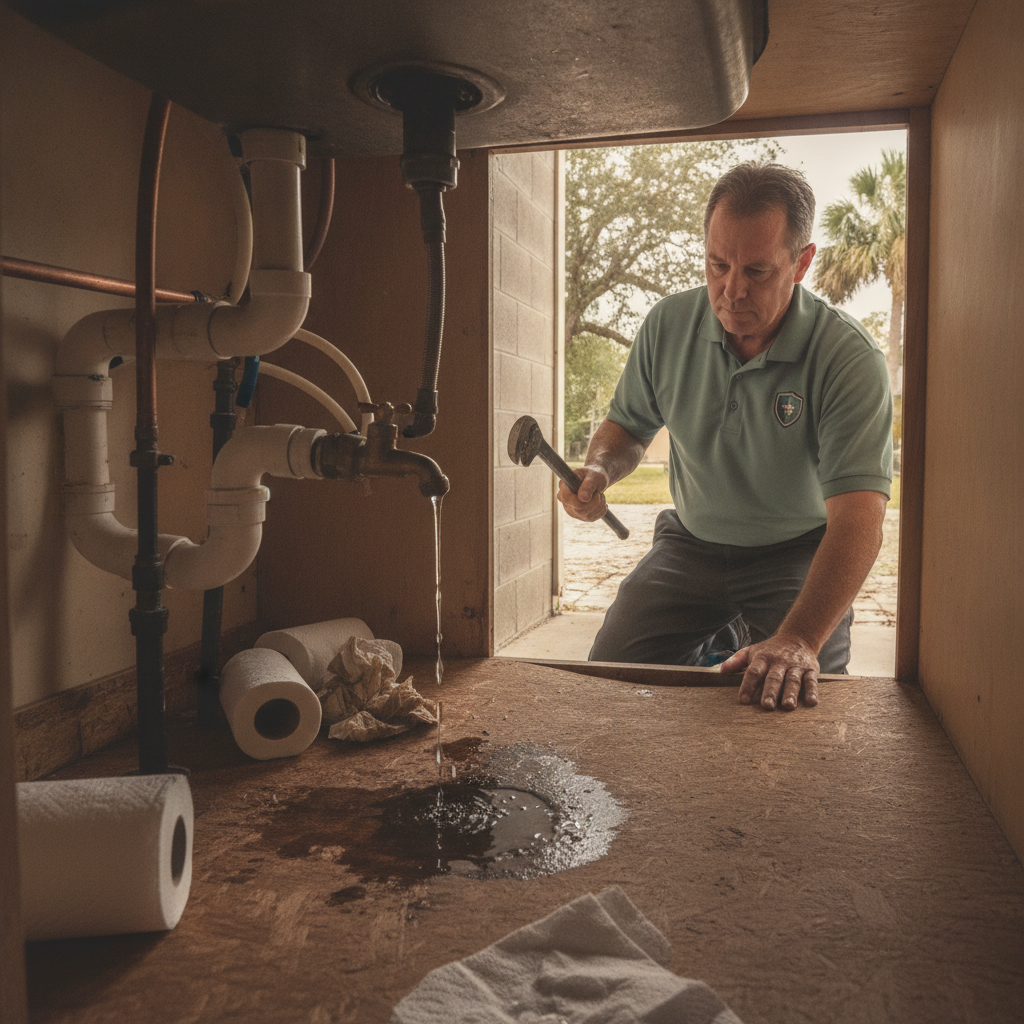
You reach under the kitchen sink to swap a faucet, turn the little chrome handle, and water beads at the stem. That is a leaking shutoff valve under sink, the angle stop on the hot or cold stub, and it will keep wetting the cabinet until the valve is replaced. In Seminole Heights and Hyde Park the stub is often old galvanized. In a 1990s Valrico kitchen it is copper with a multi-turn stop that has not moved since the house was built. Either way the drip hits particle board first. The floor swells, the door drags, and a humid Tampa week turns a small weep into a soft, sour cabinet.
Angle stop vs the house main
The angle stop is a local shutoff. It kills water to one faucet, one toilet, or the dishwasher branch. The house main kills everything. When the angle stop itself is the leak, turning that little handle does not help. You have to close the private shutoff on the side of the house. The City of Tampa Water Department puts it plainly: the fastest way to shut water off is that private valve, typically on the side of the home. Walk the steps in our emergency water shutoff guide before you keep twisting a valve that is already spraying.
| Angle stop under the sink | House main | |
|---|---|---|
| What it shuts off | Only that faucet, toilet, or dishwasher branch | Every fixture in the house |
| Where it sits | On the supply stub inside the cabinet | On the side of the house, or at the meter box as a last resort |
| When it helps | A faucet swap, a supply-line change, a dripping spout | A spraying angle stop, a burst line, a valve that will not close |
| How it usually fails | Packing weep, seized stem, cracked body, scored ferrule | A gate that will not seat, a handle that will not turn |
If you cannot find the private valve, the meter box at the curb is the next stop. Hillsborough County tells its customers the meter sits near the street in a plastic box, in a line with the main outside faucet. Closing at the meter is awkward, and it is easy to load the meter yoke the wrong way. Learn the private valve. Leave the meter for a licensed plumber.
A wet cabinet is not always the angle stop. If the puddle grows only when the sink drains, look at the trap and the dishwasher hose before you blame the stop. That is drain cleaning territory, or a loose slip-nut, not a new valve. If the puddle grows with the faucet off and the supply lines still wet, it is the valve, the compression nut, or the copper stub. A drip on the garage floor at the tank is a different part. That is water heater repair, not an under-sink stop.
St. Pete Beach and the Gulf cottages add salt air. Chrome handles pit, then the stem weeps even when the body still looks intact. In Land O’ Lakes, Odessa, and Thonotosassa, well water leaves a rusty crust on the same valve. Same part, different stain. A hall-bath toilet uses the same angle stop with a different fixture on top. If that valve will not close, the house main is still the only reliable kill switch.
Why a leaking shutoff valve under the sink weeps
Tampa Bay water is hard. This site’s own range is 11 to 17 grains per gallon across the metro. The City of Tampa’s 2025 water quality report put finished-water hardness at 211 mg/L, or 12.3 grains per gallon. That mineral load plates the stem, the seat, and the packing of a multi-turn valve that nobody turns for a decade.
A multi-turn stop uses a stem that travels up and down through packing. Leave it parked open and the rubber dries. Minerals glue the stem in place. The first turn of a faucet project shears that dried washer. Water then follows the stem and drips onto the cabinet floor. Snugging the packing nut can slow a small stem weep. It will not reseat a scored washer, and it will not close a cracked body. Lean on a seized handle and the stem can snap off in the bonnet. Then you have an open pipe under the sink, and the only move left is the house main.
Quarter-turn ball valves fail less often in this water because the seal is a ball and seats, not a long packing travel. They still leak at the inlet if the ferrule is scored or the solder joint was starved. They still leak at the outlet if the supply-line gasket is cooked. They are the usual replacement, not a magic part.
High pressure makes every weak seal worse. Florida’s plumbing code requires a pressure-reducing valve when static pressure inside the building exceeds 80 psi. Most Tampa Bay utilities deliver somewhere around 45 to 60 psi at the meter under normal use, so many older bungalows never got a PRV. A PRV is designed to remain open if the valve fails, which is a design rule, not a promise about any one installed valve. When one does fail open, street pressure comes inside. That shows up as a noisy water heater, banging pipes, and angle stops that weep at the packing. Swapping the under-sink valve and skipping the PRV treats the drip, not the cause. High water pressure in Tampa belongs on the same visit.
Galvanized supply in pre-1975 South Tampa, Hyde Park, and inner neighborhoods corrodes from the inside. The nipple that holds the angle stop can be a brown shell. You cannot thread a new valve onto metal that is already dust. That is when a local swap becomes a repipe conversation, the same talk that starts after clustered leaks in Seminole Heights. In Brandon and Valrico, late-1970s-to-mid-1990s subdivisions still hide polybutylene on some supply runs. A new chrome stop on brittle PB is a short pause, not a repair.
Hurricane season is when a lot of these valves finally move. Someone shuts water to a sink before a storm, and the handle that has not turned since 2014 crumbles. The leak starts on a September Saturday because that is when people finally touch the valve, not because the storm created it.
Do not park an angle stop half-closed to quiet a dripping faucet. That wears the seat. Fix the faucet. The valve is a shutoff, not a throttle.
What a replacement actually involves
A replacement is a short, wet job if the stub is sound copper and the house main holds. The plumber shuts the private valve, opens the faucet to drain the stub, backs off the supply line, and pulls the old stop. On a compression valve, the old ferrule often stays stuck on the copper. Forcing a new nut over a scored ferrule just leaks again, so the copper gets recut or the ferrule gets pulled. On a sweat valve, the old body is heated and lifted, and the new stop is soldered on. That is torch work inside a wood cabinet, next to cleaners and a garbage bag. It is licensed plumbing, not a Saturday experiment with a propane torch.
Threaded valves on galvanized need a backup wrench on the stub so the pipe in the wall does not spin. If the nipple unscrews into flakes, more of the wall supply has to come out. Pushing a new valve onto failing galvanized is how the next leak shows up in the same cabinet a month later.
The new stop is usually a quarter-turn with a new supply line. Old braided lines crease at the nut. Reusing them on a new valve is how the leak moves two inches to the left. When the plumbers we send are already doing faucet and fixture work, adding new shutoffs is published here as $50 to $100 per valve. A standalone call is a different shape. Access, the joint type, and whether the stub has to be rebuilt all move the number. A quote after the cabinet door is open is the honest path. If the wet spot cannot be traced to the valve, leak detection runs $250 to $450 and is applied toward the repair.
Florida’s building code puts repairing a leak in a pipe, valve, or fixture on the plumbing exemption list. The same sentence takes the job back out of that exemption once the valve is replaced rather than repaired. That is a boundary, not a prediction about any one building department. Confirm the permit question locally. The under-$7,500 permit exemption that took effect July 1, 2026, does not cover plumbing on a single-family dwelling. City of Tampa residential plumbing (general) is $120.00 plus the Florida Building Permit surcharge, stated as 2.5% of permit value or a $4.00 minimum. Unincorporated Hillsborough County residential plumbing (general) is $130.00. Those are permit line items, not the price of the valve job, and they apply when a permit is actually issued.
Confirm the plumber’s license on Florida’s DBPR search before the cabinet comes apart.
If the board is already swollen, pull the stored bottles, dry the cabinet, and get air moving. The EPA’s mold guidance is to dry water-damaged materials within 24 to 48 hours to help prevent growth. That is a prevention window, not a clock that guarantees mold at hour 49.
Common questions
How much does it cost to replace a shutoff valve under a kitchen sink?
When the plumbers we send are already replacing a faucet, new shutoffs add $50 to $100 per valve. Faucet and fixture labor on this site runs $150 to $300, plus the fixture, and the valve is the add-on in that package. A dedicated replacement is quoted from the joint you actually have. Compression on clean copper is the simple end. A sweat valve against a backsplash, or a galvanized nipple that crumbles, is the other end. The valve itself is a small part. The labor is the access, the drain-down, and the new joint that has to hold Tampa water.
What causes a shutoff valve to leak?
Hard water scale locks the stem. Dried packing and washers stop sealing. A scored compression ferrule leaks at the inlet. High pressure pushes water past a seal that was already tired. A cracked body weeps through the metal. Touching a valve that has sat for years is the usual trigger, not the original cause. A drip that only appears when the sink is in use is more often the trap or the dishwasher hose than the stop.
How long does an under-sink shutoff valve last?
There is no honest year-count that covers every Tampa Bay house. A multi-turn valve that never moves in hard water can look fine and then fail on the first turn. A quarter-turn that gets used when you service the faucet keeps its seals wet. Lifespan here is about mineral load, pressure, and whether anyone ever turns the handle, not a calendar date stamped on the chrome.
When to call us
If the angle stop is spraying, seized, or soaking the cabinet, the licensed plumbers we send shut the house main and replace it. Call on the same problem if the stub is galvanized or the handle spun off in your hand. Call us at (813) 590-0625.