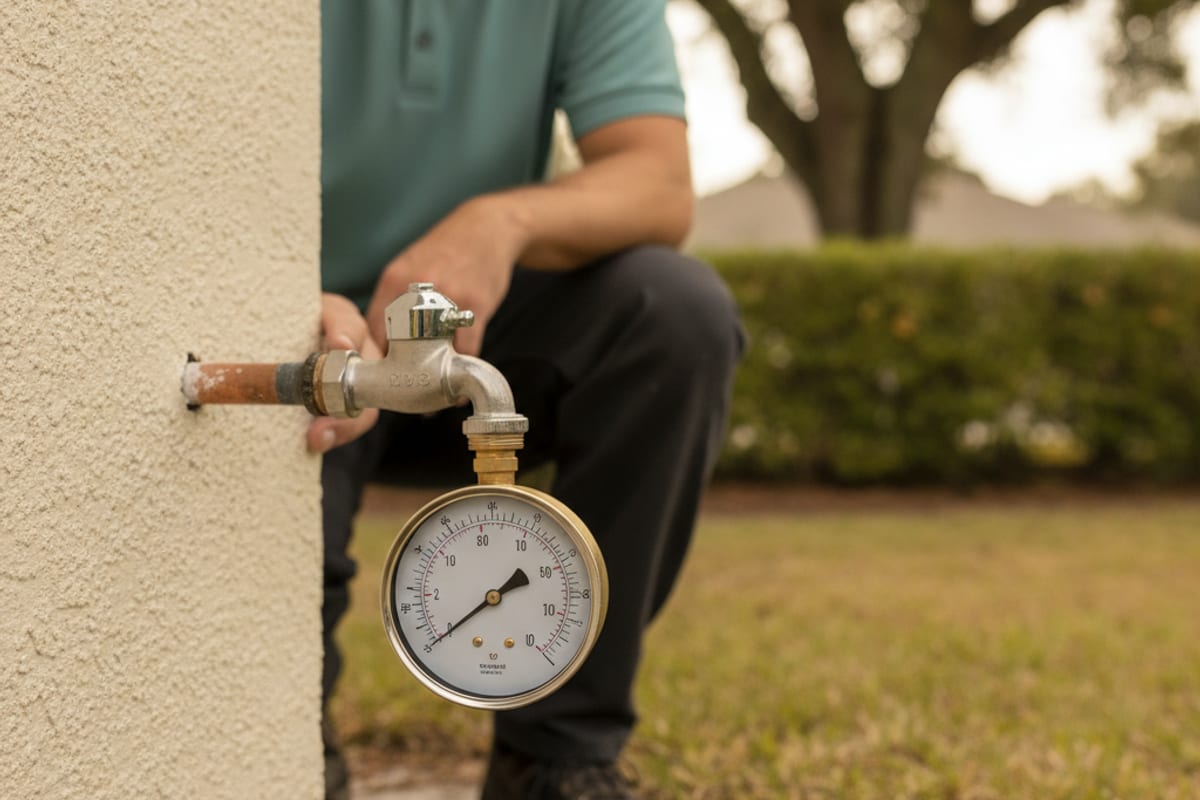
High water pressure in a house means static pressure above 80 psi inside the building. Florida’s plumbing code requires an approved pressure-reducing valve when pressure crosses that line. Test the indoor plumbing before blaming the utility or adjusting a valve. If your problem is weak flow instead, start with our low water pressure guide.
Most Tampa Bay utilities deliver somewhere around 45 to 60 psi at the meter under normal use. That’s a broad regional guide, not a reading for your address. A pressure gauge shows what your plumbing is experiencing today.
What counts as high water pressure in a house?
Static pressure above 80 psi inside the building crosses the Florida code threshold. Section 604.8 of the Florida Building Code, Plumbing requires an approved pressure-reducing valve, or PRV, to bring that pressure down to no more than 80 psi static.
Static pressure is the force in the pipes while nobody is using water. Flowing pressure is what remains after a faucet or fixture opens. A forceful shower can feel impressive without proving the static pressure is excessive.
The reverse can happen too. Corrosion can restrict an old pipe while static pressure stays high, so weak flow at the tap doesn’t rule out a pressure problem behind it. Older galvanized lines corrode inward and lose usable diameter. Our guide to galvanized pipe replacement costs explains that restriction pattern.
How do you test your water pressure?
A threaded pressure gauge connected downstream of the PRV gives the useful reading. Stop water use inside the house, then read the gauge under static conditions. A plumber may also observe the gauge while fixtures run to see how pressure changes under demand.
Test location matters because Florida’s code contains an exception. Sill cocks and outside hydrants don’t have to sit behind the reducing valve. A high reading at an exterior hose connection doesn’t automatically prove the indoor plumbing exceeds the code ceiling.
| Test point or condition | What the reading reveals | Why it matters |
|---|---|---|
| Indoor connection downstream of the PRV | Pressure reaching the building’s fixtures | This is the useful location for judging interior static pressure |
| Exterior sill cock or hydrant | Pressure that may bypass the PRV | The code expressly allows this arrangement |
| No water running | Static pressure inside the tested section | This is the condition addressed by the code ceiling |
| Fixture running | Pressure behavior under demand | A sharp change can point toward restriction or regulator trouble |
One measurement is helpful, but changing readings reveal more. Pressure can move as neighborhood demand changes. A plumber can leave a recording gauge in place when a brief test doesn’t capture the problem.
Diagnostic work that needs specialized testing or an opened wall typically runs $89 to $150. That fee is often credited toward the repair. Our leak detection service is the right starting point when pressure changes accompany unexplained water use or damp areas.
What does high water pressure actually break?
Excess pressure keeps extra force on every closed valve, seal, and connection. Toilet fill valves may hiss or cycle. Faucet cartridges can begin dripping. Appliance hoses and flexible supply connectors face the same added load.
High pressure can also turn a small weakness into a visible leak. That doesn’t mean pressure created every failure. Corroded pipe, a loose fitting, or movement under a slab may already be present. Pressure simply keeps pushing against the weak point.
A warm floor, unexplained water use, or moisture near a baseboard needs more than a PRV adjustment. Those symptoms can overlap with the signs of a slab leak. Find the leak before deciding which repair solves the whole problem.
Repeated leaks across older supply lines may point toward a system problem. The plumbers we send can compare isolated repair with a whole-home repipe after they inspect the pipe material and failure pattern.
Why doesn’t Florida cap pressure at the meter?
Florida’s distribution rule sets a minimum pressure at the customer’s connection, not a maximum. Rule 62-555.350(7) generally requires water suppliers to maintain at least 20 psi there. The rule carries exceptions for main breaks, equipment failures, and documented unusual conditions.
That rule doesn’t set a ceiling for pressure arriving at the connection. The 80 psi ceiling appears separately in the building code and applies inside the building. In practice, a house needs its own pressure control when interior static pressure exceeds that threshold.
The City of Tampa’s Water Pressure Issue page addresses low-pressure troubleshooting. It doesn’t provide a high-pressure figure or PRV guidance. Pinellas County’s Water FAQs also address low pressure without publishing high-pressure guidance.
That separation explains why a utility page may not answer the homeowner’s question. The distribution rule governs the supplier’s minimum. The building code governs excessive static pressure inside the house.
When does the code require a pressure-reducing valve?
A PRV is required when static pressure inside the building exceeds 80 psi. The valve must reduce that pressure to no more than 80 psi and conform to ASSE 1003 or CSA B356. Section 604.8 also calls for a strainer.
The exception matters. Service lines to sill cocks and outside hydrants can remain outside the reduced-pressure section. Main supply risers may also qualify where pressure is reduced to 80 psi or less at individual fixtures.
Section 604.8.1 requires the valve’s design to remain open and preserve water flow if the valve fails. That’s a design requirement, not a promise about how every aging valve will behave. A pressure test still has to show what the installed valve is doing.
A PRV that isn’t reducing pressure can send full street pressure into the indoor system. Banging pipes, a suddenly noisy water heater, or a pressure spike can follow. A valve stuck in the other direction may produce low pressure instead.
The plumbers we send can test the pressure, inspect the regulator, and identify whether adjustment or replacement fits the condition. The related permit and expansion details are covered in our Tampa water heater permit guide.
Why do banging pipes show up with high pressure?
Banging begins when moving water stops abruptly and sends a pressure wave through the pipe. Higher starting pressure can make that event harder on connections and pipe supports. A loose pipe can make the sound more noticeable.
Florida Plumbing Code Section 604.9 requires a water-hammer arrestor where quick-closing valves are used. The arrestor must conform to ASSE 1010. It cushions the pressure wave near the quick-closing valve.
An arrestor isn’t a substitute for correcting excessive static pressure. A plumber should separate three possible issues: high pressure, a quick-closing valve, and unsupported piping. More than one can exist at once.
What happens to a storage water heater after a PRV goes in?
A PRV can create a closed section where heated water can’t expand backward toward the supply. As water warms inside a storage tank, its volume increases. That added volume needs somewhere to go.
Section 607.3 requires thermal expansion control when a storage water heater’s cold supply passes through a PRV, check valve, or backflow preventer. The expansion device belongs downstream of those valves. This requirement is written for storage water heaters, not tankless units.
A dripping temperature and pressure relief valve can be a symptom of pressure or thermal expansion. It can also have another cause. Don’t assume the relief valve itself is the whole problem.
Our guide to a leaking water heater helps separate water from the tank, fittings, drain valve, and relief discharge. For diagnosis or repair, we can match you with a local pro through our water heater repair service.
What are the signs of high water pressure in a house?
The strongest sign is a gauge reading above 80 psi inside the building. Sounds and leaks support the diagnosis, but they don’t replace that measurement.
Common clues include banging after a valve closes, a newly noisy storage water heater, recurring faucet drips, and toilet fill valves that cycle without being used. A sudden change after years of steady pressure can point toward a PRV that’s no longer regulating correctly.
Several symptoms overlap with other plumbing faults. A worn toilet component can cycle at normal pressure. A loose pipe can bang without excessive static pressure. Galvanized buildup can weaken flow while the system remains highly pressurized.
That’s why the diagnosis begins at the gauge. The same test settles it whether you’re in South Tampa or Clearwater: read the static pressure reaching the indoor fixtures, then work back from that number.
What does water pressure regulator replacement cost in Tampa Bay?
A water pressure regulator replacement cost depends on access and the surrounding plumbing. Valve size and location affect the work. Corroded connections, a damaged shutoff, or cramped placement can add repair steps.
The system may also need thermal expansion control for a storage water heater. That changes the scope beyond simply exchanging one valve. A pressure test should define the problem before anyone prices the repair.
A typical diagnostic visit requiring specialized testing or wall access runs $89 to $150 and is often credited toward the job. When a broader look needs a camera inspection plus a pressure test, that runs $250 to $500.
The PRV replacement cost itself needs a job-specific quote. A useful quote should identify the valve work, related pipe repairs, and any thermal expansion work separately. That lets you compare the same scope instead of comparing totals built around different repairs.
How do you reduce water pressure in a house?
An operating PRV reduces pressure before water reaches the indoor distribution piping. If the house already has one, the first step is measuring pressure on both sides and checking how it responds under flow.
Adjustment may correct a working valve that’s set too high. Replacement makes more sense when the valve won’t hold the intended pressure or its condition prevents reliable adjustment. The plumbers we send make that call after testing the installed system.
Most advice on how to reduce water pressure in a house points straight at the adjustment screw. Turning it without a gauge leaves you guessing. It can also hide a failing regulator or create low pressure without resolving the underlying fault.
Frequently asked questions
Is 80 psi too high for a Tampa Bay house?
Pressure above 80 psi static inside the building crosses Florida’s code threshold. The code calls for an approved PRV to reduce it to no more than 80 psi before it reaches indoor fixtures.
What is normal water pressure for a house?
Most Tampa Bay utilities deliver somewhere around 45 to 60 psi at the meter under normal use. Your address may differ, so an indoor static-pressure test gives the answer for your house.
Can an outside hose connection read higher than the house?
Yes. Florida’s code allows sill cocks and outside hydrants to sit outside the reduced-pressure section. A high hose connection reading alone doesn’t establish excessive pressure at indoor fixtures.
Can high pressure make a water heater relief valve drip?
High pressure or trapped thermal expansion can contribute to relief-valve discharge. The tank, valve, and expansion control need inspection because replacing the dripping valve alone may not address the cause.
Does every banging pipe need a new pressure regulator?
No. Banging can involve high pressure, a quick-closing valve, loose piping, or several conditions together. A pressure reading and inspection should identify the cause before a plumber replaces the regulator.
How much does a PRV replacement cost?
The price depends on access, valve placement, pipe condition, and related thermal expansion work. Get a written quote after pressure testing so the regulator and any connected repairs are priced separately.
When to call us
Call when indoor static pressure exceeds 80 psi, leaks begin repeating, or the regulator won’t hold steady pressure. We’ll match you with a licensed local plumber who can test the system and quote the right repair. Call us at (813) 590-0625.