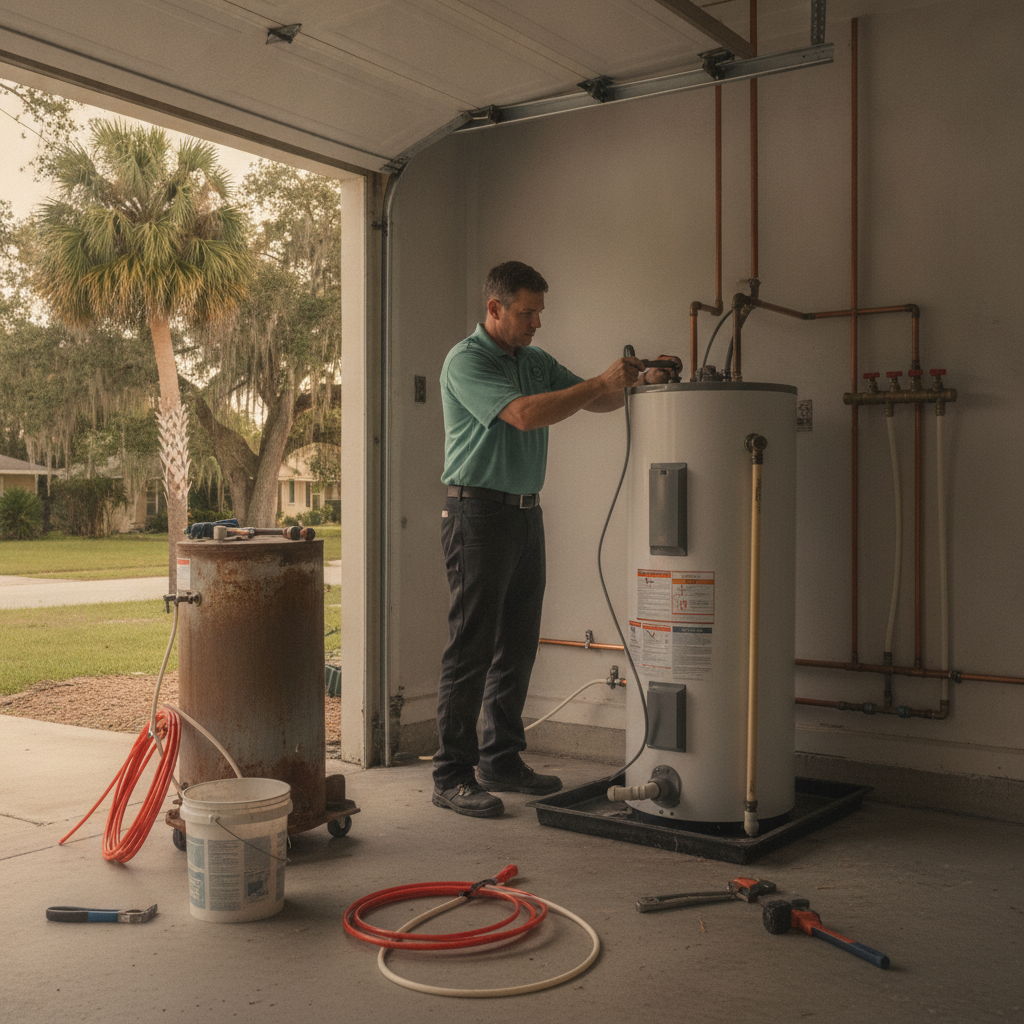
A new faucet on the counter is only the visible half of plumbing fixture installation. The rest is shutoffs, supply lines, and drain gaskets. Hidden parts scale up in Tampa Bay’s hard water. The plumbers we send set the fixture so it seals and sits level. It should not drip into a cabinet or onto a slab. Labor for a typical faucet or fixture install is $150 to $300, plus the cost of the fixture. A stuck shutoff or a tired supply line adds $50 to $100 per valve.
What plumbing fixture installation includes in a Tampa Bay house
The job is connecting a faucet, toilet, sink, hose bib, or shower trim to supply and drain so it holds water. Looks come last. First comes whether the new piece matches the holes in the sink or the valve in the wall.
A kitchen faucet makes the point. A single-handle body will not cover a three-hole spread without a deck plate. A widespread set will not sit on one hole. The same rule hits a Hyde Park lavatory and a 1990s Brandon spec bath. Match the deck, then match the stops.
Tampa Bay water runs 11 to 17 grains per gallon. That hardness crusts aerators, cartridges, and the cheap plastic inside a bargain faucet. Ceramic disc cartridges hold up better in that water than rubber washers. A faucet that still drips after a fresh cartridge usually has scale packed in the valve. That is the same mineral load that works on a water heater sitting on city water.
Toilets are a different joint. The bowl seals to the closet flange with a wax ring that is single-use. The china has to sit on a floor that does not flex. In a 1950s Seminole Heights bath, that flange often lands on a cast-iron stack. In a slab-on-grade Valrico house, it is often PVC set in the slab. A rocking bowl will break the new seal in weeks. That is toilet installation, not a box from the store dropped on the old ring.
Outdoor spigots pick up a third problem. Salt air along St. Pete Beach and South Tampa eats the hose bib and the nipple in the wall. Corrosion-resistant brass is the usual swap when the threads still hold. Those exterior fittings run $150 to $450 per fixture, depending on access and any related pipe repair. Florida’s residential code also wants a vacuum breaker on a hose connection. A garden hose left in a bucket, a pool, or a chemical sprayer can pull that water back into the house.
Under the sink, the P-trap is part of the install even when nobody ordered a drain job. A new lavatory with the old trap sitting off-center weeps at the slip joints. Toothpaste and hair packed in that trap is drain cleaning, not a finish swap.
The faucet and fixture work the plumbers we send do is this whole path. Shut off. Open. Clean. Set. Connect. Test. The chrome you see is the last ten minutes.
When a swap is a plumbing job, not a finish job
A finish swap lands on plumbing that is already sound. A plumbing job starts the moment that plumbing is not.
The tell is almost always access. If the angle stops under a Carrollwood vanity turn by hand, and the supply lines are braided stainless in good shape, a faucet change stays a faucet change. Frozen stops change the visit. So do galvanized nipples that have gone thin. So does the gray polybutylene that showed up in late-1970s-to-mid-1990s East Hillsborough subdivisions around Brandon and Seffner. Patching one galvanized leak in Seminole Heights usually means the next one is a few months out. That is when a whole-home repipe is the honest conversation, not another chrome set.
Shower trim versus shower valve is the other split people miss. Handles, an escutcheon, and a tub spout can come off an existing valve body. The valve in the wall is a different job. Florida’s residential code wants shower and tub/shower valves that are balanced-pressure, thermostatic, or both, installed at the point of use, and field-set so the water cannot be cranked past 120°F. An in-line thermostatic valve in the attic does not satisfy that rule. Once tile has to come down to reach the body, you are in shower valve replacement, not a weekend trim kit.
Toilets cross the line when the closet flange is cracked, rusted, or sitting below the finished floor. Tightening the bowl onto a bad flange just cracks the china. Soft subfloor around an old bungalow toilet is a carpentry problem hiding under a plumbing one.
Hose bibs cross it when the pipe in the wall crumbles as the old sillcock comes off. That is no longer a hose bib swap. It is a pipe repair, then a fixture.
High street pressure pushes the same way. Florida’s plumbing code requires a pressure-reducing valve when static pressure inside the building exceeds 80 psi. Hose bibs and outside hydrants can sit outside that reducer. A new indoor faucet on a house with no reducer, or with a reducer that has failed open, will hammer and dump water past the new seats. The fixture is not the defect.
| Fixture | Stays a finish swap when | Becomes a plumbing job when |
|---|---|---|
| Faucet | Hole pattern matches and the shutoffs turn | Stops are frozen, holes do not match, or the supply pipe is failing |
| Toilet | Flange is solid and the floor is quiet | Flange is rotten, offset, or the subfloor moves |
| Shower | Trim only, on a working valve body | The valve in the wall has to come out |
| Hose bib | Threads in the wall are sound | The nipple or the pipe behind it is gone |
Permits, shutoffs, and the supply-line mistakes
The permit question is a boundary, not a prediction about any one building department. Florida’s building code exempts clearing stoppages and repairing leaks in pipes, valves, or fixtures, and the removal and reinstallation of a water closet, as long as that work does not replace or rearrange valves, pipes, or fixtures. Repairing a dripping valve can sit inside that exemption. Replacing the valve, moving the faucet, or roughing a new toilet location is the proviso that takes the job back out. From there, the local building department is the one that says what paperwork that replacement needs. The water heater permit page walks the same line for heater work.
A July 2026 state law waived building permits on some single-family work valued under $7,500. Plumbing is named in the carve-out, so that waiver never covered a fixture rough-in or a repipe. In the City of Tampa, the residential plumbing (general) trade permit line is $120.00, plus the Florida Building Permit Surcharge of 2.5 percent of permit value or a $4.00 minimum. Unincorporated Hillsborough County publishes $130.00 for residential plumbing (general). Other cities and counties set their own fees.
Shutoffs are the step that turns a calm swap into a wet ceiling. The fastest way to kill the water is the private shutoff on the side of the house, the same advice the City of Tampa gives its customers. Fixture stops under the sink are better when they actually work. Many older Tampa stops do not. Forcing a seized valve is how a supply line lets go inside the cabinet. The walk-through for finding those valves is on how to shut off the water.
Supply-line mistakes are small and expensive. Old chrome-plated or plastic risers get reused because they still look fine. They are the part that bursts at 2 a.m. Braided stainless is the usual replacement, and it should be new whenever the fixture is new. Overtightening a faucet nut cracks a porcelain deck. Undertightening a drain flange weeps into the cabinet and swells the particle board. Thread seal tape belongs on male pipe threads, wrapped with the thread. It does not belong on compression nuts, and it is not a substitute for a gasket.
Plumber’s putty still has a job. It beds some faucet bases and drain flanges on porcelain. It does not belong on natural stone, where the oil can stain, and it is not a thread sealant. Silicone is the better bed on a granite or quartz sink. The manufacturer’s sheet for that fixture wins if the two disagree.
A dripping faucet left for later is not a small leak on this water. The City of Tampa puts a one-drop-per-second faucet at 7 gallons a day, more than 2,500 gallons a year. Hard water makes that drip leave a trail of scale on the way down.
Confirm the plumber is licensed on the state licensee search before anyone opens a wall. Choosing a licensed plumber in Tampa is the longer version of that check.
How much does it cost to install plumbing fixtures in Tampa Bay?
Labor for a faucet or fixture install is $150 to $300, plus whatever the fixture itself costs. Replacing supply lines or shutoff valves adds $50 to $100 per valve. Outdoor brass fittings in salt air run $150 to $450 per fixture when access is the driver. A shower valve in the wall is a different job, quoted after the pro sees the tile and the valve body. The fixture on the truck, the hole pattern, and the condition of the stops are what move the number.
Should I use plumber’s putty when installing a faucet?
Putty is for bedding a faucet base or a drain flange on a porcelain or stainless sink, where it stays flexible and makes a water ring. Skip it on granite, marble, and quartz, because the oil can stain the stone. Skip it on plastic parts that the maker says will degrade. Do not wrap it on threads. Threads get tape or pipe dope. If the spec sheet calls for a gasket and silicone only, use that.
How do bathroom fixtures get installed without soaking the room?
Water comes off at the stops or at the house shutoff. The old fixture comes off. The deck or flange gets cleaned down to a surface that will seal. The new piece is set to the maker’s hole pattern and torque. A toilet always gets a new wax ring. A faucet always gets lines that match the new shanks. The test is both supplies on, both handles cycled, and the cabinet dry after the basin is filled and drained. If the stops will not turn, or the flange is junk, that is the moment it stops being a finish install.
When to call us
Call when a faucet, toilet, hose bib, or shower trim is leaking, mismatched to the holes, or sitting on shutoffs and supply lines that will not hold. That is licensed plumber work, and it is the work the plumbers we send do. Call us at (813) 590-0625.