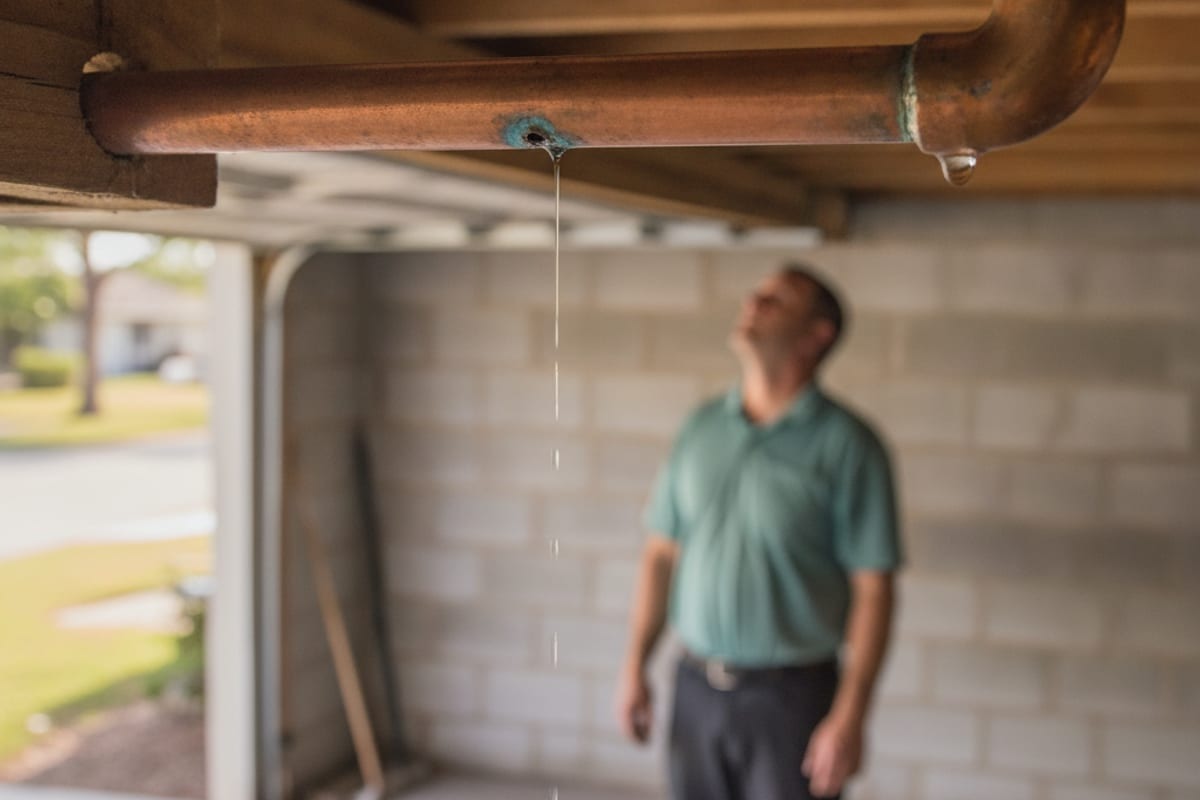
One pinhole leak in copper pipe doesn’t automatically mean a whole-home repipe. An isolated, accessible spot may only need a section repair. Recurring leaks or visible pitting elsewhere make repiping the stronger long-term option. The deciding factor is the surrounding copper, not the size of today’s wet spot.
Does one copper pinhole mean you need a repipe?
One pinhole can be a local failure rather than a system-wide problem. The plumber needs to examine the exposed pipe and nearby joints before recommending either path.
The same decision appears on our Lutz plumbing page. One pinhole doesn’t necessarily mean the entire copper system is failing. More than one leak or visible pitting makes a full repipe the smarter conversation.
| What the plumber finds | Section repair may fit | A repipe conversation makes sense |
|---|---|---|
| Leak pattern | One isolated opening appears in accessible pipe. | Leaks have appeared in more than one location. |
| Nearby copper | The surrounding section shows no visible pitting. | Pitting or corrosion appears beyond the leaking point. |
| Repair history | This is the first known failure in the system. | Previous sections have already needed repair. |
| Leak location | The damaged line can be opened and examined directly. | Multiple concealed runs show signs of failure. |
A section repair stops the current opening. It doesn’t establish the condition of every other copper line. That distinction matters when you compare a focused repair with whole-home repiping.
What causes a pinhole leak in copper pipe?
Localized pitting creates a pinhole by thinning one small area of copper. General corrosion spreads across a broader surface. Pitting concentrates the damage until water finds a path through the pipe wall.
It usually starts as a damp bead you’d miss in a dark corner. Pressure turns that bead into a steady drip, then a fine spray. The copper right beside it can still look perfectly fine from the outside.
Replacing the damaged section takes out the piece that failed. It doesn’t undo pitting anywhere else. That’s why the plumbers we send look past the visible hole before anyone closes the wall or ceiling back up.
One pinhole also won’t tell you whether Tampa Bay’s water is to blame. Utility numbers describe a water system and a set of sampled taps. They can’t reconstruct what happened inside one particular pipe in one particular house.
Shut it off, clamp it, then decide section versus repipe
Shut the water off at the fixture or the main before anyone talks about a repair. Here’s how to shut off the water in an emergency if you haven’t found the valve.
A temporary clamp or push-fit coupling can hold an accessible pinhole until a plumber can see the pipe. That stop is not the repair. It buys time.
From there the ladder is the same one in the table above: an isolated, accessible section can be cut out and replaced. Repeat leaks or visible pitting move the conversation to a whole-home repipe. Do not treat a clamp as a long-term fix on Tampa Bay copper.
Is the problem Tampa Bay water or the home’s copper?
Local water reports can’t identify the cause of one home’s pinhole. They do show how Tampa and Pinellas manage corrosion and what appeared at sampled household taps.
The City of Tampa’s 2025 Water Quality Report says lime and caustic soda adjust pH and help prevent pipe corrosion. Tampa’s finished water averaged a pH of 7.88 during 2025. Average hardness was 211 mg/L, or 12.3 grains per gallon.
Tampa also reported copper results from taps inside sampled homes. The 90th-percentile result was 0.287 ppm from January through June. It was 0.253 ppm from July through December. No sampled site exceeded the 1.3 ppm action level during either window.
Those household results varied considerably. The first window ranged from 0.005 to 0.838 ppm. The second ranged from not detected to 1.12 ppm. Tampa’s table lists corrosion of household plumbing among the likely copper sources.
The Pinellas County Utilities 2024 Consumer Confidence Report describes a different corrosion-control process. Pinellas adds a polyphosphate inhibitor designed to form a protective layer inside piping. FDEP has designated the utility’s treatment as optimized for copper and lead corrosion control.
Pinellas reported a 0.3 ppm copper result at the 90th percentile. No sampled site exceeded the 1.3 ppm action level. That copper data came from 2023, and the report notes that it is more than one year old.
The optimized designation applies to the utility’s treatment program. It isn’t a promise about the copper inside an individual Pinellas home.
What does a tap-water copper result actually tell you?
A tap-water result measures dissolved copper at sampled household taps. It doesn’t measure pit depth, remaining pipe thickness, or future pinhole risk.
These samples aren’t measurements of water leaving the treatment plant. They include copper that may dissolve from a home’s plumbing and fixtures. That makes them useful for water-quality monitoring, but not for mapping physical damage inside a pipe.
Pitting is localized. A small area can cut deeply through the wall while the broader pipe releases little dissolved copper. A low tap result therefore doesn’t rule out a developing pinhole.
The reverse conclusion also doesn’t work. A dissolved copper result doesn’t prove that a pipe has pitted. The physical condition, leak history, and surrounding copper guide the repair decision.
What signs make repiping worth discussing?
Recurring failures and visible pitting make a repipe discussion reasonable. The pattern matters more than the diameter of one opening.
- Leaks appearing in different sections show that the problem isn’t confined to one repair point.
- Visible pitting beyond the wet area means the damaged section may extend past the hole.
- Corrosion at exposed pipe joints gives the plumber another physical sign to evaluate.
- Previous section repairs can reveal a system that is failing in separate locations.
One leak can still stay one repair. Multiple pinholes change the risk of opening another wall soon after the first repair.
Water emerging through a floor or slab follows a different diagnostic path. Review the signs of an under-slab leak instead of treating it like exposed copper. The pros handling slab leak repair may need to locate the failed run before discussing access.
What does copper pinhole repair involve?
An accessible pinhole starts with exposing the line and looking at it properly. The plumber we send cuts out the failed section, checks the copper on either side of it, and puts the line back together.
Access changes the work. Tampa Bay homes sit on slab, so the easy finds are the exposed runs in a garage wall, a utility room, or an attic. Pipe hidden above finished drywall costs more to reach, and a longer concealed run means more material to open and restore.
When the source isn’t visible, professional leak detection runs $250 to $450 and is applied toward repair. The pinhole repair itself still needs a quote based on access, damaged length, and the condition of the pipe around it.
A standard single-story whole-home repipe runs $4,000 to $10,000. That isn’t the price of fixing one pinhole. It’s the number to compare against when leaks keep coming back or pitting shows up in several places.
Material and routing also change a full-repipe decision. Our PEX versus copper repipe guide explains those tradeoffs without treating one wet spot as proof that every line needs replacement.
Frequently asked questions
Can a plumber repair one copper pinhole without repiping?
Yes, an isolated and accessible pinhole may only require section replacement. The plumber we send will inspect the nearby copper before deciding where sound pipe begins.
Does one pinhole mean the whole copper system is failing?
No, one pinhole doesn’t establish system-wide failure. Recurring leaks or visible pitting in multiple areas provide stronger reasons to discuss repiping.
How much does copper pinhole repair cost in Tampa Bay?
The quote depends on access, damaged length, and the condition of the pipe around it. A visible line and a concealed line need very different amounts of opening and restoration. Leak detection runs $250 to $450 when the source has to be located first.
Can a low copper test rule out pipe pitting?
No, dissolved copper and localized pitting measure different conditions. A low tap result doesn’t show how much wall thickness remains at one small point.
What should I do while the copper pipe is leaking?
Close the home’s main water shutoff so pressure stops feeding the opening. Here’s how to shut off the water in an emergency if you’ve never found the valve. Put a container under the pipe if the drip can be caught without opening a wall.
What if the leak is beneath the concrete slab?
An under-slab leak needs a separate location and access decision. Our guide to under-slab plumbing failure in Tampa explains the repair paths without confusing them with an exposed copper pinhole.
When to call us
Call when an active pinhole needs isolation or repeat leaks suggest broader pipe trouble. We’ll match you with a licensed local plumber who can inspect the copper and explain the available repair paths. Call us at (813) 590-0625.