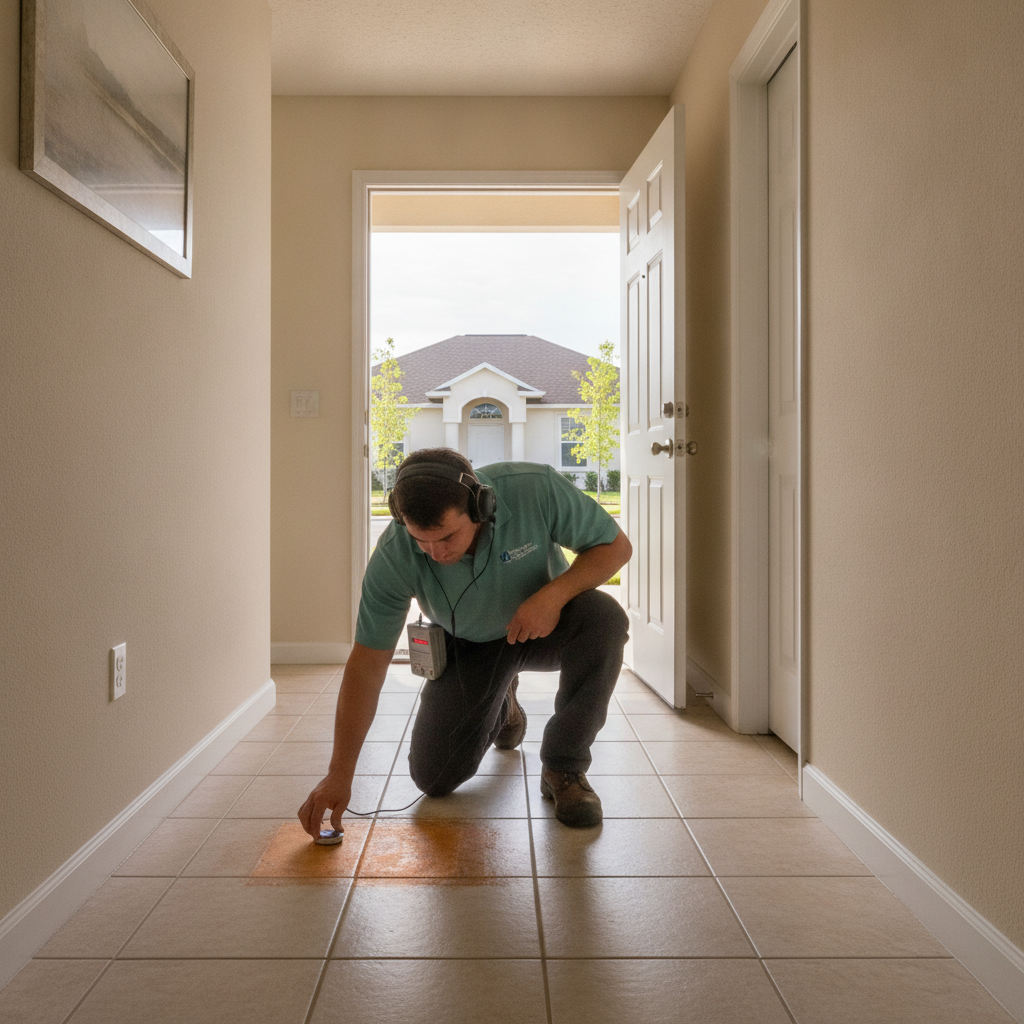
Most people who type plumber riverview fl into a search bar have water in the wrong place. A warm stripe across hallway tile in a 1998 ranch. A hiss under the slab after the dishwasher runs. A gray plastic supply line that split at a fitting in the garage. Riverview sits on the East Hillsborough slab-on-grade belt, so plumbing in Riverview is usually slab leaks and aging polybutylene, not a Pasco well or a South Shore surge lot.
What a plumber in Riverview FL is usually fixing
The housing here is 1980s-to-2000s subdivision stock poured on a concrete slab. Supply and drain lines went into that slab, or into the fill under it, when the house was built. There is no crawlspace and no 1950s cast iron stack like you’d find in Seminole Heights or Hyde Park. On most of these streets the lot is on municipal water and sewer. The plumber is working inside a ranch, a two-story HOA plan, or a 2000s tract home, not a well house.
That changes the call. Low pressure at the hall bath, a meter that still turns with every fixture off, a soft spot in the grout, a water heater closet that smells damp: those are the Riverview jobs. Hard water in this metro runs 11 to 17 grains per gallon, and Riverview sits in that band, so scale also shows up on valves and in tanks. Scale is a nuisance. The floor that is warm in August is the emergency.
Older streets closer to the Alafia mix late-1970s-to-mid-1990s plumbing with later additions. Newer HOA tracts from the 2000s often skipped polybutylene entirely. They still sit on a slab. A supply nick, a failed coupling, or a drain joint under the house still presents as a slab leak. The surface looks like tile and carpet. The pipe is in the concrete.
The plumbers we send are licensed and insured. Florida publishes contractor licenses through the state licensee search, which is how you confirm the person at the door holds a plumbing license. We match you with that pro. We do not pour the slab or own the truck.
Water heaters, toilets, and a slow kitchen sink still fail here, same as anywhere in Hillsborough. If that is the whole job, it stays a fixture or a drain call. If the same house also has a warm hallway and a climbing bill, start under the floor. That is the East Hillsborough pattern.
Slab-on-grade leaks in 1990s and 2000s subdivisions
A slab leak is a pressurized supply line (sometimes a drain) failing in or under the concrete. Water follows the trench the pipe was laid in. It can travel a long way before it shows. On a Riverview ranch that often means a discolored grout line in the hall, a baseboard that feels cool and wet, or a room that stays humid with the AC running.
The house tells on itself if you listen. With every tap closed you can still hear water moving. The hot side is the usual giveaway: a warm patch on tile that does not match the air vent. The cold side is quieter and often shows up first on the bill. Hillsborough County tells its utility customers to watch the meter with all water off; if the register still moves, something is using water. That test does not say where. Under a slab, location is the whole job.
Detection is acoustic listening, thermal scanning, and sometimes a camera once a line is opened. The site’s published leak detection range is $250 to $450, applied toward the repair. That is the diagnostic visit, not the cost of opening concrete. What moves the repair itself is access: a line under a tiled hall costs more labor than a line that can be abandoned in the slab and rerouted through a wall or the attic.
Spot repair makes sense when the failure is one coupling, one pinhole, one short run you can isolate. A 2000s HOA street with PEX or copper in good shape can take a targeted fix. A 1992 house with original piping in the slab is a different conversation. One break in a long buried run is often the first break, not the last. The signs of a Florida slab leak are the same physics on every East Hillsborough floor. Riverview just has a lot of those floors, because almost every house from this boom was poured on grade.
Do not jackhammer a hallway to find it. The plumber locates the line, then chooses a break in the slab, a reroute, or a larger repipe if the rest of the system is the same age and material.
Polybutylene supply lines on the East Hillsborough belt
Polybutylene is the gray flexible plastic supply pipe used from the late 1970s into the mid-1990s. East Hillsborough is the polybutylene and slab-on-grade belt: Brandon, Valrico, Seffner, FishHawk’s older edge, and the Riverview streets that went in during those years. You will see it in a garage, a water heater closet, an attic run, or coming up through the slab at a bath group.
It fails in two ways. Fittings (often acetal plastic, sometimes metal) crack and weep. The pipe wall itself becomes brittle with age and with chlorine in municipal water, then splits along a score or a bend. A drip at one fitting is not a one-off part. The same material is in the walls. Patch the visible leak and the next one shows up a few months later, usually in a worse place.
Riverview is not one poly-b neighborhood. Brandon’s older core still carries more of that late-1970s-to-mid-1990s stock, which is why common plumbing problems in Brandon lean so hard on poly-b and slab work. Riverview added a lot of 2000s HOA product after polybutylene had already left the market. Walk a 2004 street and you may never see gray pipe. Walk a 1991 street toward the Alafia and you might see it at every hose bib and under every sink.
Identifying it is visual. Gray plastic, often with a stamp that includes PB. It is not the white or beige PEX used later, and it is not copper. If you are not sure, the plumber is. Polybutylene in Tampa Bay is the same product across the metro. The local twist is how much of Riverview never had it, sitting next to pockets that still do.
A single fitting swap is a stopgap on an occupied house. A whole-house replacement of that supply system is the lasting move, because every remaining run is the same age. The plumbers we send repipe those houses. We do not.
How Riverview differs from Brandon and from South Shore flood lots
Search results treat “plumbing riverview fl” like a generic Tampa suburb. The pipes disagree. Brandon, Riverview, and the South Shore towns share a county and almost nothing else under the floor.
| | Riverview | Brandon | South Shore (Apollo Beach, Ruskin) | | Housing | 1980s to 2000s slab subdivisions: older Alafia-side streets plus newer HOA tracts | Older East Hillsborough core, denser late-1970s to mid-1990s polybutylene | Newer construction on low ground, storm-surge and flood exposure | | What actually fails | Slab supply leaks, poly-b on the older streets, scale from hard water | Poly-b fittings and slab leaks on a tighter older grid | Floodwater at fixtures and outdoor piping, not the poly-b belt | | Water service | Municipal water and sewer on most subdivision lots | Municipal water and sewer | Municipal service on flood-prone lots | | What this is not | Not Pasco well-and-septic country | Not 1920s Tampa cast iron | Not a Gulf-beach salt-air problem |
Brandon concrete slab leak repair is the sibling job, not the same street. Brandon’s poly-b core is older and thicker. Riverview’s 2000s HOA streets often skipped that pipe and still leak under the slab because the house was poured on grade. A plumber riverview florida search that lands on a Brandon page will talk past the newer tracts.
South Shore is the other mix-up. Apollo Beach and Ruskin sit lower, closer to the bay, with surge and standing water after a Gulf storm. The National Weather Service Tampa Bay office is the right place for that flood and hurricane picture. Riverview is inland East Hillsborough. The August storm still saturates yards. It does not make this the surge belt. A sump conversation that belongs on a South Shore lot is the wrong diagnosis for a warm hallway in a 1999 Riverview ranch.
Pasco is the third miss. Land O’ Lakes, Odessa, and Wesley Chapel are where wells and septic actually live. Riverview’s subdivision grid is municipal. If a rural pocket on the far edge of the community is on a well, that is the exception, and the plumber treats it as well work. Do not assume every Riverview lot is that exception.
When a spot repair is not enough
One leak is a repair when the rest of the system is a different material and a different age. One leak is a warning when the house still has original polybutylene, or when a second warm spot appears on the same slab.
Polybutylene fails in clusters. Galvanized in inner Tampa does the same thing, for a different reason. Here the cluster is gray pipe and original fittings. Copper in some 1990s houses starts pitting in the same decade of life. One pinhole does not force a full repipe. Recurring leaks in more than one spot usually does. The licensed plumber traces the material, not just the wet tile.
Rerouting a single hot line through an attic can spare a tiled hall. It does not spare you if the cold lines, the manifold, and the other baths are the same pipe. At that point the honest job is a whole-home repipe, then abandoning the bad run in the slab. Florida did not fold plumbing into the under-$7,500 permit shortcut that took effect July 1, 2026. Plumbing on a single-family house is carved out of that exemption, so a repipe still goes through the building department. Unincorporated Hillsborough County’s published residential plumbing (general) trade permit is $130.00, due at submission, plus the state’s building-permit surcharge. That is the permit line, not the cost of the job.
If the failure is under the slab and the rest of the piping is sound, stay with a targeted slab leak repair. If the camera or the listening gear keeps finding the next leak, stop paying for openings and replace the system.
Do 1990s Riverview homes still have polybutylene?
Many of them do, especially on streets built from the late 1970s through the mid-1990s. Gray flexible supply pipe in a garage, attic, or water heater closet is the tell. Newer 2000s HOA streets in the same city often used later materials and never had polybutylene. The plumber confirms by looking at the pipe, not the year on the tax record.
How do I know the floor problem is a slab leak?
A warm or discolored patch on tile, a meter that moves with every fixture off, and the sound of water in the slab with the house quiet are the usual trio. A high bill without a visible drip points the same way. Those signs locate the problem in the slab. They do not tell you whether a spot repair will hold. That takes leak detection on site.
How do I check that a plumber is licensed in Florida?
Search the contractor on Florida’s DBPR licensee lookup before anyone opens a floor. The plumbers we send are licensed and insured. The brand that answers this line is a matchmaker, not the licensee. A license number on a truck you cannot find in the state database is not a license.
When to call us
Call when the floor is warm, the meter is moving, or you can see gray polybutylene weeping at a fitting. Opening a slab, replacing a supply system, and locating a leak under concrete are licensed plumber jobs. We match Riverview homeowners with those licensed local plumbers. Call us at (813) 590-0625.