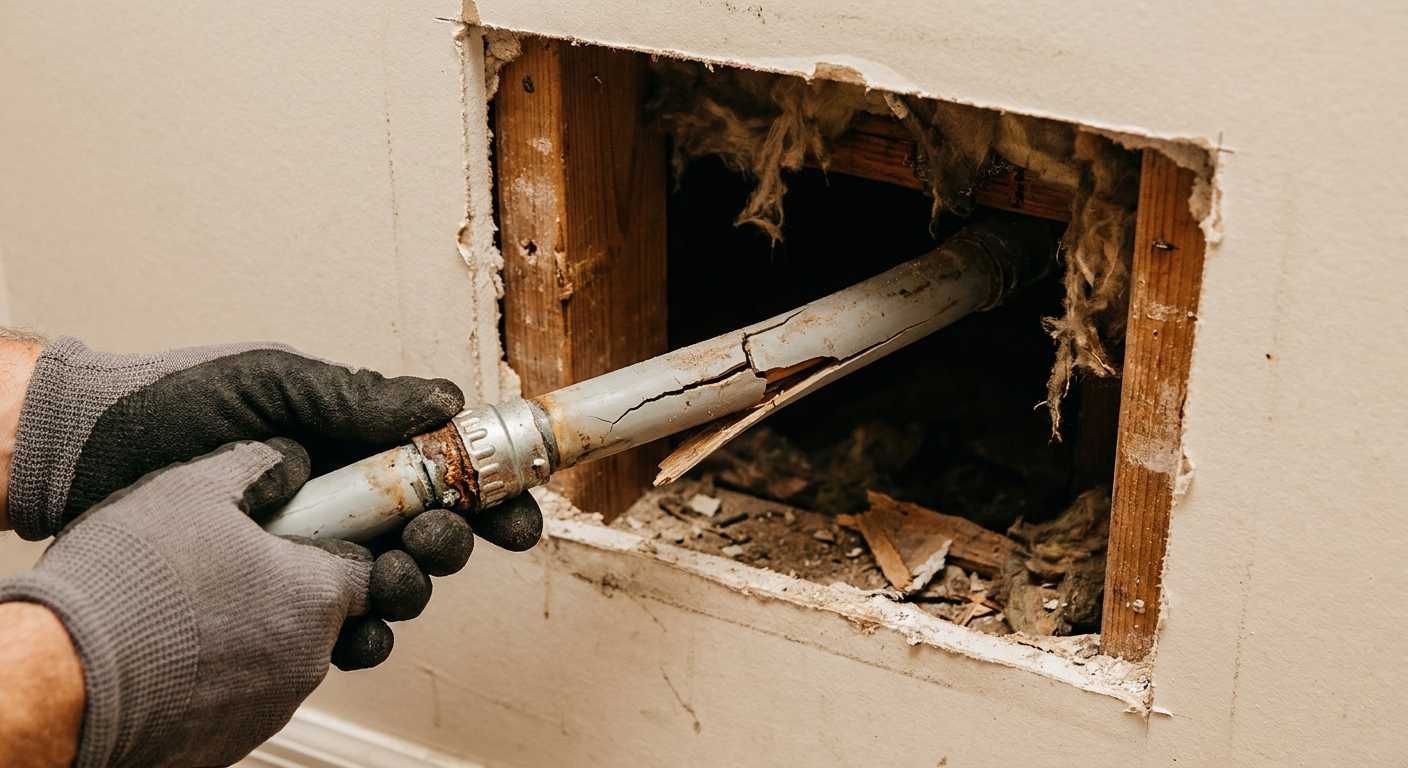
Homeowners across Carrollwood, Town ‘n’ Country, and New Tampa keep hearing the same phrase from their insurance agent: “We need proof this house has been repiped.” If your house was built between 1978 and 1995, there’s a good chance the reason is polybutylene.
Licensed plumbers across Hillsborough and Pinellas still find original polybutylene in 1978 to 1995 houses, and the insurance angle catches almost every owner off guard. This isn’t a scare tactic. It’s what’s actually happening on renewal notices right now.
What polybutylene pipe actually is
Polybutylene, often called “poly-b,” is a gray plastic pipe that builders used heavily from the late 1970s through the mid-1990s because it was cheap and fast to install. It shows up as the main water line running from the meter to the house, and as the branch lines feeding sinks, tubs, and toilets inside walls.
The problem isn’t how it looks. It’s how it fails. Chlorine in treated water reacts with the plastic over decades, making it brittle from the inside out. The pipe can look fine on the outside and still be flaking apart internally. When it finally gives, it usually doesn’t leak slowly. It splits, and you get a wall or ceiling full of water with almost no warning.
Why Tampa’s boom years mean so much poly-b
Tampa’s population exploded during exactly the years poly-b was standard. New Tampa, Carrollwood, and Town ‘n’ Country all went from citrus groves and ranchland to subdivisions in that 1978-1995 window. If you own a home in one of those areas and haven’t had the plumbing replaced, you’re statistically likely to still have the original poly-b lines.
Add in Tampa’s hard water, sitting around 11.7 grains per gallon and climbing past 17 in the dry season, and the mineral load speeds up the pipe’s breakdown from the inside even further. Hard water is rough on any pipe material. It’s especially rough on plastic that’s already degrading from chlorine exposure.
The insurance reality nobody explains upfront
This is the part that actually drives most of the repipe calls we match. Starting a few years ago, major carriers writing policies in Florida started flagging polybutylene the same way they flag aluminum wiring or older roofs. Some insurers won’t write a new policy on a home with confirmed poly-b at all. Others will write it but exclude water damage claims tied to the plumbing, which defeats the purpose of having a policy. A growing number are sending non-renewal notices to existing customers once a 4-point inspection or a claim reveals poly-b in the walls.
If you’re selling a home in South Tampa or buying one in Brandon, a home inspector who spots poly-b supply lines under a sink or a gray line coming out of the meter box will flag it in the report. That flag can stall a closing while the buyer’s lender or insurer demands a repipe or a steep premium increase.
How to tell if you have it
Poly-b is gray, sometimes with a printed marking that reads “PB2110” stamped along the pipe. Check where the water line enters the house near the meter, and look under sinks where flexible connector lines run to fixtures. If you see gray plastic pipe with a slight flexibility to it, not the rigid white or cream-colored PVC, that’s your first clue. A full inspection checks the attic, crawl spaces if you have them, and behind access panels, because poly-b can be present in some runs and not others depending on renovation history. While you’re at the meter box, the same two-minute check tells you whether the line coming into the house is lead, which is the other material question homeowners here ask about.
If your home was built in the identified window and you’ve never had plumbing work done, assume it’s there until a plumber tells you otherwise.
In a manufactured home the check runs differently, because the supply lines sit under the floor inside belly wrap rather than in an attic or a wall. Our guide to mobile home plumbing problems in Tampa Bay covers how that access works.
What a repipe actually costs and takes
A full repipe replaces every poly-b line in the house with modern PEX tubing, which doesn’t react to chlorine the same way and handles Tampa’s hard water far better over the long run. For a typical single-story home in the 1,500 to 2,500 square foot range, most repipes land somewhere between $4,000 and $8,000. Larger homes, two-story layouts, or homes with slab foundations that require more careful routing can run higher, up to $15,000 in some cases.
The job usually takes two to four days. The plumbers we send cut small access points in drywall to route the new PEX lines, then patch and leave the drywall ready for paint. Water is off in short windows during the workday, not the whole time, so most families can still live in the house during the repipe.
What to ask your insurer before you call a plumber
Before you commit to a full repipe, call your insurance agent and ask directly: does this policy currently exclude poly-b related water damage, and would a documented repipe change your premium or renewability. Some carriers offer a real discount once they have proof of PEX or copper replacement on file. That documentation matters, so keep the invoice and any permit paperwork from the job.
Slab homes add a wrinkle
A lot of Tampa’s poly-b-era stock sits on slab foundations, which means some of the original lines run under the concrete rather than through the walls. A repipe in a slab home typically reroutes those lines up through the attic and down through the walls instead of tunneling back under the slab, which is faster, cheaper, and avoids future slab leaks tied to the old under-slab poly-b.
If you’ve already had a slab leak repaired once, that’s often a sign the rest of the poly-b in the house isn’t far behind. Fixing one leak without addressing the rest of the system is a short-term patch.
What we’d tell a neighbor
If your house falls in that 1978-1995 window and you’re getting insurance pushback, don’t wait for a pipe to fail before you deal with it. A planned repipe on your schedule costs less and causes less damage than an emergency plumbing call after a wall floods. We’ll match you with a licensed plumber who can inspect what’s actually running through your walls and give you a straight number, not a scare-tactic estimate.
Call Tampa Plumbing Pro at (813) 590-0625 and we’ll connect you with someone who can tell you what they find, no pressure either way.