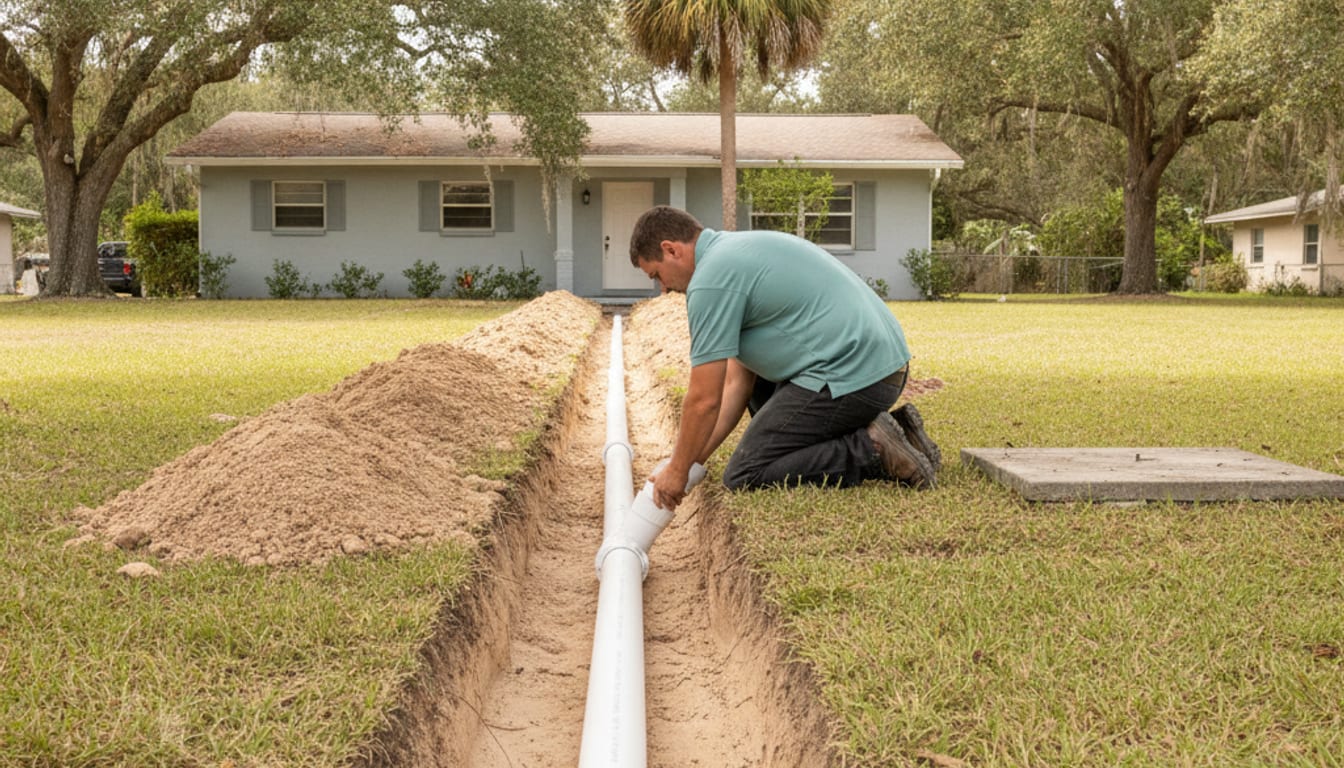
A septic to sewer conversion cost splits into three separate bills: the county capacity fee, the plumbing work to run a new lateral, and the cost to abandon the old tank. Unincorporated Hillsborough County publishes a wastewater capacity fee per dwelling unit of $3,268.75 in the north and $4,884.75 in the south and central service area. You pay that capacity fee to the utility. You pay licensed contractors separately for the plumbing connection and for the tank abandonment on your property.
There is no single all-in price for this project. When weighing septic vs sewer in the Tampa suburbs, you have to budget for the municipal charges plus the specific site work your lot requires.
How long do you actually have to connect?
Florida sets the timeline in statute, and the clock starts later than most people assume. Florida Statutes 381.00655 requires a utility to give you no less than one year of advance notice before a sewerage system becomes available.
Once you receive written notification that the sewer is actually available, you have 365 days to connect. The clock starts at that written notification, not on the day a crew starts digging in your street.
The timeline changes if your existing system fails. If your tank or drain field needs repair, the state law requires you to connect to an available sewer system within 90 days.
What does a septic to sewer conversion cost in Hillsborough County?
Unincorporated Hillsborough County is the only local jurisdiction that publishes exact dollar figures for its utility fees. The county’s Converting Your Septic System to County Wastewater program pages split the wastewater capacity fee per dwelling unit by region and system type:
- North: $3,268.75
- South and central, non-LPSS: $4,884.75
- South and central, LPSS: $3,907.80
The county also charges a $25 one-time account set-up fee and a $165 wastewater deposit. The county notes it may waive the deposit with an approved credit check. These fees cover your right to use the public system. You are still responsible for the plumbing connection from the utility’s clean out to your home and the cost to abandon your old septic system.
Hillsborough also runs a scoped University Area program. On the county’s septic and low-pressure sewer conversion page, it says the program is completely free for qualifying University Area residents, and that “For residential properties, all application and connection costs are free to the property owner and will be covered by the program.” Eligibility is limited to that neighborhood (Fowler Avenue to Bearss Avenue, Interstate 275 to Bruce B. Downs Boulevard) and to the connection-distance rules on that page. It is not a countywide subsidy, and it is not an all-in conversion price for the rest of Hillsborough.
What the county asks you to do, and in what order
Hillsborough County publishes the sequence, and the order matters because two of the steps cost money before the plumbing starts. You confirm the property is adjacent to a wastewater line, get estimates from licensed plumbers for the on-site work, request a connection contract from Water Resources, pay the connection fees, and pass final inspections from the county plumbing inspector, DOH and EPC before billing begins. A county plumbing permit is required to initiate the account.
Two timing details are worth planning around. If your connection is to a low-pressure sewer system, the county says the installation could take up to 12 weeks to complete. And you are responsible for keeping your current septic system working until the new low-pressure system is installed and operating, or until you have connected to the gravity line. That means the old system is still yours to maintain during the wait, and a tank that fails mid-project is still a septic service call.
What Pinellas County says about conversion costs
Pinellas County is currently running the Lake Tarpon Septic-to-Sewer Conversion project for three specific communities. The county’s own FAQ asks how much it will cost a property owner to abandon their tank and connect to the sewer system.
The county answers: “It is too early in the design phase to provide an accurate cost to homeowners.”
That answer is scoped to the Lake Tarpon project, which covers three named communities northeast of the lake: Oakhill Acres, Keystone Ranchettes and Lora Lane. Design is complete and no construction timeline has been published.
The county does describe the physical work. A new sewer lateral extension gets run from a selected point on your existing septic lateral out to the county sewer in the right-of-way or easement. Your old lateral to the septic tank is then cut and reconnected to the new one. Pinellas puts the service interruption at 2 to 4 hours on average.
This means if you live in Pinellas County, there is no published all-in price for every conversion. The county does publish that the average cost for its residential sewer service is approximately $45 to $55 per month, which is the ongoing bill rather than a conversion cost. The Lake Tarpon project is backed by $10 million from the Florida Department of Environmental Protection, but that money funds the public street infrastructure. The state does not pay for your private plumbing lateral on that project.
Pinellas also has a separate Tampa Bay Estuary Program project. On that TBEP septic-to-sewer page, Pinellas County Utilities says it “will give eligible property owners the opportunity to connect to the County’s sewer system at no cost.” Specific owners have already been identified. If your property is on that list, the county contacts you. Once connected, you still pay the sewer bill: about $45 to $55 a month, billed every other month. That is not an all-in conversion price for the rest of Pinellas.
The rules and costs for abandoning your old tank
The old tank usually stays in the ground, but it cannot stay in service. Florida rule 62-6.011, the state onsite sewage rule formerly numbered 64E-6.011, sets out what happens to it once you connect to the sanitary sewer. The system must be abandoned within 90 days, and any further use of it for any purpose is prohibited.
A permitted septage disposal company must pump the tank out. The bottom of the tank is then opened or ruptured, or the entire tank is collapsed so it cannot retain water. Finally, the tank is filled with clean sand and completely covered with soil.
One exception is worth knowing before you pay for a permit you may not need. The rule waives its own permit requirement where a local utility or local plumbing authority runs an abandonment program that already covers the pumping, the rupture, the fill and the inspection. Ask your utility which situation you are in before assuming you are pulling the permit yourself.
Otherwise the abandonment is a distinct job that requires a permit and an inspection. The registered septic contractors we send handle this septic service work and pull the abandonment permit before they start.
The plumbing cost to run your new sewer lateral
The county brings the sewer main to the street. You have to bring your home’s plumbing to the sewer main. This requires running a new sewer lateral from your house to the connection point.
Neither county publishes a figure for this half of the job. The closest number we publish is for a related job: a full sewer lateral replacement in an older Tampa neighborhood runs $6,000 to $15,000, in our guide to sewer line problems in older Tampa. Treat that as a lateral replacement figure, not as a conversion quote. What your own bill looks like depends on the distance from the house to the connection point, what has to be opened up to get there, and what the site work involves. Our sewer line replacement cost guide walks through what moves that number.
Can you pay connection fees over time?
Florida law does offer a prepay option for the utility side of the bill. Homeowners can prepay the amortized value of required connection charges in equal monthly installments over a period not to exceed two years. This helps spread out the municipal capacity fee, but it does not cover your private plumbing work.
The statute also includes a five-year hardship installment plan, but this is written specifically for investor-owned sewerage systems. It is a discretionary option that an investor-owned utility may provide. It is not a statewide guarantee, and it is not written for the county-run utilities in Hillsborough or Pinellas.
Frequently asked questions
Does the county pay for my new sewer pipe?
Usually no. The county builds the public main in the street, and you hire a plumber for the private sewer line from the connection point to the house. Two scoped exceptions: qualifying University Area residential connections in Hillsborough, and Pinellas TBEP properties the county has already identified. Neither is a countywide free conversion.
Who pumps and crushes the old septic tank?
Florida rule requires a permitted septage disposal company to pump the tank out. The bottom is then opened or ruptured, or the tank collapsed, and it is filled with clean sand and covered with soil.
Do I need a permit to abandon my septic system?
Yes, the state rule requires an abandonment permit and a final inspection. The registered pros we send pull this paperwork before they begin the work.
What if my drain field is already failing?
A failing system can put you in front of a drain field replacement. It can also shorten your deadline: a system needing repair must connect within 90 days of written notification from the department.
Do I need an inspection before converting?
If you are buying a home scheduled for conversion, a septic tank inspection tells you what condition the system is in. A system needing repair falls under the 90-day deadline instead of the 365-day one.
When to call us
A conversion requires a licensed plumber for the new lateral and a registered septic contractor to properly abandon the old tank. Whether you live in Lutz or South Tampa, we match you with local professionals who handle both sides of the transition. If you also need drain cleaning or fixture updates during the project, the pros we send handle that too. Call us at (813) 590-0625.