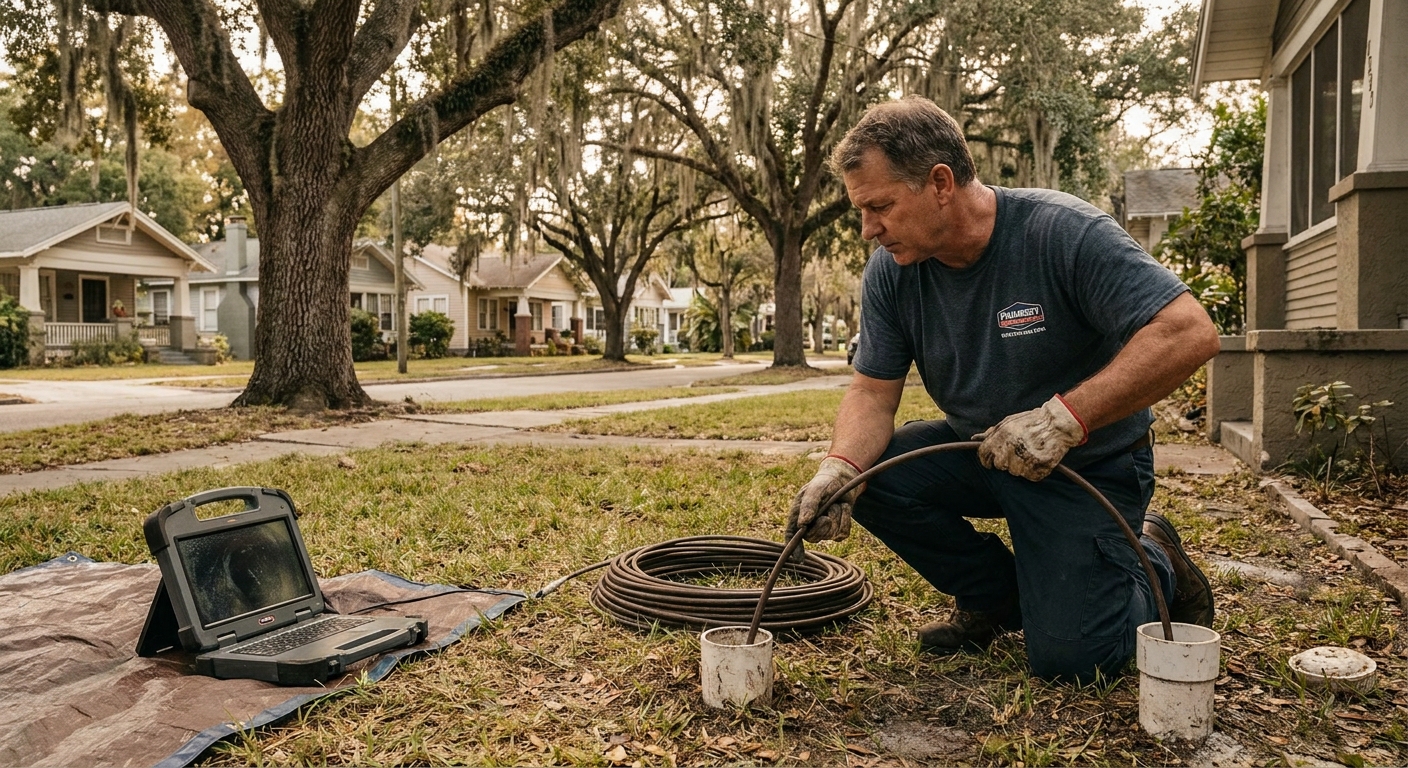
If you own a home in one of Tampa’s older, established neighborhoods, Seminole Heights, Hyde Park, Tampa Heights, Ybor City, or the equally historic pockets of St. Petersburg like Old Northeast and Roser Park, your sewer line is probably older than you think, and it’s probably made of a material that’s showing its age. These neighborhoods share a common set of sewer problems tied directly to when and how they were built, and knowing what to watch for can save you from an expensive emergency.
Why older Tampa neighborhoods have specific sewer risks
Homes built before 1975 across the urban core were typically plumbed with cast-iron or clay sewer laterals, the pipe running from your house to the city’s main line. Both materials were standard for their era and both have real, well-documented failure patterns after 50-plus years in the ground, especially in Florida’s sandy, shifting soil.
Cast iron corrodes from the inside out over decades, especially with our hard, mineral-heavy water passing through it continuously. As it corrodes, the interior surface roughens, which gives waste and paper something to snag on, leading to more frequent drain cleaning calls even with normal household use. Eventually, corrosion can progress to the point of actual holes or collapse in the pipe wall.
Clay pipe, meanwhile, is brittle and comes in short joined sections, and those joints are exactly where tree roots find their way in, seeking the moisture inside the line. Once a root gets a foothold, it grows aggressively toward the water source, eventually cracking the pipe further and choking the line.
Seminole Heights and Tampa Heights: the root intrusion epicenter
These two neighborhoods combine two risk factors at once, pre-1960s clay and cast-iron piping and mature, established tree canopies that have had 60-plus years to grow root systems deep into the ground. If you own a bungalow in Seminole Heights and you’ve never had a camera inspection of your sewer lateral, it’s genuinely one of the more valuable preventive services available for a home your age. Root intrusion doesn’t announce itself gradually and gently, it often shows up as a sudden, complete backup, usually at the worst possible time.
Watch for: gurgling sounds from your bathtub drain when you flush the toilet, slow drains across multiple fixtures at once (not just one sink), and any sewage smell in your yard, especially near where large trees are growing close to your home’s foundation.
Hyde Park and Ybor City: the historic-home constraint
Hyde Park’s brick streets and near-century-old housing stock and Ybor City’s roughly 950 historic buildings share a different challenge: sewer repair work in these areas has to account for historic district regulations, tighter lot access, and in Ybor’s case, a lot of rental and mixed-use property where the plumbing has taken decades of hard, inconsistent use. When a sewer lateral needs replacement in a historic district, trenchless repair methods, which avoid digging a full trench across a protected brick street or a tightly built lot, are often the more practical option, and it’s worth asking specifically about trenchless pipe lining or bursting rather than assuming full excavation is the only path.
St. Petersburg’s Old Northeast and Kenwood
St. Pete’s median home build year sits around 1969, and its historic bungalow cores in Old Northeast, Kenwood, and Roser Park carry the same cast-iron and clay risk profile as Tampa’s older neighborhoods, compounded by the fact that literally every part of Pinellas County sits in some form of flood zone. That combination, aging pipe plus a higher water table plus more frequent heavy rain events, means sewer laterals here take on stress that inland, newer-construction homes simply don’t face.
What a camera inspection actually tells you
A sewer camera inspection is a flexible camera fed through your line via a cleanout access point, giving a real-time video look at the interior condition of your pipe: root intrusion, corrosion, cracks, bellies (sagging low spots from soil settlement), and any collapsed or offset sections. For a home over 50 years old that’s never had one, this is the single best way to know what you’re actually dealing with before it becomes an emergency, and it typically costs a few hundred dollars, a small fraction of what an emergency sewer backup and cleanup runs. Cleanup often lands on the homeowner too, since sewer backup insurance isn’t part of a standard policy.
Trenchless repair options
If a camera inspection turns up damage, trenchless pipe lining (also called cured-in-place pipe, or CIPP) and pipe bursting are both viable alternatives to full excavation in a lot of cases. Pipe lining inserts a resin-saturated liner into the existing pipe that cures into a smooth, joint-free interior surface, effectively creating a new pipe inside the old one without digging up your yard, driveway, or historic brick street. Pipe bursting replaces the pipe entirely by pulling a new one through while breaking apart the old one, still through access points rather than a full trench. Both options cost more per linear foot than open trenching in some cases, but they save significantly on landscaping, hardscape, and historic-district restoration costs, which often makes them the more economical choice overall in these neighborhoods.
Don’t wait for the emergency version of this conversation
The homeowners who call us for an emergency plumbing visit over a full sewer backup at 9pm on a Friday are almost always the ones who never got a camera inspection done. If you’re in Seminole Heights, Hyde Park, Tampa Heights, Ybor City, or any of Tampa Bay’s older established neighborhoods and you don’t know the condition or material of your sewer lateral, call Tampa Plumbing Pro at (813) 590-0625. We’ll run a camera inspection, show you exactly what’s going on down there, and give you real options before it turns into a weekend emergency.
What replacement actually costs
A full sewer lateral replacement in an older Tampa neighborhood typically runs $6,000 to $15,000 depending on length, depth, and whether trenchless methods are viable for your lot. Trenchless lining or bursting often costs more per foot but saves significantly on restoring brick streets, mature landscaping, or historic hardscape, which usually makes it the smarter total spend in these neighborhoods.