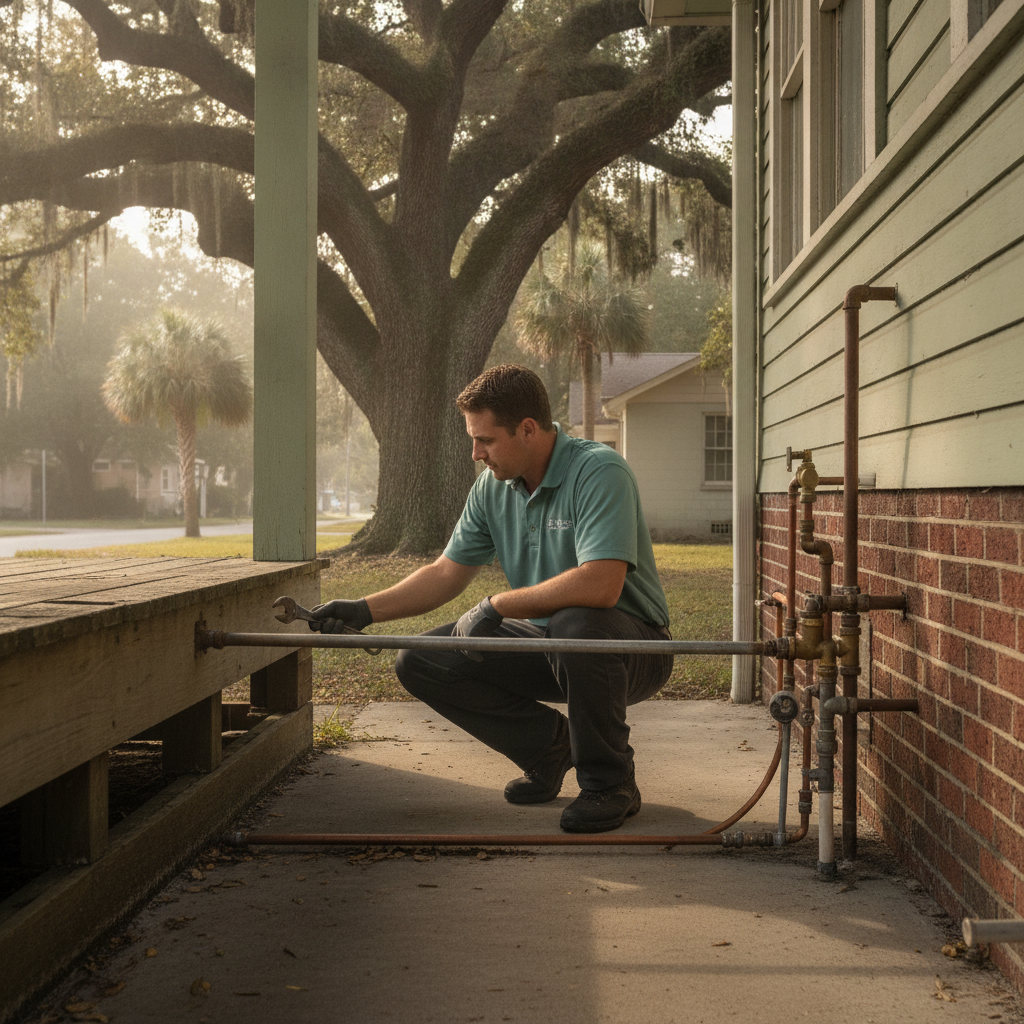
A Hyde Park bungalow south of Kennedy can still be running the galvanized supply and cast iron drains it was built with. When the water at the tub turns rusty, a fitting weeps under the porch, or a toilet backs up on Davis Islands, people start looking for plumbers in South Tampa who know that stock. We match you with licensed local plumbers who work this side of the bay.
What plumbers in South Tampa get called for
The typical call is an old house on city water and city sewer, not a well and not a septic tank. Original galvanized steel is still in the walls of many 1920s-to-1960s homes from Hyde Park through Palma Ceia and down to Ballast Point. That pipe corrodes from the inside out. Scale narrows the opening until the upstairs bath loses pressure while the kitchen still looks fine. Brown or rusty cold water that does not clear after a short flush is often that steel, not the City’s main.
Cast iron drain lines sit under the same houses. The metal thins over decades. Roots find a joint. Grease and paper hang on the rough interior. A toilet that gurgles when the washing machine drains, a slow floor drain, or sewage smell at a cleanout is the drain side of the same era of construction.
Broken-pipe work on Davis Islands follows the same pattern. Salt air off the bay attacks outdoor hose bibs and exposed fittings, and a supply line that has already been patched once often fails at the next joint a few months later. Galvanized fails in clusters once it starts. A South Tampa plumber who works Hyde Park every week will look at the whole run, not just the wet spot on the porch.
Water heaters on City of Tampa water collect mineral scale the same way the rest of the metro does. Outdoor spigots near Bayshore and the Westshore edge corrode faster than the same brass inland. None of this is a Pasco well problem and none of it is a 1990s Brandon slab leak. It is city plumbing in housing that predates plastic pipe.
We cover South Tampa from the historic blocks to the MacDill side. The plumbers we send are licensed and insured. They handle the diagnosis, the shutoff, and the repair. We answer the line and get the right trade to you.
Hyde Park, Palma Ceia, and Ballast Point housing stock
Hyde Park plumbing is the oldest layer. Brick and wood bungalows under live oaks, many from the 1920s through the 1950s, still hide original galvanized supply and aging copper. Historic interiors mean access is tight. A leak in a plaster wall is a different job than a leak in an open garage. The same house may have had a kitchen remodel in the 1990s while the bath and the main run were left alone, so you get mixed materials on one street.
Palma Ceia sits in that same south-of-Kennedy belt. Lots are established. Trees are mature. Sewer laterals have been in the ground long enough for roots and offset joints. The houses are on municipal water and sewer, so the work stays inside plumbing: supply, drains, fixtures, water heaters. You are not waiting on a tank pump-out. You are dealing with what the original plumber put in, plus whatever a later owner patched.
Ballast Point and the MacDill edge skew a little later. 1940s-to-1960s ranches are common. Galvanized and copper still show up. Crawl or raised access on some lots makes a supply leak visible; on others the line is in the wall or under a finished floor. Westshore and the older South Tampa blocks toward the bay add salt air on every hose bib and outdoor shower.
Davis Islands is its own pocket: older houses, city utilities, and a lot of broken-pipe calls after a fitting finally lets go. The island does not change the materials. It just concentrates the same galvanized-and-cast-iron story onto a smaller map.
A licensed plumber who has already opened houses on these streets will check the visible pipe with a magnet and a coin, look at the far fixtures for pressure drop, and ask whether rusty water is hot-only or both sides. Hot-only often points at the tank. Both sides points at the supply. That is Hyde Park and Palma Ceia in a sentence: original metal, city water, and a house that has been loved longer than the pipe was designed to last.
Galvanized supply lines and aging drains under older homes
Galvanized steel was the standard supply for a long stretch of Tampa building. A zinc coating delayed rust. Inside the pipe, Tampa’s hard water still ate the coating and then the steel. Buildup narrows the interior until volume drops at the far end of the house or on a second floor. The pipe is well past the 40 to 50 year life people still quote for it. Pinellas Park homes from 1950 to 1985 show the same material. South Tampa’s 1920s-to-1960s stock is older still.
Once one joint weeps, the next one is usually close. Patching a single leak on galvanized is a stall, not a finish, because the rest of the run is in the same water. A whole-home repipe is the point where the plumber stops chasing fittings and replaces the supply as a system. Copper and PEX are the two common replacements. Galvanized is more labor-intensive to pull than polybutylene, which is why older South Tampa and Westshore houses sit at the harder end of that job.
Drains are a separate system with their own clock. Cast iron under a Hyde Park or Ballast Point house has been thinning since it was hung. A camera down the line shows cracks, belly sags, and root intrusion that a cable cannot permanently fix. Sewer line repair on this side of town is often a targeted section or a lining job when the rest of the run is still sound. When it is not, the lateral from the house to the city connection is the conversation.
Cast iron across older Tampa neighborhoods is covered in our older-neighborhood sewer guide. This page is the South Tampa hire: city water, city sewer, and houses south of Kennedy that still have metal in the walls. For how a galvanized replacement is actually scoped, see galvanized pipe replacement in Tampa.
Hurricane season from June through November is when a weak lateral shows itself. A storm saturates the yard, roots move, and a line that was barely holding starts to back up. The National Weather Service Tampa Bay office is the right place for the storm forecast. The plumber is the right call for the cleanout that is standing full of water.
How South Tampa differs from St. Pete bungalows and East Hillsborough slabs
South Tampa is not a St. Pete bungalow and it is not a Brandon slab. The materials overlap on paper. The house, the air, and the ground do not.
St. Petersburg and the Gulf beaches add salt air, tight lots, and pre-1975 bungalows over cast iron drains. The drain story is similar. The outdoor metal is worse over there, and the lots leave less room to open a yard. East Hillsborough, Brandon, Valrico, Seffner, FishHawk, Plant City, is 1980s-to-2000s subdivision stock. That is the polybutylene and slab-on-grade belt. A leak there often means concrete. A leak in Hyde Park often means a wall, a crawl, or a porch.
South Tampa sits on City of Tampa water and sewer. Pasco and rural Hillsborough still have wells and septic. If someone quotes you a tank pump or a drain field, they are describing a different county. The work here is licensed plumbing on municipal lines.
| What you are looking at | South Tampa | St. Pete bungalows | East Hillsborough slabs |
|---|---|---|---|
| Typical stock | 1920s–1960s Hyde Park, Palma Ceia, Ballast Point, Davis Islands | Pre-1975 cottages, tight lots, Gulf air | 1980s–2000s subdivisions, Brandon to Plant City |
| Supply | Galvanized and aging copper | Galvanized plus salt-eaten outdoor fittings | Polybutylene, copper, later PEX |
| Drains | Cast iron on city sewer | Cast iron on city sewer | PVC under a slab |
| How a leak shows | Wall, porch, fitting cluster, rusty taps | Same, plus outdoor corrosion | Warm floor, wet slab, higher bill |
| What it is not | Well or septic | A new-build PEX leak | A 1920s bungalow |
A plumber who only works new Wesley Chapel construction will still find the shutoff. A plumber who already knows these three belts will not treat a Palma Ceia galvanized cluster like a single Valrico poly-B fitting. That difference is the reason this page exists.
When a spot repair is not enough
One weeping fitting on otherwise sound copper can be a repair. One weeping fitting on original galvanized is usually a warning. The rest of the steel has been in the same hard water. Pressure that is already weak at the far bath will not recover because you tightened one union. Rusty water on both hot and cold will not clear because you swapped a valve.
Recurring leaks in more than one spot, visible corrosion at exposed joints, and a second failure within months of the first are the usual line between a patch and a repipe. The plumber should pressure-test and, when the drain is in doubt, camera the line before anyone opens a finished floor. Spot repair still has a place: a failed hose bib near the bay, a toilet supply, a single copper pinhole on a later remodel. The mistake is treating the original galvanized main as if it were that later remodel.
Access drives the work as much as the material. A Ballast Point ranch with an open garage is a different day than a Hyde Park bath with plaster and tile. Mixed materials in one house, new PEX in the kitchen, old steel in the hall, are common. The licensed plumber maps what is actually in the walls instead of guessing from the year on the tax roll.
Florida plumbing contractors are licensed at the state level. Hire licensed, and look the license up. That is how to choose a licensed plumber in Tampa.
What neighborhoods sit in South Tampa?
Hyde Park, Palma Ceia, Ballast Point, and Davis Islands are the older core south of Kennedy. Westshore and the blocks toward MacDill sit in the same city-water, city-sewer pattern, with more 1940s-to-1960s ranch stock and more salt on outdoor fittings. Bayshore is the water edge of that map. These are the streets where galvanized supply and cast iron drains still show up on a first visit.
Does Florida require plumbers to be licensed?
Florida licenses plumbing contractors through the state. The plumbers we send are licensed and insured. You can confirm a license on the Florida DBPR licensee search before anyone opens a wall. Ask for the state plumbing credential, then look it up.
When is a broken pipe on Davis Islands a full repipe?
A single failed fitting on later copper can stay a repair. Original galvanized that has already leaked once, with rusty water or weak pressure at the far fixtures, is usually the start of a cluster. The plumber should test the rest of the run. If the steel is the original supply, replacing one joint leaves the next joint in the same water.
When to call us
Call when rusty water will not clear, a fitting is weeping, a drain is backing up, or a pipe has already broken on an older South Tampa house. That is licensed plumbing on city water and city sewer, and it is the work the plumbers we send do in Hyde Park, Palma Ceia, Ballast Point, and Davis Islands. Call us at (813) 590-0625.