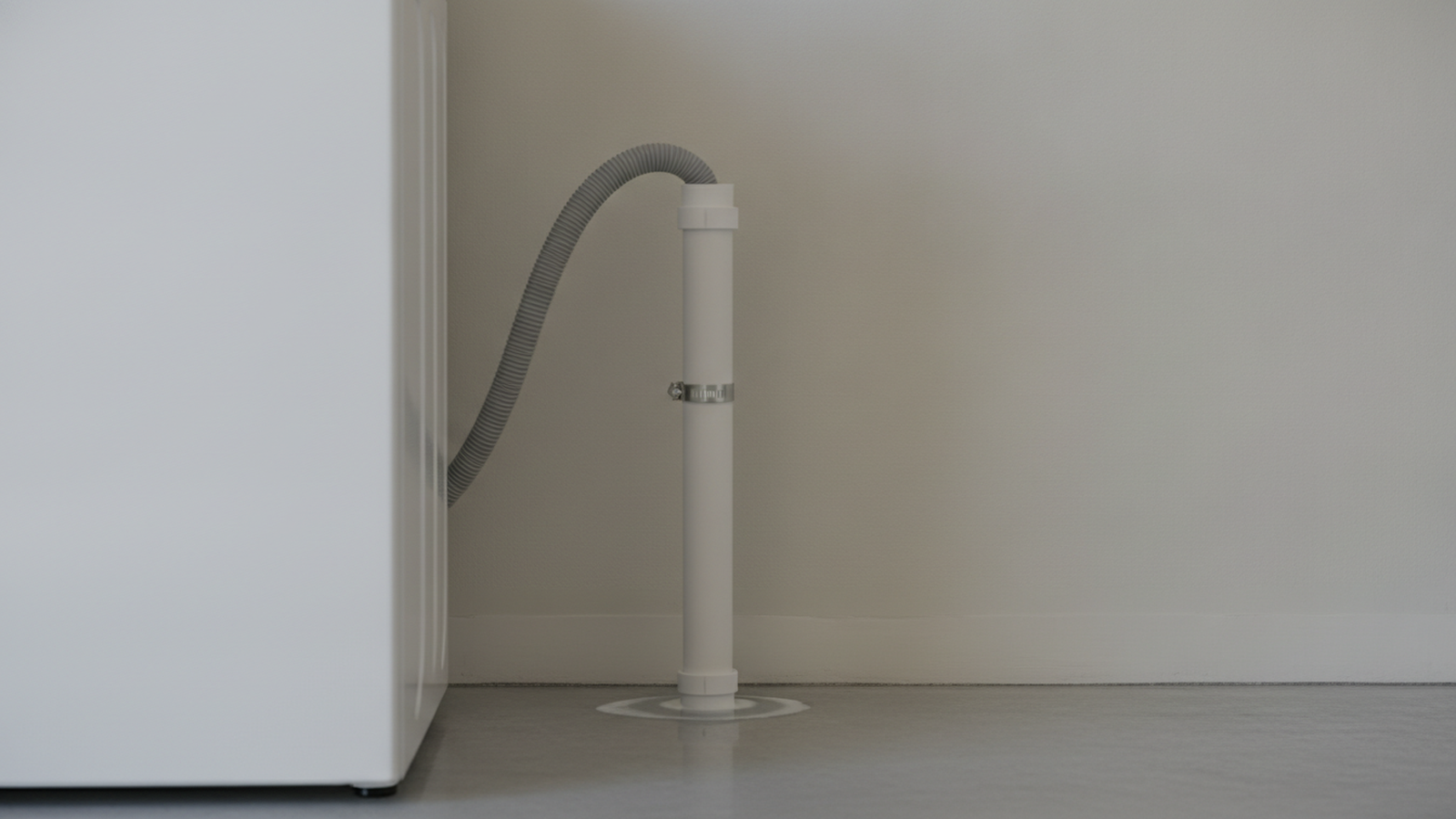
A washing machine drain overflow usually means the drain can’t carry water away as quickly as the washer pumps it out. The restriction may sit inside the laundry standpipe, along its branch line, or farther down the home’s drainage system. Testing the washer hose and standpipe separately reveals which side needs attention.
What causes a washing machine drain overflow?
A partial blockage lets the standpipe drain, but not quickly enough. The washer’s pump sends out a strong surge during its drain cycle. Water rises inside the standpipe once that surge exceeds the pipe’s remaining capacity.
GE’s installation instructions, document 49-3000217, call for a drain capable of removing 10 gallons per minute. That’s GE’s requirement for the models covered by that document. Other washers can carry different installation requirements.
The same GE instructions call for at least a 1-1/4 inch standpipe. That specification also applies only to the covered models. Your washer’s own manual controls its installation requirements.
Lint, soap residue, and mineral scale slowly narrow laundry drain lines. A line can still accept water between cycles. It can then overflow when the pump delivers everything at once.
That explains why the washer worked normally last month. The opening didn’t disappear overnight. It gradually became too small for the pump’s discharge.
Tampa Bay’s hard water runs 11 to 17 grains per gallon. Scale can join lint and soap inside an aging laundry branch. The mixture forms a rough surface that catches more debris.
Is the washer or the drain causing the problem?
A separate discharge test identifies which side can’t move water properly. Stop the cycle before more water reaches the floor. Then keep the washer’s discharge separate from the standpipe.
- Pull the drain hose from the standpipe without straining its connections.
- Place the hose into a container and prepare to stop the cycle quickly.
- Run a drain or spin cycle while watching the hose discharge.
- Pour a bucket of water directly into the empty standpipe.
- Compare how the hose and standpipe handle water separately.
Water comes from the hose quickly during this test. Don’t leave the container unattended. Stop the cycle before the container fills.
A strong hose discharge shows the pump is moving water. If the standpipe backs up during the bucket test, the restriction is inside the drain system. The washer isn’t needed to reproduce the overflow.
A weak or missing hose discharge points back toward the washer. Check the hose for a visible kink before arranging appliance service. Don’t assume the wall drain caused a problem the hose can’t reproduce.
| Test result | Likely source | What the result means |
|---|---|---|
| The hose discharges strongly, but the standpipe backs up. | Laundry drain | The drain can’t accept water at the washer’s discharge rate. |
| The hose barely discharges into the container. | Washer or hose | The appliance side isn’t moving water normally. |
| The standpipe accepts a bucket, then overflows during a cycle. | Partial restriction | The line drains slowly but can’t handle the pump surge. |
| A lower fixture rises during the washer cycle. | Drain beyond the laundry branch | The discharge is meeting a restriction farther downstream. |
This test gives a plumber a useful starting point. It also prevents paying an appliance technician to inspect a working pump.
Can the drain hose cause the overflow?
A badly positioned hose can create drainage trouble without a pipe clog. GE says no more than 7 inches of hose should enter the drain pipe. Its instructions also require an air gap around the hose.
Taping the hose tightly against the standpipe removes that air gap. A snug fit can create siphoning, according to GE’s instructions. Pushing the hose too deeply can cause the same problem.
The hose should stay secure without sealing the opening. Correcting its position costs nothing and takes little effort. Run another controlled drain cycle after making that adjustment.
The standpipe’s construction matters too. The Florida Building Code, Plumbing (2023), Section 802.4.3 requires an individual trap. It sets the standpipe height at 18 to 42 inches above the trap weir. The drain must also remain accessible for rodding.
The trap weir is the internal point where water leaves the trap. That code measurement doesn’t begin at the laundry floor.
GE gives a different height band of 24 to 96 inches. Its measurement begins at the floor or washer base. The code and manufacturer aren’t measuring from the same point. Both requirements can therefore apply without matching numerically.
A short standpipe also provides less room for rising water. It can expose a marginal restriction sooner. Changing the pipe height won’t remove the blockage causing that rise.
Where does the laundry drain clog in Tampa Bay homes?
The restriction often sits after the standpipe trap and before the main drain. Many Tampa Bay homes place laundry equipment inside a garage or interior closet. That layout can create a long horizontal branch beneath a slab.
Older plumbing adds another layer. Pre-1975 homes around central Tampa and St. Petersburg can have galvanized laundry piping or branches tied into cast iron. Corrosion and scale leave less room for washer discharge.
A St. Petersburg bungalow may still drain small sink flows normally. Its laundry pump delivers water differently. That surge exposes a narrowing branch that quieter fixtures don’t reveal.
Our guide to cast iron pipe failure in St. Petersburg explains that older material in greater detail. Laundry overflow alone doesn’t prove the cast iron has failed. It only shows that the drain isn’t carrying the pump discharge.
Newer slab-on-grade homes can develop the same symptom. Lint and soap don’t need old metal to collect. Pipe layout, access, and the restriction’s location decide how the line gets cleared.
Tampa Plumbing Pro covers Hillsborough, Pinellas, and Pasco through our referral network. We can also connect homeowners with drain-cleaning help in New Port Richey.
What can you fix without opening the drain?
Correcting the hose position is the cleanest homeowner fix. Remove any visible kink and preserve the air gap. Pull excessive hose length back from the standpipe.
Visible lint at the standpipe opening can also be removed. Don’t mistake a clean opening for a clear branch. Most restrictions sit beyond the section you can see.
If the bucket test produces standing water, the line needs clearing. Professional drain cleaning can reach beyond the trap and restore the branch’s carrying capacity.
A standard single-fixture drain clearing through our network runs $150 to $350, depending on access and severity. Main line jetting runs $350 to $700.
A laundry-branch clearing normally belongs with single-fixture work. A downstream blockage can move the job into main-line work. The full Tampa drain-cleaning cost guide explains the pricing branches and cleaning methods.
When does the overflow point to the main sewer?
Water rising in another low fixture points beyond the laundry branch. Watch the nearest shower pan or lower drain while the washer empties. A response there means the discharge is meeting a shared restriction.
That symptom belongs with sewer line repair, not a standpipe adjustment. Our guide to signs of sewer line trouble covers that larger diagnosis without confusing it with a laundry-only clog.
A standpipe that overflows by itself still deserves attention. A second affected fixture changes the likely location, not the need for service.
What should you do while water is spreading?
Stop the washer cycle first to halt the pump discharge. Move nearby belongings away from the wet area. Towels or a wet vacuum can contain what has already escaped.
If water continues entering from a supply connection, close the washer’s supply valves. Our emergency water shutoff guide explains the broader shutoff locations.
Use emergency plumbing help when water is actively spreading or affecting nearby rooms. Don’t restart the washer until the drain can accept its discharge.
Frequently asked questions
Why does the standpipe overflow only during the drain cycle?
The washer releases water quickly during its drain cycle. A partly restricted branch may handle slow flows but overflow when the pump’s discharge exceeds the line’s remaining capacity.
How can I tell whether the washer or drain is clogged?
Test them separately. A strong discharge from the loose hose, followed by water backing up during the standpipe bucket test, points to the drain rather than the washer.
How far should the washer hose enter the standpipe?
GE document 49-3000217 says no more than 7 inches for its covered models. The hose also needs an air gap, since a deep or tightly sealed fit can cause siphoning.
How much does laundry drain clearing cost?
A standard single-fixture drain clearing runs $150 to $350, depending on access and severity. A deeper shared-line blockage can move the job into main line work.
Does a laundry overflow mean the main sewer is clogged?
Not by itself. A laundry-only overflow usually points toward its branch. Water rising in a lower fixture during the same cycle suggests a restriction farther downstream.
When to call us
Call when the standpipe fails the bucket test or another fixture starts rising. Tampa Plumbing Pro connects you with licensed local plumbers through our 24/7 network across Hillsborough, Pinellas, and Pasco. Call us at (813) 590-0625.