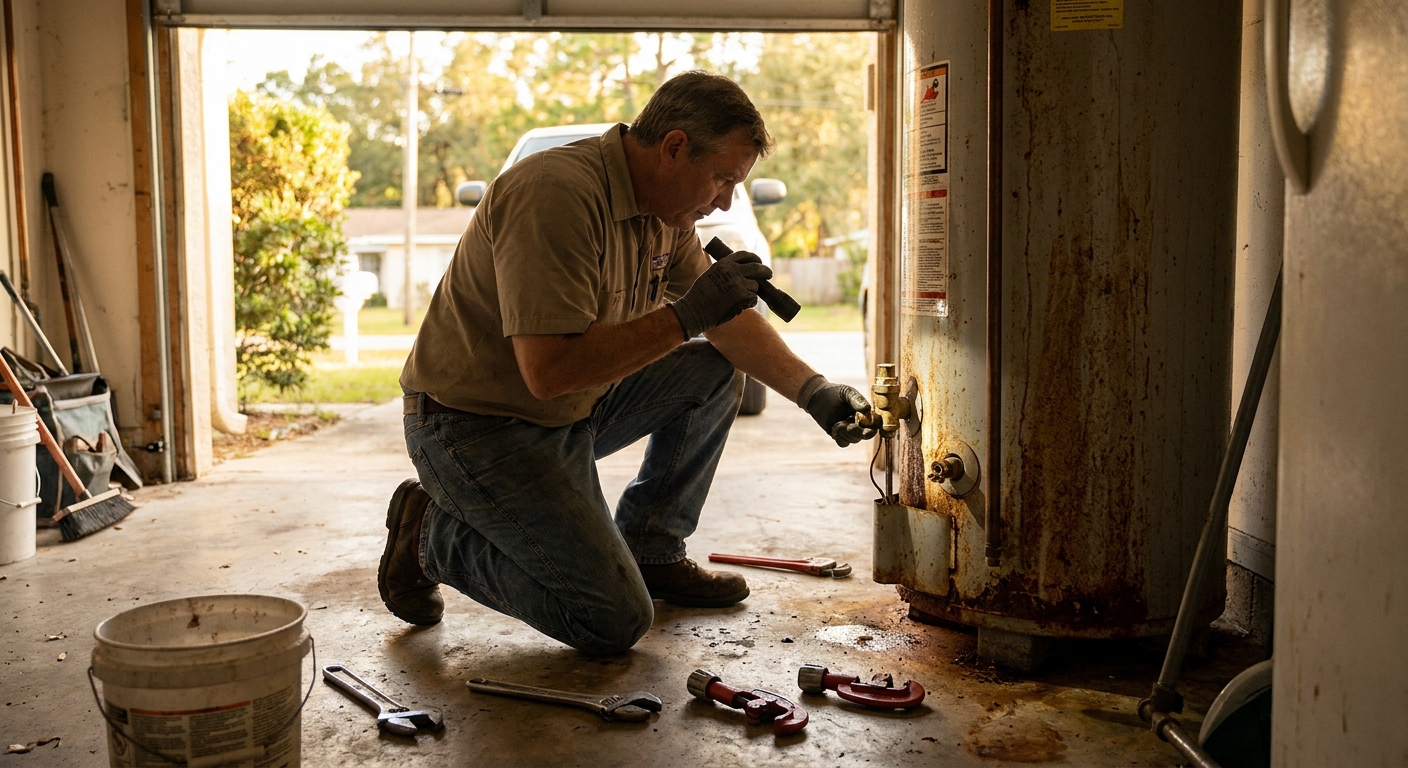
A water heater rarely fails all at once. It usually sends a few warning signs first, and that’s exactly the window where homeowners have to decide: fix what’s wrong now, or replace the whole unit before it fails on its own schedule instead of yours. In Tampa’s hard water, that decision skews toward replacement earlier than it would in most of the country, and here’s the actual reasoning the plumbers we send walk homeowners through on a call.
Why the calculus is different here
Tampa’s water runs hard, averaging 11.7 grains per gallon and climbing toward 17-18 in the dry season. That mineral load builds scale inside every tank water heater in the metro, insulating the burner or heating element from the water it’s supposed to be heating, forcing the unit to work harder, and eventually cracking and clogging components as the scale layer breaks down. A tank rated for 8-12 years nationally often makes it 5-7 years here without a softener or regular flushing. That shortened lifespan means the repair-versus-replace math shifts earlier than the manufacturer’s rating would suggest.
The age threshold that actually matters
If your water heater is under 5 years old, repair is almost always the right call for a single issue, a bad thermostat, a faulty heating element, a failed pilot assembly, or a leaking valve. These are individually inexpensive fixes on a unit that still has most of its working life ahead of it.
If your water heater is between 5 and 8 years old, the answer depends on what’s actually wrong. A single component failure is still usually worth repairing. But if you’re seeing scale-related symptoms, popping and rumbling noises, reduced hot water capacity, rusty water, alongside the specific failure, that’s a sign the tank itself is nearing the end of its practical life in Tampa’s water, even if the manufacturer’s rating says otherwise.
If your water heater is 8 years or older, replacement is usually the better call than repair, especially for anything involving the tank itself rather than an external component. At this age in this water, you’re often one repair away from another, and the accumulated scale means efficiency has already dropped significantly even if the unit is technically still working.
Repairs that make sense at almost any age
Some fixes are worth doing regardless of unit age because they’re inexpensive relative to a full replacement. Most water heater repairs run $150 to $450 depending on the part. A thermostat or heating element sits on the lower end of that band. A gas control valve or thermocouple, with labor, is $350 to $450. There’s rarely a reason not to fix a single failed part on a tank that is still within its useful life.
Signs that point clearly toward replacement
Rust-colored water coming from the hot side specifically. This usually means the tank itself is corroding internally, not just an external part. Once the tank is rusting from the inside, there’s no repair that fixes that.
Water pooling around the base of the tank. If it’s coming from a fitting or valve, that’s repairable. If it’s coming from the tank body itself, the tank has a structural failure and needs replacement, not repair. Our walkthrough on tracing a water heater leak to its source covers the six places it comes from and how to tell them apart.
Popping, rumbling, or knocking sounds that have gotten progressively louder over time. This is scale buildup at a level that’s compromising efficiency significantly, and it usually means the tank is closer to failure than the noise alone suggests.
Rising energy bills with no change in hot water usage. A heavily scaled tank has to run longer to deliver the same hot water, and that shows up directly on the utility bill.
Multiple repairs within a short window. If you’ve called a plumber twice in the past year for different issues on the same unit, that’s usually the tank telling you it’s failing as a system, not experiencing isolated component problems.
What replacement actually costs in this market
A standard 40-50 gallon tank water heater replacement typically runs $1,400 to $2,600 installed in Tampa Bay, depending on tank size, fuel type, and whether code requires any updates to venting or the water lines during the swap. Tankless water heater installations run higher, generally $3,500 to $6,500 installed, reflecting both the unit cost and the more involved installation. Those installed bands are the ones we publish in water heater replacement cost in Tampa. The plumber we send will be upfront if your home’s gas line or electrical service needs upgrading to support a tankless unit, since that adds to the project.
The softener question when you replace
If you’re replacing a water heater that failed early due to scale, and you don’t already have a softener, this is the natural point to consider one. A water softener installed alongside a new water heater protects that investment and gets you closer to the unit’s actual rated lifespan instead of losing years to the same scale problem again. It’s not required, but for a homeowner who’s already been through one early water heater failure, it’s worth the conversation.
How we make the call with you
When the licensed plumber we send is standing in front of your water heater, they’re not selling replacement by default. They check the tank’s actual condition, look at the specific symptoms you’re describing, factor in the unit’s age, and give you a straight recommendation with the reasoning behind it, repair cost against replacement cost against how much life is realistically left in the tank either way.
Call Tampa Plumbing Pro at (813) 590-0625. We’ll match you with a licensed plumber who can look at your unit, tell you honestly whether it’s worth fixing, and give you real numbers either way.