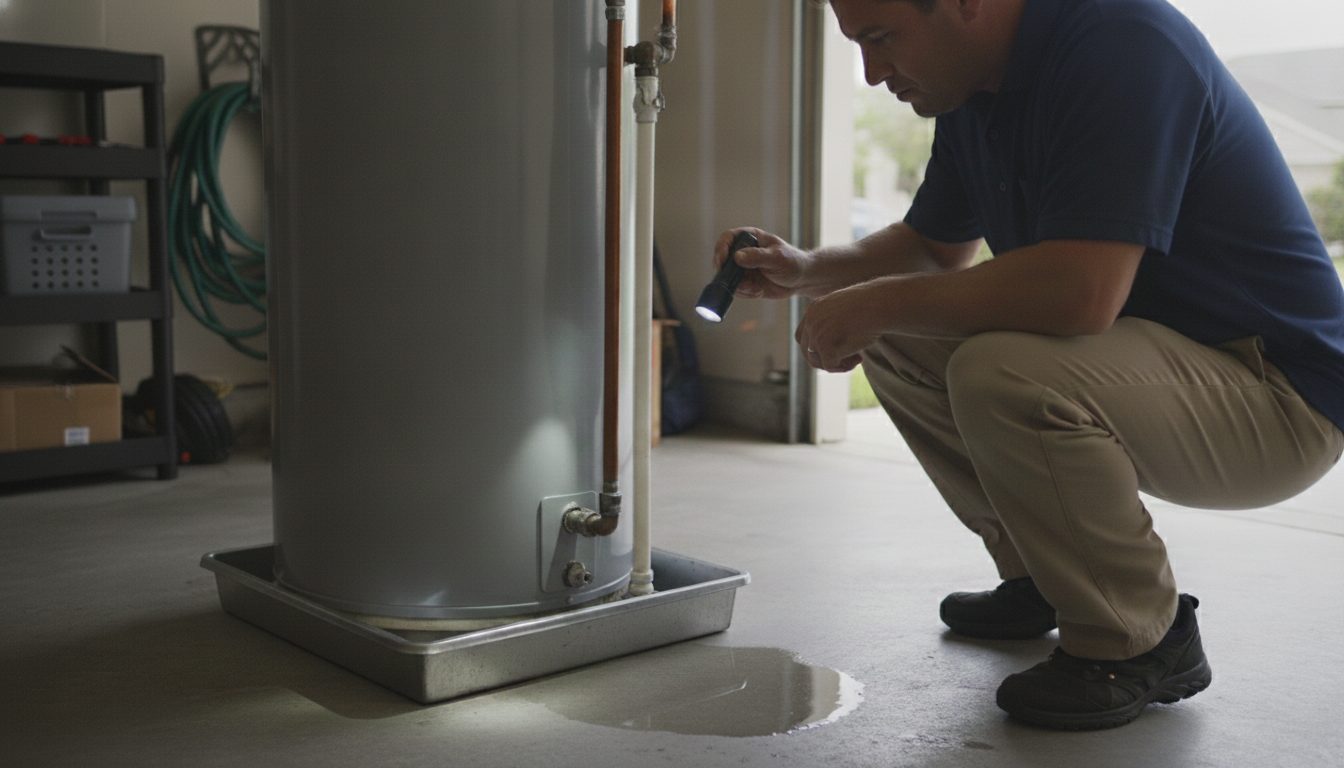
Where the water is actually coming from decides whether a leaking water heater is a small repair or a failed tank. A drip from a valve or fitting is often a straightforward fix. Water coming from the tank body itself means the tank is done, and no repair reverses that. The pan underneath the tank, if it drains anywhere, is often the only thing keeping a small leak from reaching your ceiling or your floor. Here’s how to trace it before you decide what’s next.
Cut the power, then the water, then drain it
Shut off the energy source to the water heater first, then its water supply. If it’s electric, switch off its breaker at the panel. If it’s gas, turn the gas control to off, or close the gas shutoff valve on the supply line. Then close the cold water shutoff valve at the top of the tank. If there isn’t one, or it won’t turn, use the main shutoff for the house.
Here’s the step people skip. Closing the cold supply stops the tank refilling. It does not stop the leak. A full tank still holds its entire charge, and it will keep emptying through whatever failed, which in an attic or closet install means it keeps going into your ceiling until it’s empty. If the unit is powered down and the supply is closed, thread a garden hose onto the drain valve at the base of the tank, run it outside or to a floor drain, open a hot tap somewhere in the house so the tank can vent, then open the drain valve. Don’t drain a water heater you can’t power down safely; call a plumber instead.
Everything you’re about to touch is hot. A residential tank stores water hot enough to scald, and the discharge pipe from the relief valve carries water hotter still. Use a towel rather than bare hands, keep your face away from the relief valve outlet, and if you’ve just shut the unit down, give it time before handling anything you don’t have to.
Water actively streaming or spraying from the tank is an emergency, a job for emergency plumbing service, not something to wait out. Slow weeping without active flow isn’t an emergency on its own, and it can wait for a scheduled visit. For the difference, see what counts as a plumbing emergency in Tampa Bay. For the full shutoff sequence, see how to shut off your water in an emergency.
Where is your water heater leaking from? Seven places to check
Dry everything around the base of the tank, then watch. A folded paper towel laid at each joint reads better than looking, because it shows a slow weep you’d never see on damp metal. Give it real time. A slow leak at a threaded joint can take an hour or more to re-wet a dried surface, so a few minutes of nothing doesn’t clear anything.
One note on order, because the shutoff you just did changes what you can see. If the supply is off and water is still appearing, the source is at or below the water line in the tank, which narrows it to the tank body, the drain valve, or an element port. If it stopped when you closed the supply, the source is on the pressure side, and you’ll need the water back on to find it.
The relief valve or its discharge pipe
Water coming out of the pipe that runs down the side of the tank doesn’t automatically mean the valve has failed. That’s the temperature and pressure relief valve, and on a closed system heated water has nowhere to expand, so pressure climbs and the valve opens to let it off. Florida’s plumbing code calls for a thermal expansion control device wherever the cold water feeding a storage water heater passes through a check valve, a pressure-reducing valve, or a backflow preventer, fitted downstream of all of them. Intermittent discharge that tracks the heating cycle is the signature of that problem, and the answer is usually an expansion device on the cold supply rather than a new valve. Our guide to high water pressure in a Tampa Bay house covers how that closed system gets created and how to test the pressure behind it.
Continuous discharge is a different story. That points to a fouled or failed valve, or to a pressure or temperature condition that needs a licensed plumber now rather than at the next convenient appointment. The valve responds to temperature as well as pressure, so water at your taps running hotter than usual, or steaming, alongside a discharging valve means shut the power or gas off and call. And whatever the cause, never cap, plug, or put a valve on that discharge pipe. Florida code specifically bars valves, tee fittings, and a threaded connection at the end of that line, because it’s the tank’s only pressure release.
If your home is a manufactured home, the federal standard routes that discharge line differently than a site-built house does, and it specifically bars it from ending underneath the home. See where a manufactured home’s relief drain is supposed to end.
The drain valve at the base of the tank
A drip at the valve where a hose threads on for flushing the tank often means it’s worn or not seated fully closed. It’s a moving part, so it’s a common point of failure. A worn drain valve is a replaceable part, and the licensed plumbers we connect you with can tell you whether swapping it fixes the leak or whether water is coming from somewhere above and running down to it.
The heating element ports, on an electric unit
Behind the access panel or panels on the side of an electric water heater, each heating element threads into the tank against a gasket. Those gaskets fail, and when they do the water runs down inside the jacket and shows up at the base of the unit looking exactly like a failed tank. It’s one of the cheaper repairs on this list, and it’s the reason water at the bottom of the tank isn’t the same finding as a tank that’s finished. The anode rod port at the top can seep the same way. Kill the breaker before anyone opens an access panel, because the terminals behind it are live.
The inlet and outlet connections at the top
Water tracking down from the top of the tank often comes from the fittings connecting the cold inlet and hot outlet lines, including flexible connectors, the union, or a dielectric fitting between dissimilar metals. Threaded joints loosen or corrode with time. A leak here is commonly a fitting repair rather than a sign the tank has failed.
Condensation, or the air handler next to it
Water in the pan on humid days that dries out again can be condensation. A tank drawing in cold makeup water sweats on its shell in Gulf Coast humidity, and that moisture collects in the pan below.
Before you settle on that, look up and look sideways. In a lot of Tampa homes the air handler sits in the same closet or the same attic as the water heater, and a clogged air conditioning condensate drain line puts water in exactly the same place, on exactly the same humid days. Follow the water to a source before you write it off as harmless. Genuine condensation appears with the weather and clears with it. A backed-up condensate line usually shows itself in the air handler’s own pan or at its drain line.
The pan and its drain line
Standing water in the pan means something above it is leaking, or the drain line is blocked. The pan catches drips, so water in it is a symptom rather than the source. Check the fittings above it first, and note that code allows a relief valve discharge to terminate into the pan, so on some installs pan water is the relief valve doing its job. If the pan is full and nothing above it looks wet, the drain line is likely clogged, and a blocked drain turns a small drip into water running through your ceiling or floor.
The tank body itself
Water appearing from under the tank’s outer jacket, or rust-colored water pooling with no fitting above it, means the tank has failed. That’s internal corrosion, and no repair reverses it. Before you buy anything, find the data plate on the side of the unit and read the model, serial, and manufacture date off it. Tanks carry a manufacturer warranty on the tank itself, and a tank that fails inside that window is often replaced by the manufacturer at no charge for the unit, which is a very different bill from a full retail replacement. Have that date in hand before anyone quotes you. Our guide to repairing versus replacing a water heater in Tampa covers how the plumbers we connect you with make that call, and water heater repair service covers the fixable end.
Two exceptions worth naming
If you have a tankless unit, the tank-specific checks don’t apply. There’s no tank body, no drain valve in this sense, and no pan requirement. Leaks there come from the isolation valves, the heat exchanger, or, on a condensing model, condensate that’s supposed to be there. Our guide to tankless water heaters in Florida covers what’s normal for those.
And if you rent, or you’re in a condo, call your landlord or your association before you call anyone else. In a condo especially, water heading toward the unit below is their problem as much as yours, and most Florida associations want to hear about it immediately.
Does Florida code require a pan under every water heater?
No. Under the Florida Building Code, Plumbing, 8th Edition, which is the edition in force now, a pan is required under a storage tank water heater only where a leak from that tank would cause damage. That’s a location-based rule, not a blanket one. The 9th Edition takes effect at the end of December 2026, so it’s worth re-checking after that.
The test is what a leak would actually reach. An interior closet, a laundry room, or an attic puts the tank straight above flooring, drywall, framing, or the ceiling of the room below, which is the situation the rule is written for. A unit in a garage, draining across a concrete slab and out toward the door, has somewhere for water to go without touching the structure. Which side of that line your install sits on is a call for your local building department, not something to settle from a photo.
The pan has to be at least one and a half inches deep and sized to catch what the tank sheds. Code lists galvanized steel or aluminum at least 0.0236 inch thick, plastic at least 0.036 inch thick, or another material your building department approves, and a plastic pan isn’t allowed under a gas-fired unit. The pan’s drain pipe has to be at least three quarters of an inch. None of that tells you whether your pan actually drains anywhere, which is the next question.
My pan doesn’t drain anywhere. Is that a problem?
Not necessarily, and code doesn’t force you to add a drain line just because you’re replacing the water heater. Code calls for a pan drain to run full size and terminate over an indirect waste receptor or a floor drain, or to run out to the exterior of the building and end there between six and twenty-four inches above the ground. That height range applies to the exterior route, not to a drain that ends over a floor drain inside. Older Florida homes turn up with a pan and no drain line at all, just a shallow catch basin with nowhere for the water to go.
Here’s the part that matters when you’re replacing the unit: the code says that where a pan drain wasn’t previously installed, one isn’t required for a replacement water heater installation. Swapping in a new tank doesn’t force a drain line onto an old, undrained pan. That’s a relief if you’re keeping a replacement simple, but read it narrowly. It excuses the drain line, not the pan, and it doesn’t reach a brand new installation. And the code’s minimum pan is only an inch and a half deep, so an undrained pan buys you very little before it overflows onto whatever is underneath. Worth knowing if the tank sits in an attic.
Where it sits changes the stakes
The location of your water heater decides how much damage a leak causes before anyone notices it. A water heater in a garage on a slab has room to fail without much consequence: water runs across the concrete floor and out toward the door, and you’ll likely see it before it travels far.
An interior closet or laundry room is different. The same leak soaks into flooring, baseboards, drywall, and framing before it’s visible from outside the closet door. An attic installation raises the stakes the most: water from a leaking tank there goes straight down through the ceiling of the room below, and by the time you see a stain inside the house, the leak has likely been running a while.
Be careful about going up there to look. A Tampa attic in summer gets dangerously hot, and people get into trouble fast in one. Go early in the morning, take water, don’t go alone, and step only on the joists. If you can’t see the source from the hatch, that’s a good moment to let someone else climb the ladder.
This is a Florida-specific problem, not a national one. With slab-on-grade construction the norm here, water heaters sit in garages, interior closets, and attics rather than a level below grade, so the leak path runs down or across. If you can see water but can’t find where it started, especially with an attic or closet install, professional leak detection finds the source before anyone opens up drywall or ceiling.
Photograph it before you clean it up
Before you mop anything, document it. Wide shots of the water, close shots of where it’s coming from, and a clear shot of the data plate on the side of the unit showing model, serial, and manufacture date. Report it to your carrier promptly, and if you pull out wet baseboard or drywall, photograph it before it goes in the bin. Start drying right away, because Florida humidity doesn’t help you here. What a policy actually pays for varies by policy, and our guide to what homeowners insurance covers on plumbing walks through how that generally breaks down.
After the tank fails: what replacement involves
A leaking tank body means replacement, not repair, and swapping a water heater is permitted work in this market rather than a quiet weekend job. Requirements and fees differ by jurisdiction across Hillsborough, Pinellas and Pasco, so check the one you’re actually in. Our guide to water heater permits in Tampa covers what that process involves and what happens when someone skips it. For what moves the price of a new unit, our water heater replacement cost guide breaks down the factors.
Tampa Bay’s water is also a factor in how long a tank lasts before you’re back here again. Hard water accelerates wear on a water heater, and our guide to how long water heaters last covers a reasonable service life in general.
Frequently asked questions
Is a leaking water heater always an emergency?
No. Active water streaming or spraying from the tank or its fittings is an emergency and needs attention right away. Slow weeping or a damp spot that isn’t actively flowing isn’t an emergency on its own, and it can wait for a scheduled visit. Dry the area first and watch how it behaves before deciding which one you’re dealing with.
Can I just tighten the fitting that’s leaking myself?
You can look, but tightening a threaded fitting on a water heater risks cracking an already-stressed connection or disturbing a gas line on a gas-fired unit. The licensed plumbers we connect you with can identify whether a fitting needs tightening, replacing, or isn’t actually the source before anything gets touched.
Does every Tampa water heater need a drip pan?
No. Florida code requires a pan only where a leak from the tank would cause damage. An interior closet, a laundry room, or an attic puts the tank right above finished surfaces, so those are the installs the rule is aimed at, but whether yours qualifies is a call for your local building department.
My replacement water heater’s pan has no drain line. Is that a violation?
Not automatically. The code says that where a pan drain wasn’t previously installed, one isn’t required for a replacement water heater installation. The pan itself is still required where the code calls for it, and the allowance covers the drain line on a replacement rather than a new install.
Why is water dripping from the pipe on the side of my tank?
That pipe carries discharge from the temperature and pressure relief valve. Intermittent discharge that tracks the heating cycle usually means pressure is building on a closed system, and the answer is an expansion device rather than a new valve. Continuous discharge is not routine: it points to a failed valve or an unsafe pressure or temperature condition, and it needs a licensed plumber promptly.
Is condensation on my water heater something to worry about?
Not on its own, but check what else is in the room first. A tank’s shell sweats against incoming cold water on humid days, and that water collects in the pan. In many Tampa homes the air handler shares that closet or attic, and a clogged condensate drain line looks identical. Genuine condensation clears when the weather does.
How do I know if the tank itself has failed versus a fixable part?
Water appearing from under the tank’s outer jacket, or rust-colored water pooling with no leaking fitting above it, points to the tank itself. Fittings, valves, element gaskets, and connections can all be repaired or replaced individually. A failure in the tank body can’t be, so replacement is the next step. Check the manufacture date first in case it’s still under warranty.
Get the leak found before it finds your ceiling
Tampa Plumbing Pro connects Tampa Bay homeowners with licensed plumbers who diagnose and repair water heater leaks throughout the metro, including Tampa and the surrounding area. Whether the source turns out to be a valve, a fitting, an element gasket, or a tank that’s finally failed, a licensed plumber can find it before ceiling or floor damage has a chance to compound. Call Tampa Plumbing Pro at (813) 590-0625.