No water from a well pump in Tampa
No water from a well pump in Tampa is not automatically a pull. Work this checklist first: check the breaker, tap the pressure tank from top to bottom, then ask whether it is May drawdown, then the pump.
A healthy tank sounds hollow above the water line and dull below it. If it sounds dull all the way up, the bladder is gone. A tripped breaker or a pitted pressure switch will also look like a dead pump. A pressure switch or tank replacement typically runs $250 to $600. A full submersible pump replacement usually runs $1,200 to $2,800.
That order matters out here. A meaningful share of homes in Odessa, Land O’ Lakes, Dade City, San Antonio, Thonotosassa, and the farm edges of Plant City run on private wells, and the failure that looks the most alarming is usually the least expensive one to fix. If you’re on city water instead, weak pressure has a different set of usual causes.
Start with the pressure tank, not the pump
If your pump is clicking on and off every few seconds while you run a faucet, that’s short cycling, and it’s almost always a waterlogged pressure tank. The tank holds a cushion of air above the water so the pump doesn’t have to start every time someone washes their hands. When the bladder fails and that cushion is gone, the pump starts and stops constantly, which is what burns out an otherwise healthy motor.
Here’s the quick check anyone can do. Tap the side of the tank from top to bottom. A healthy tank sounds hollow above the water line and dull below it. If it sounds dull and solid all the way up, the tank is full of water and has no air charge left.
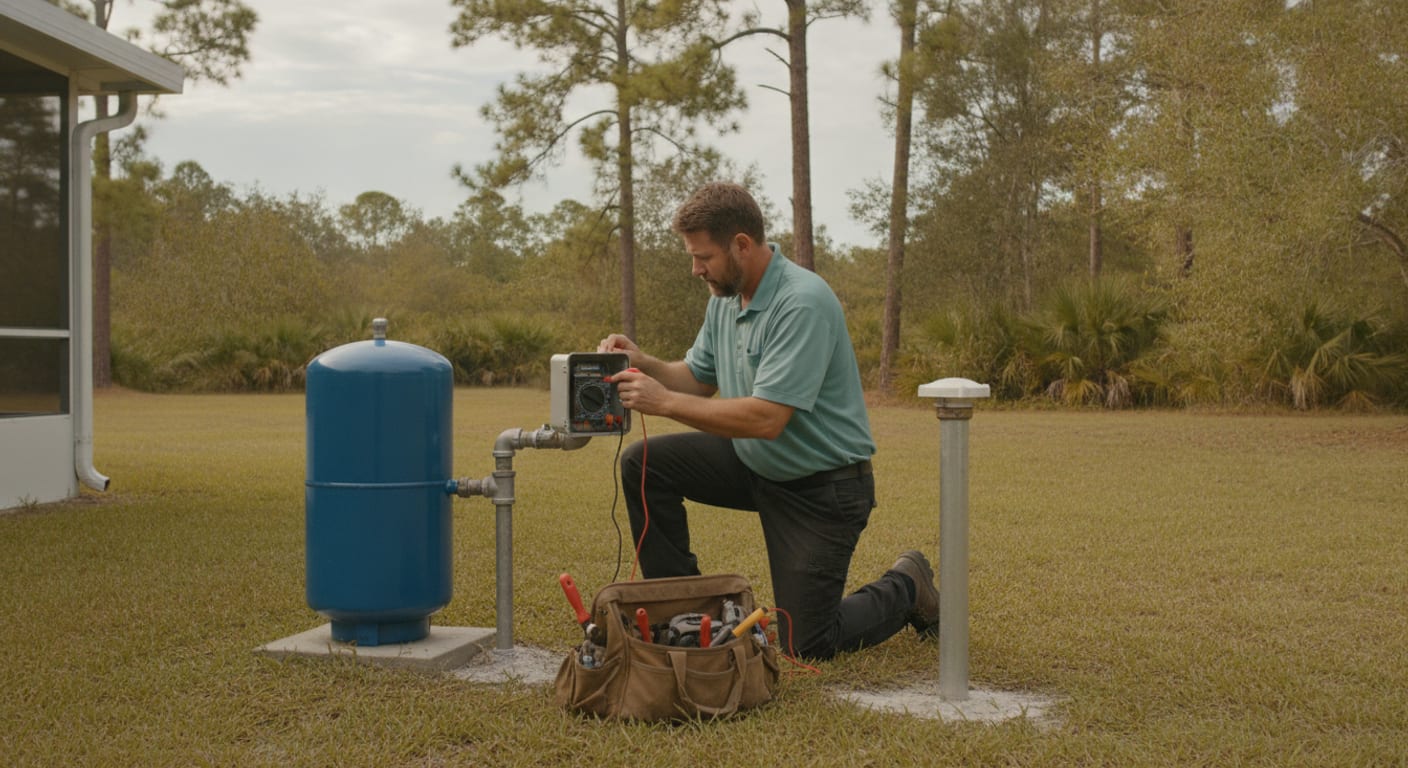
The other two cheap failures are the pressure switch and the wiring. A pitted or corroded switch contact will stop calling for the pump even though the pump itself is fine, and a tripped breaker or a chewed wire will do the same. All three of these get diagnosed at ground level with a pressure gauge and a multimeter, in one visit, without touching the well.
Why Tampa Bay wells lose water in May
Sometimes nothing failed at all. The water just moved.
The Southwest Florida Water Management District, which permits every well in this region, warns that groundwater levels can vary more than 40 feet between wet and dry years and seasonally as demand peaks. In District territory, May is usually the month water levels sit at their lowest, and September the highest after the summer rains. If your pump is set at a depth that worked all winter, a deep May drawdown can drop the water below the pump intake. You get sputtering, air in the lines, then nothing.
There’s a specifically local version of this. The District’s own consumer guide notes that agricultural operations pumping groundwater for frost and freeze protection in winter have lowered water levels by as much as 40 feet in parts of Plant City, Dover, and other areas of Hillsborough County. Homeowners near those groves lose water for reasons that have nothing to do with their equipment.
A pump running dry damages itself fast. The District recommends a low pressure cut-off switch for exactly this reason, and on a well that has already run dry once, it’s the cheapest insurance you can add.
What well pump repair in Tampa Bay actually costs
Pricing splits cleanly along the same line as the diagnosis.
A pressure switch or pressure tank replacement typically runs $250 to $600. Both are above-ground parts, both are same-visit work, and together they account for a large share of the well pump repair calls we run in Pasco and rural Hillsborough.
A full submersible pump replacement usually runs $1,200 to $2,800. The spread comes from well depth and pump size, because a deeper well means pulling and reinstalling more drop pipe. A 90-foot well and a 300-foot well are different jobs with the same parts list.
The reason the order of operations matters financially is simple. If you replace the pump without fixing a waterlogged tank, the new pump short cycles the same way the old one did, and you’ve bought yourself the identical failure on a shorter timeline.
Which pump you have changes the repair
Not every Tampa Bay well runs a submersible. The District groups residential pumps into a few types, and the one at your house sets what’s even possible.
Centrifugal and shallow well jet pumps sit at ground level and are limited to about 25 feet of suction lift. If your water table drops past that in a dry May, no amount of repair will help, because the pump physically can’t reach the water.
A deep well jet pump also sits at ground level but can normally lift water about 200 feet. These are easier to service, since the working parts are in your yard rather than down the casing.
A submersible pump sits inside the well with its motor, usually in a casing four inches or larger, and it’s invisible from the surface. Servicing one means pulling the pump and drop pipe, which is why the labor cost is what it is.
Knowing which type you have before anyone comes out speeds the whole visit up. If you can see a pump housing next to the tank, it’s a jet or centrifugal. If all you see is a capped pipe, it’s a submersible.
Who’s legally allowed to work on your well in Florida
This trips people up, so here’s the plain version.
Florida law draws the line at the hole in the ground. Under Florida Statute 373.303, construction of a water well covers everything necessary to get groundwater out of the ground, including locating and excavating the well, but it specifically excludes the installation of pumps and pumping equipment. Drilling a new well, repairing the well itself, or abandoning an old one requires a licensed water well contractor, and in this region that work also needs a permit from the Southwest Florida Water Management District. Abandonment permits are free, and a District representative witnesses the work.
Pumps, tanks, switches, and water conditioning equipment are a different category. Licensed water well contractors are allowed to install and repair them, and so are licensed plumbing contractors, since that equipment falls under the Florida Building Code plumbing provisions for private potable water systems. Florida Statute 373.323 also puts a limit on the other side: a water well contractor license by itself doesn’t authorize work that requires a Chapter 489 construction license.
What that means for you as a homeowner is straightforward. Pump, tank, switch, and treatment work is normal plumbing scope. If the diagnosis turns out to be the well itself, a collapsed casing or a well that needs deepening, that’s a water well contractor’s job, and we’ll tell you that instead of selling you a pump you don’t need.
What shortens pump life out here
A quality submersible pump typically lasts 8 to 15 years. Wells across Pasco and rural Hillsborough tend toward the shorter end of that range, and water chemistry is the reason.
Sediment and sand from this area’s aquifer grind at internal components every hour the pump runs. Iron does its own damage, feeding iron bacteria that builds a reddish slime inside pipes and pump equipment. Heavy hardness leaves scale on everything the water touches, the same way it destroys water heater elements.
Treating the water protects the pump, not just the taste. If you’ve never had your well tested, that’s the first move, and our guide to well water treatment in Pasco County walks through iron, sulfur, and hardness separately, because each one needs its own treatment stage and a plain water softener won’t handle all three.
No power means no water
Well homes lose water in an outage. City water customers usually keep pressure through a storm because the utility runs elevated storage and backup power, but your well pump runs on your house’s electricity and nothing else. When the power goes, so does the shower, the toilet refill, and the tap.
That’s worth planning around before hurricane season peaks, not during it. Filling containers ahead of a storm and knowing whether your generator can actually start a well pump motor are both worth sorting out early. Our hurricane season plumbing prep guide covers the rest of the storm checklist for Tampa Bay homes.
If you come back after an outage to no water at all, don’t keep flipping the breaker. Repeated dry starts are hard on a pump, and a burned-out motor turns a straightforward emergency plumbing visit into a full pump replacement.
Frequently asked questions
Why does my well pump keep turning on and off?
That’s short cycling, and it’s most often a waterlogged pressure tank rather than a failing pump. The tank has lost the air cushion that lets the pump rest between draws, so it starts and stops constantly. Replacing the tank typically runs $250 to $600, far less than a pump, and doing it early keeps the pump from burning out.
How much does well pump repair cost in Tampa Bay?
A pressure switch or pressure tank repair typically runs $250 to $600. A full submersible pump replacement usually runs $1,200 to $2,800, depending on well depth and pump size, since deeper wells require pulling more drop pipe to reach the pump.
My well has no water at all. Is it the pump?
Not necessarily. Check the breaker first, then consider the season. Groundwater in this District can vary more than 40 feet between wet and dry years, and May is typically the lowest month, so the water level may simply have dropped below your pump intake. A complete loss of water can also mean a failed pump or an electrical fault, which is why we test pressure and electrical draw before recommending anything.
How long do well pumps last around Tampa?
A quality submersible pump typically lasts 8 to 15 years. Wells with high sediment or iron content, which is common across Pasco and rural Hillsborough, usually land at the shorter end because those minerals wear internal components faster.
Do I need a permit to replace my well pump?
No. In this region a permit is required to construct or abandon a well, not to service the pump or tank. Florida Statute 373.303 excludes pumps and pumping equipment from the definition of water well construction, so a pump, tank, or switch replacement is normal plumbing work.
Can a plumber work on my well, or do I need a well driller?
Both are allowed to work on pumps, tanks, and water conditioning equipment. Only a licensed water well contractor can drill, repair, or abandon the well itself. If the problem turns out to be the well rather than the equipment, that’s the point where you need a driller.
Get a straight diagnosis before you buy a pump
We test pressure at the tank and at a fixture, check electrical draw against the pump’s rated specs, and inspect the tank and switch before anyone talks about pulling a pump. Most of the time the answer is a part you can hold in one hand.
We work the well belt across Pasco and rural Hillsborough constantly, we’re available 24/7, and we’ll tell you when the problem is the well instead of the pump.
Call Tampa Plumbing Pro at (813) 590-0625 and we’ll get your water back on.