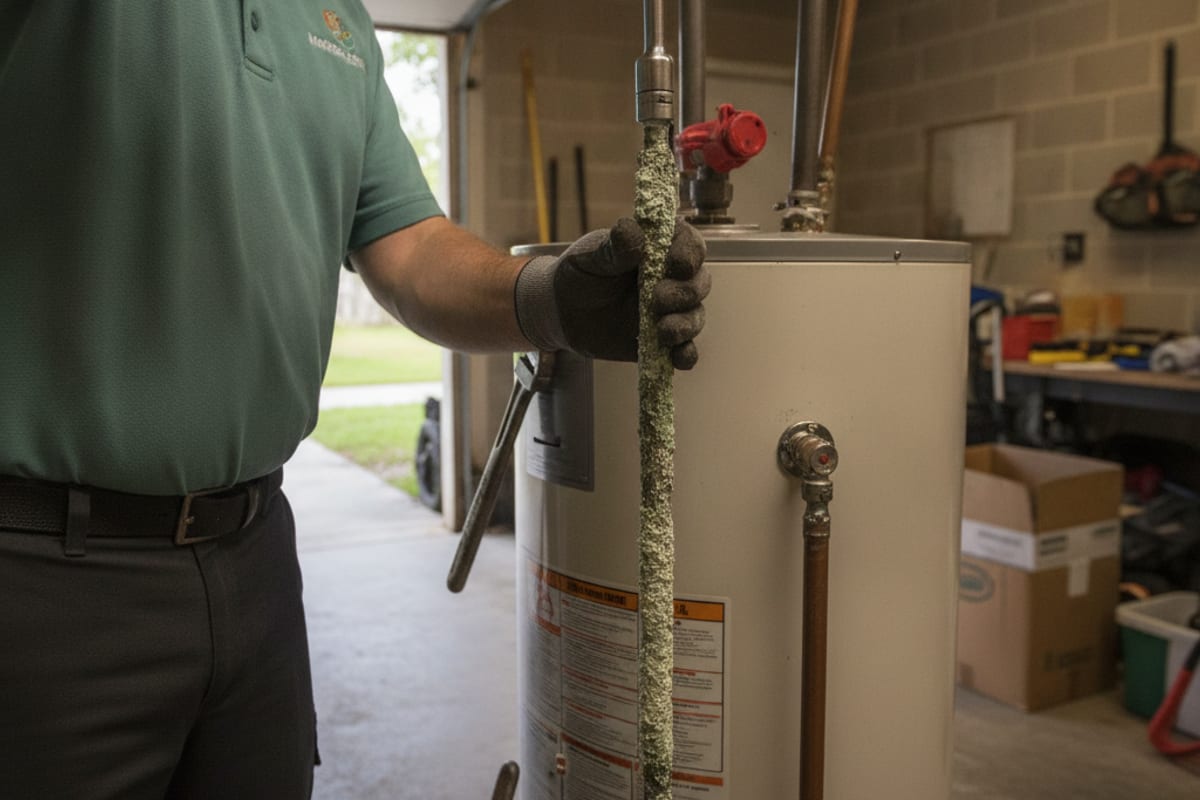
Tank water heaters carry a manufacturer rating of 8 to 12 years, and tankless units are rated 15 to 20 years. In Tampa Bay’s hard water, tank units without a softener commonly fail at 5 to 7 years instead, well short of that rating. The real number for your specific unit depends on water hardness, maintenance history, and whether it runs on gas or electric.
The licensed plumbers we send check water heater age and condition on service calls across Hillsborough, Pinellas, and Pasco, and most diagnostic visits get you a straight answer about how much life is left the same day.
How long do tank water heaters last nationally?
A standard 40 to 50-gallon tank water heater is built and rated for 8 to 12 years under normal conditions, meaning moderate water hardness and reasonably regular use. That rating assumes the tank isn’t fighting anything unusual, no unusually hard water, no extreme usage patterns, no skipped maintenance. It’s a national average, and it’s the number you’ll see on the unit’s spec sheet or warranty documentation regardless of where you live.
How long do tankless water heaters last?
Tankless units are rated significantly longer, typically 15 to 20 years, since they don’t hold a standing tank of water that’s constantly exposed to mineral buildup at the bottom. Instead, water passes through a heat exchanger only when you’re actually using hot water. That said, tankless heat exchangers use narrow internal passages that scale up fast in hard water without regular flushing, which means the gap between a well-maintained tankless unit and a neglected one is wider than it is with a tank heater.
Why Tampa Bay water heaters often fall short of that rating
Tampa’s municipal water averages around 11.7 grains per gallon, solidly in the very hard category, and climbs toward 17 to 18 grains per gallon during dry season. Every gallon that passes through a water heater leaves behind trace calcium and magnesium, and that mineral load settles as scale at the bottom of a tank or inside a tankless unit’s heat exchanger. Over years, that scale insulates the heating element or burner from the water it’s supposed to heat, forcing the unit to work harder and eventually cracking and clogging internal components. That’s the mechanism behind why a tank rated for 8 to 12 years nationally regularly makes it only 5 to 7 years here. Our deeper breakdown of how Tampa’s hard water wrecks a water heater covers exactly what that scale buildup does inside the tank.
Homes on private well water, common around Odessa and rural Pasco, often see even shorter lifespans, since well water frequently tests harder than treated municipal supply and sometimes carries iron or sulfur on top of the hardness. That sulfur is also behind the classic rotten-egg smell in hot water, which points at the anode rod rather than the tank’s age.
Gas versus electric: does fuel type change lifespan?
Both fuel types suffer from the same hard water scaling, but the failure points differ. On a gas unit, scale insulates the bottom of the tank from the burner underneath, forcing longer burn cycles to reach temperature. On an electric unit, the heating elements sit submerged directly in the water, and scale builds up directly on the element surface, which is why electric heating elements in this water often need replacement well before the tank itself fails. Neither fuel type reliably outlasts the other here. The bigger factor is whether the unit has a softener working ahead of it.
How to find out how old your water heater actually is
Most water heaters have a serial number on the manufacturer’s rating plate that encodes the manufacture date, though the format varies by brand. If you can’t decode it, a water heater repair technician can usually identify the age from the serial number and the unit’s general condition during a routine visit. Knowing the actual age matters more here than in a lot of markets, since a unit that looks fine on the outside can already be past the point where Tampa’s water typically causes internal failure.
What actually extends a water heater’s life here
Annual flushing, draining a few gallons from the tank’s bottom valve once a year, clears loose sediment before it hardens into a solid layer, and it’s the single cheapest thing a homeowner can do to push a unit closer to its full rated life in this water. Our guide to water heater flush cost in Tampa Bay covers what the service costs and what the manufacturer manuals actually ask for. A whole-house water softener addresses the problem at the source instead of managing symptoms after the fact, swapping calcium and magnesium for sodium before water ever reaches the heater. Homes with a properly sized softener routinely get closer to the full 8 to 12 year rating instead of losing years to scale. Checking and replacing the anode rod, the sacrificial metal rod that corrodes instead of the tank, every two to three years instead of the standard four to five also matters more here because hard water consumes it faster.
Signs your water heater is nearing the end, regardless of age
A few symptoms point to a unit running out of usable life no matter what the calendar says. Popping or rumbling sounds mean scale has built up enough to trap water underneath it, which boils and pushes through. Rusty or discolored hot water, especially when it’s only on the hot side, usually means the tank itself is corroding internally rather than an external part failing. A damp spot or active drip at the base of the tank is worth a leak detection visit right away, since a tank leaking from the shell rather than a fitting means the unit is done. Hot water that runs out faster than it used to signals lost tank capacity from sediment. And rising energy bills with no change in usage mean the unit is working harder to deliver the same result. Any one of these on a unit past 5 years old in this market is worth a look. Our guide on repairing versus replacing walks through exactly how the plumber we send makes that call on a service visit, and our full cost breakdown for replacement covers what a new unit actually runs installed. Whoever ends up doing the work, it’s worth confirming their CFC plumbing license at myfloridalicense.com before anything starts.
Frequently asked questions
How long do water heaters last on average?
Nationally, tank water heaters are rated 8 to 12 years and tankless units 15 to 20 years. In Tampa Bay’s hard water, tank units without a softener commonly fail at 5 to 7 years, roughly a third to half short of the national rating.
How long do tankless water heaters last compared to tank units?
Tankless units carry a longer manufacturer rating, 15 to 20 years against 8 to 12 for tank units, because they don’t hold standing water exposed to scale continuously. But their heat exchangers use narrow passages that scale up fast without regular maintenance, so a neglected tankless unit in hard water can underperform its rating just as much as a neglected tank.
Does a water softener really extend a water heater’s life here?
Yes, meaningfully. A softener removes the calcium and magnesium responsible for scale buildup before water reaches the heater, and homes with a properly sized softener routinely get much closer to the unit’s full rated lifespan instead of losing years to mineral scale.
How can I tell how old my water heater is?
Check the serial number on the manufacturer’s rating plate, usually located on the upper portion of the tank. The format for decoding a manufacture date from the serial varies by brand, so if you can’t tell, a technician can usually identify the age during a routine visit.
Should I replace a water heater before it actually fails?
If it’s past 8 years old in Tampa’s water, or showing any of the warning signs like popping sounds, discolored water, or reduced hot water volume, replacing on your own schedule beats waiting for a tank to fail and flood a closet on its own.
Does the brand of water heater matter for how long it lasts here?
Less than water hardness does. Reputable brands all build to similar tank and warranty standards, but none of them are immune to Tampa’s mineral load. A mid-range unit with a softener ahead of it will consistently outlast a premium unit without one.
Get a straight answer on your unit
Call Tampa Plumbing Pro at (813) 590-0625 and we’ll match you with a licensed plumber who can check your water heater’s age, condition, and how much life it likely has left in this water. The pros we send service tank and tankless units across St. Petersburg and the rest of Hillsborough, Pinellas, and Pasco counties.