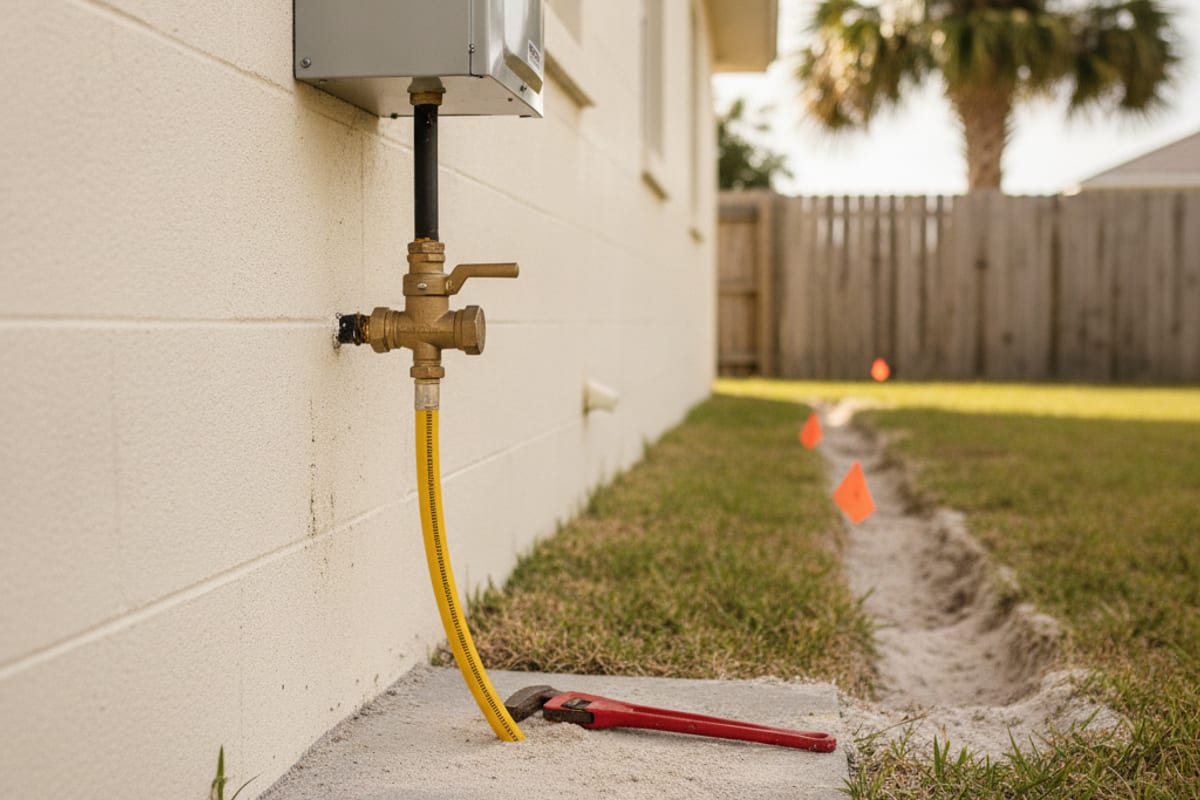
Gas line work in Tampa splits at the meter, and knowing which side of it your problem sits on tells you who to call. The piping from the street to the meter belongs to TECO Peoples Gas. Everything past the meter, the line feeding your range, your water heater, your pool heater, belongs to you, and a gas line plumber in Tampa is who works on it. If what you have right now is a gas smell rather than a project, stop reading and get out: call 911 from outside, then the utility. For everything else, here is who handles what, and why.
Who owns which part of the gas line
Peoples Gas draws the boundary itself: “While TECO Peoples Gas owns and maintains the natural gas piping from the street to your meter, natural gas customers are responsible for maintaining any natural gas lines from the meter to the point of use.” That one sentence settles most of the confusion we hear on calls. A problem with the meter, the service line under the parkway, or gas pressure arriving at the house is the utility’s equipment. A problem anywhere downstream of the meter is the homeowner’s piping, and the utility will not repair it for you.
That customer-owned side is bigger than most people picture. The utility’s own page on customer-owned piping lists the runs people forget: lines to a detached garage or workshop, to a swimming pool heater, to an outdoor grill, under some manufactured homes. In Tampa Bay that list also describes the standby generator pad that went in after the last two hurricane seasons, the outdoor kitchen on a FishHawk lanai, and the fire feature by the pool. Every foot of that pipe is yours to maintain, and the buried portions matter most. Peoples Gas puts it plainly: “Natural gas pipes that are buried in the ground can leak and metal pipes deteriorate with age, causing a potentially dangerous situation.”
Do plumbers handle gas lines in Florida
Yes, by the trade’s own legal definition. Florida’s contractor licensing statute writes gas piping directly into the plumbing contractor’s scope, which covers “the installation of water, natural gas, liquefied petroleum gas and related venting, and storm and sanitary sewer lines.” That is section 489.105, Florida Statutes, the same definition that covers the rest of the plumbing trade. Some outfits in the Tampa SERP market themselves as dedicated gas contractors, and plenty of plumbing companies run gas crews. Either way, the person cutting into fuel piping on your side of the meter should hold a current Florida contractor license, and checking it takes two minutes. Our guide to choosing a licensed plumber shows exactly where to look the license up.
Propane changes the label but not the logic. Out in Pasco County, in Odessa, Land O’ Lakes and Zephyrhills acreage where the mains don’t reach, the gas appliance runs on LP from a tank in the yard. The statute’s plumbing scope includes liquefied petroleum piping, and Florida separately licenses LP gas dealers and installers for the tank side of the system. Practically, your propane supplier owns the tank relationship, and the house piping past it is contractor work, same as city gas.
A leak is not a project, it’s an evacuation
The repair call and the emergency call are different calls, and the order matters. Natural gas is odorless out of the ground; the utility adds the rotten-egg odorant so your nose works as the alarm. If you smell it, Peoples Gas’s instruction is to get everyone out immediately, “report the situation to 911 and then call our 24/7 hotline at 877-832-6747.” Their safety page is specific about what not to do on the way out: no flames, no smoking, and nothing that can spark, which includes flipping light switches on or off and using garage door openers. The plumber comes later. Once the utility has made the scene safe and shut the gas, the repair of whatever failed on your side of the meter is contractor work, and that is the point where we can get an emergency plumber moving for you.
Here is the whole who-does-what question in one place:
| Situation | Who handles it | Why |
|---|---|---|
| Gas smell, hissing, dead vegetation over a buried line | 911, then Peoples Gas | Active leaks are life safety and utility jurisdiction, not a service call |
| No gas arriving, meter trouble, service line to the street | Peoples Gas | The utility owns and maintains everything up to your meter |
| New run to a range, generator, pool heater or outdoor kitchen | Licensed plumber or gas contractor | Customer-owned piping is licensed contractor work, permitted and inspected |
| Old buried line to a detached garage or grill | Licensed plumber or gas contractor | The utility says to have customer piping inspected periodically and repaired as needed |
| Moving or converting a water heater to gas | Licensed plumber | Fuel, venting and water connections sit squarely in plumbing scope |
Permits and digging rules before anyone cuts pipe
Gas piping work on a Tampa Bay home is permitted work, and the state just underlined it. Florida’s new under-$7,500 permit exemption, effective July 2026, expressly does not reach “Any electrical, plumbing, structural, mechanical, or gas work performed on property containing a single-family dwelling.” Small dollar value doesn’t exempt a gas run. The same bill also put gas permits on a fast clock: for an existing single-family home, work valued under $15,000 using a local government plans reviewer must be approved or denied within 5 business days. The permit is not paperwork theater either. It’s what puts a pressure test and an inspector between new fuel piping and live gas, which is exactly the step a handyman price skips. We walked through how Tampa Bay permitting works on the water heater permit post, and the logic for gas is the same.
Trenching matters too. Any buried run, say meter to pool heater, triggers Florida’s locate law. Peoples Gas states it flatly: property owners and excavators “MUST call 811 or go to sunshine811.com at least two full business days prior to digging to get underground utility lines marked at the dig site.” That rule exists because the line a shovel finds in a Tampa yard can be the gas service itself.
What gas work looks like around the bay
The jobs cluster by housing stock. In Seminole Heights, Hyde Park and the older South Tampa grid, homes that have burned gas since the 1950s carry original black iron pipe in walls and crawl spaces, and the common calls are corroded fittings, a range swap that reveals a valve nobody can turn, and appliance relocations during remodels. St. Pete’s pre-1975 bungalows are similar, with salt air working on anything exposed. The newer suburbs generate the opposite job: homes built all-electric where the owner now wants gas, usually for a tankless unit, a generator or an outdoor kitchen, which means a new run from the meter or a propane set. If a tankless conversion is the goal, size the decision before the pipe: our tankless water heater guide covers what the switch actually involves, and the water heater pros we send can tell you if your existing gas supply and venting support it. After the last few storm seasons, standby generator hookups have become the fastest-growing gas job in the metro, and they deserve the same permit-and-pressure-test treatment as anything else that burns fuel. Hurricane prep season is the wrong week to discover your generator line was never inspected, which is why gas sits on our hurricane plumbing checklist.
One caution on availability: not every Tampa street has a main. Whole neighborhoods here are all-electric, and Peoples Gas publishes its own availability checker. Confirm the main exists before you price the trench.
Frequently asked questions
Do plumbers install gas lines in Florida?
Yes. The statutory definition of a plumbing contractor includes “the installation of water, natural gas, liquefied petroleum gas and related venting.” Not every plumbing company chooses to do gas work, but it sits inside the licensed trade, and dedicated gas contractors work the same scope. Whoever you hire, verify the Florida license before they cut pipe.
What does it cost to repair a gas line in Tampa?
It’s quoted per job, because the drivers swing too widely for a flat number to mean anything. What moves the price: whether the failed section is exposed or buried, how long the run is, whether the line can be repaired at a fitting or needs replacing end to end, the material that’s there now, and the permit and pressure test that close the job out. A corroded union behind a range and a failed buried line to a pool heater are different afternoons. Get the diagnosis first, then the quote in writing.
Can I run my own gas line in my house?
Florida law treats gas work as permitted, licensed-trade work on a single-family home, and the new permit exemption law specifically carves gas out. Beyond the legal answer there’s a practical one: a water piping mistake leaks water, a fuel piping mistake can fill a wall cavity with gas. This is the one plumbing category where we tell even confident DIYers to put the wrench down and hire the license.
Does Tampa have natural gas service?
Yes. TECO Peoples Gas serves the Tampa area, and much of the older urban core has had mains for generations. Coverage is street by street, though, and plenty of newer subdivisions were built all-electric. Peoples Gas can confirm availability at your address, and where the main doesn’t reach, propane fills the same role with a tank and an LP conversion.
When to call us
Call us when gas work needs a license on your side of the meter: a new run for a range, generator or pool heater, an old buried line that’s never been inspected, or the repair after the utility has shut things down and cleared the scene. We’ll match you with a licensed plumber who handles gas piping, pulls the permit and pressure tests the work. Call us at (813) 590-0625.