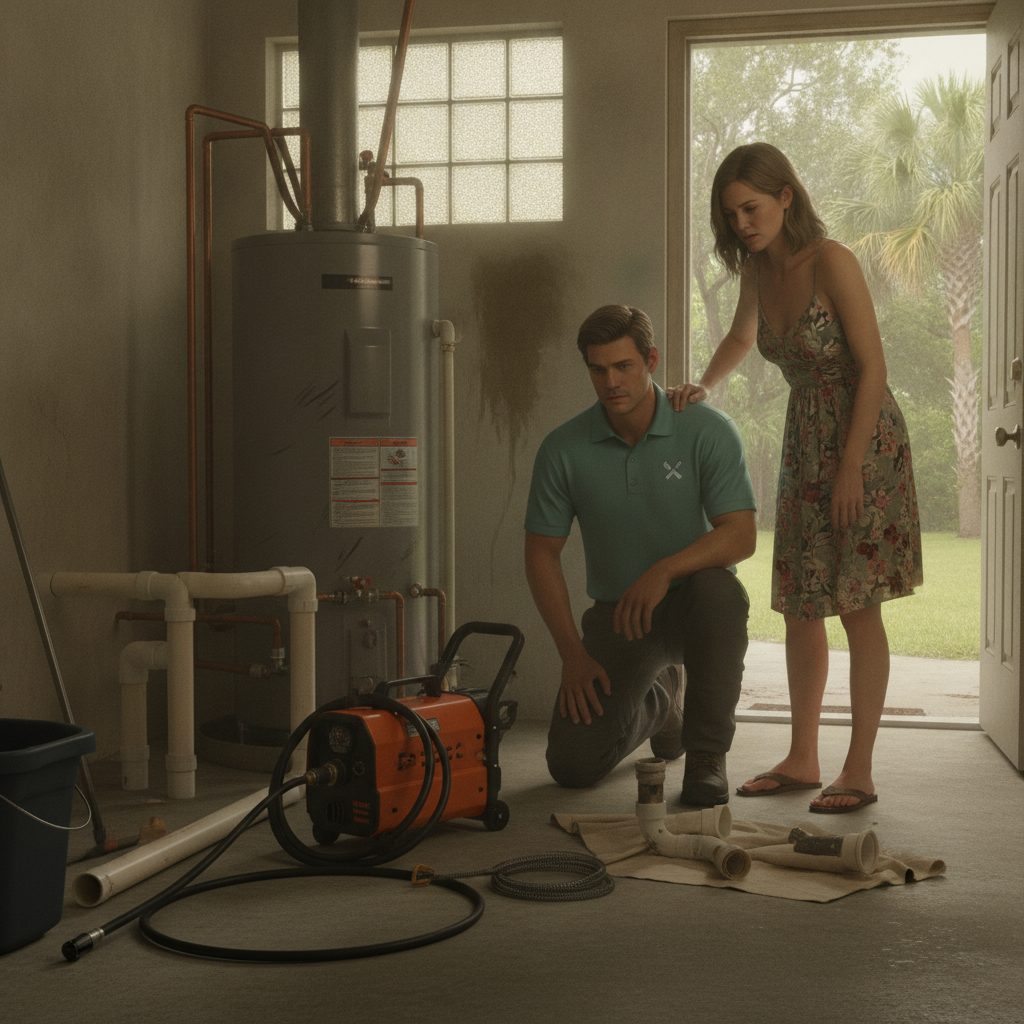
The kitchen sink in a South Tampa bungalow slows after dinner. A Brandon shower gurgles the same week the washing machine runs. Those two backups are not the same job, and hydro jetting vs snaking is the choice that decides whether the line stays open or clogs again in a month. A snake punches or hooks the obstruction so water can move. A jetter scours grease, soap, sand, and small roots off the pipe wall. The licensed plumbers we send pick the tool from what is actually in the line.
What a snake can reach and what it leaves behind
A drain snake is a flexible cable with a corkscrew or cutting head. The plumber feeds it until it hits the clog, then spins it to break the mass apart or pull it back. A short handheld cable is the tool for a bathroom sink or shower. A motorized machine through a yard cleanout is the tool for a main lateral.
Snaking is the right first move on a single fixture that has never backed up before. Hair in a Hyde Park shower. Paper in a Town ‘n’ Country toilet. A wad of food sitting in a kitchen trap. The City of Tampa’s blocked-drain guidance names grease, hair, food, paper, and roots as the usual suspects, and a cable can open a path through most of those.
What it does not do is wash the wall. Grease film, soap scum, and mineral scale stay stuck after the water starts moving again. That film is the next clog’s foundation. If the same line slows down days or weeks later, the snake did its job and still left the cause in place.
A cable can also compact a soft mass or shove it farther down a long run under a Valrico slab. That is how a clog can feel worse after a careless snake: the hole closes, or the wad sits deeper, past the next bend, where the next cable has farther to travel. On this site a standard single-fixture clearing runs $150 to $350 depending on access and severity. A straightforward cable cleaning through an accessible cleanout sits in the low hundreds. The drain cleaning page is where that work is scoped, and drain cleaning cost in Tampa is the page that owns the ranges.
A toilet is its own case. A plunger is the first tool because the trap is short and the clog is often right there. A closet auger, not a drain snake jammed down the bowl, is the next step if plunging fails. Forcing the wrong cable can scratch porcelain and still miss the wad. Our how to unclog a toilet walkthrough covers that sequence, and toilet repair is the call when the flange or the trap itself is the real problem.
When jetting is the right tool on Florida laterals
Hydro jetting sends water through a hose and a nozzle that sprays forward to punch the blockage and backward to drive the hose and scrub the wall. A jetter is built to clear sludge, soap, and grease and flush that debris out of the run. It is not a promise that every pipe can take that water.
Main-line hydro-jetting on this site runs $350 to $700. That is the published main-line figure, not a fixture snake. A camera inspection, bought on its own or bundled into other work, runs $150 to $500, and it is how a pro sees whether the pipe is sound enough for a jet. Sewer camera cost in Tampa is the page that owns that band.
Jetting fits when more than one fixture is slow at once. That pattern usually means the clog is in the building drain or the lateral to the city tap, not in one P-trap. It fits when a kitchen in Seminole Heights keeps slowing after every snake, because the wall is coated. It fits when a St. Petersburg bungalow on 1950s cast iron has roots at a joint. A cable cuts a hole through the root mass, and the roots grow back through that hole. Water can strip smaller roots and the sand they dragged in.
Florida laterals sit in sandy soil with a high water table, especially in Pasco and rural Hillsborough. Sand migrates into offset joints and sits on the invert, the low inside of the pipe. A snake rides over that sand. A jet can move it if the pipe is still intact.
Jetting is the wrong tool on a pipe that is already cracked, collapsed, or eaten through. Thinning cast iron in St. Petersburg is the local version of that risk. High-pressure water does not repair a broken bell. It can open a weak spot that grease had been sealing. That is why the plumbers we send look with a camera when the line has failed more than once, when more than one fixture is involved, or when the house is old enough that the pipe material is a question. If the camera shows a collapsed or offset run, cleaning is finished and sewer line repair is the next conversation. Recurring backups also show up on our signs you need sewer line repair list.
| Snaking | Hydro jetting | |
|---|---|---|
| What it does | Breaks or hooks the clog so water can pass | Water scours the full pipe wall and flushes debris |
| Best fit | One fixture, hair, paper, a first backup | Recurring clogs, grease, roots, sand in the lateral |
| What it leaves | Film and scale on the wall | Far less residue if the pipe is sound |
| Published range here | $150 to $350 for a single fixture | $350 to $700 for main-line jetting |
| When it is the wrong tool | Soft mass that packs deeper, roots that grow back | Cracked, collapsed, or badly thinned pipe |
Grease, roots, and sand in Tampa Bay lines
Tampa Bay clogs are not generic. The kitchen line in a Carrollwood rental coats with grease because cooking oil cools on the way to the stack and sticks. A snake pokes a hole through that ring. The ring stays, and the next weekend’s bacon fat grabs it. That is the pattern behind a clogged kitchen sink in Tampa that keeps coming back.
Roots are an older-stock problem. Live oaks and ficus find the joints in pre-1975 laterals under Seminole Heights, Hyde Park, Ybor, and the Gulf bungalows. Cast iron thins. Clay bells shift. A cable chops a window in the root ball. Jetting strips the finer intrusion and the soil that rode in with it. Neither tool welds a cracked joint. If the camera shows a belly or a break, you are past cleaning.
Sand is the Pasco and rural Hillsborough version. Land O’ Lakes, Odessa, Thonotosassa, and Wimauma sit on fast-draining sand and a high water table. Fine grit works into offset joints and sits on the invert of a shallow lateral. A snake skips over it. A jet can move it if the pipe still has a round interior. After an August afternoon storm, that same sand-and-water mix is why a line that was fine in March starts to gurgle.
Hard water adds a mineral film on top of all three. Tampa Bay water runs 11 to 17 grains per gallon depending on season and source, and that same scale that crusts a shower head and a water heater also clings inside drains with soap. Jetting can knock that film off a sound pipe. It does not soften the water.
The same pre-1975 South Tampa and Seminole Heights stock that still has thinning cast iron drains often still has galvanized supply. Jetting a drain does not fix a supply line that is rusting from the inside. That is a repipe conversation, and it is a different pipe.
Access changes the job as much as the clog does. Inside City of Tampa wastewater service, many homes have two cleanouts: one near the foundation and one at or near the property line. Water in the house cleanout with a dry property-line cleanout points to a clog in the house plumbing. Water at the property line points toward the city main, and city crews do not work on private property between the right-of-way and the house. That split is Tampa’s own guidance, not a countywide rule. Pinellas and Pasco customers confirm the same question with their own utility. How often a lateral should be cleaned, once you have a usable cleanout, is the subject of how often sewer lines should be cleaned.
Hurricane season, June through November, is when South Shore homes in Apollo Beach, Ruskin, and Gibsonton see the storm-surge and flood side of a backup. A jet or a snake restores flow. It does not fix a line that groundwater is already entering through a crack. Confirm the plumber on Florida’s license search before anyone opens a cleanout.
Hydro jetting vs snaking questions
How expensive is hydro jetting in Tampa Bay?
Main-line hydro-jetting on this site runs $350 to $700. A single-fixture snake sits lower, at $150 to $350 depending on access and severity. A camera, on its own or bundled, runs $150 to $500. What moves a job toward the high end is a long run under a slab, a buried cleanout, roots at several joints, or a pipe the camera shows is too weak for a full jet. Drain cleaning cost in Tampa is the page that walks those drivers without turning them into a flat rate.
Can snaking make a clog worse?
A careful snake opens a path. A rushed one can pack a soft grease mass or push it past a bend, so the backup returns faster and farther from the fixture. The more common miss is quieter: the line flows, the film stays, and the next clog builds on what was left on the wall. If the same drain slows again within days or weeks, the next step is a camera and, on a sound pipe, a jet, not a third pass with the same cable.
Is hydro jetting bad for old pipes?
Water pressure is hard on a pipe that is already cracked, offset, or eaten thin. It is the right cleaning method on a sound lateral coated with grease, soap, sand, or small roots. Older Tampa Bay homes, especially pre-1975 bungalows on cast iron in St. Pete and the inner neighborhoods, are where that distinction matters. The camera is what tells the plumber which of those two pipes you have. Jetting does not repair a break, and it should not be used as a test to see whether the pipe holds.
Is it better to plunge or snake a toilet?
Plunge first. Most toilet clogs sit in the trap, and a plunger is the tool that belongs there. If plunging fails, a toilet-specific closet auger is next, not a drain snake forced through the bowl. A toilet that keeps clogging after a clear trap is often a flange, a wax ring, or a deeper line problem, which is toilet repair rather than another plunge.
When to call us
Call when more than one fixture is slow, when the same drain comes back after a snake, or when sewage is backing into a tub or floor drain. The licensed plumbers we send will look at the clog, the pipe, and the cleanout access, then snake, jet, or move to a repair instead of repeating the wrong tool. Call us at (813) 590-0625.