If your home in Hillsborough, Pinellas, or Pasco County was built between 1978 and 1995, there’s a real chance the water lines running behind your walls are polybutylene, the gray plastic pipe that dominated new construction for almost two decades before it fell out of favor for a very specific reason: it fails from the inside out, often without any warning at all. Homeowners in Carrollwood, Town ‘n’ Country, and pockets of St. Pete’s Pinellas Point and Shore Acres neighborhoods run into this constantly, usually when a routine home inspection flags it or an insurer starts asking questions at renewal. Here’s what polybutylene actually is, why it matters more now than it did a decade ago, and what repiping it actually costs across Tampa Bay.
What polybutylene pipe is and why it fails
Polybutylene, often shortened to “poly-b,” is a flexible gray or off-white plastic pipe that builders used heavily from the late 1970s through the mid-1990s because it was cheap and fast to install compared to copper. The problem showed up over time: chlorine in treated municipal water reacts with the plastic at a molecular level, causing the pipe to grow brittle and flake apart from the inside. The damage is invisible from outside the pipe, which is what makes poly-b unpredictable. A line can look completely intact right up until the moment it splits open, usually inside a wall or ceiling where you won’t see it coming.
Fittings are often the weaker point rather than the pipe itself. Many original installations used acetate or plastic insert fittings that degrade even faster than the pipe run, so a failure often starts at a joint instead of mid-line.
Signs your Tampa Bay home might still have it
Polybutylene is usually visible where the main line enters the house, at the water heater connection, or in an accessible crawlspace or attic run. Look for a dull gray, half-inch to one-inch flexible pipe, sometimes stamped “PB2110” along its length. If your home was built in that 1978 to 1995 window anywhere in the metro, especially in New Tampa or the older sections of Carrollwood, it’s worth a look even if nothing has leaked yet. A lot of homeowners only find out during a real estate transaction, when an inspector flags it and the closing timeline suddenly gets complicated.
Why insurers are the real pressure point now
For years, poly-b sat quietly in walls without much scrutiny. That’s changed. A growing number of Florida insurers now decline to write new policies, or refuse to renew existing ones, once polybutylene shows up during underwriting. Some carriers require documented proof that a repipe is complete before they’ll issue coverage at all. That shift is what pushes most homeowners to act, not an actual leak. If your renewal notice mentions poly pipe, or your agent flagged it during a policy review, the clock is effectively already running whether or not you’ve had a leak yet.
What repiping actually involves
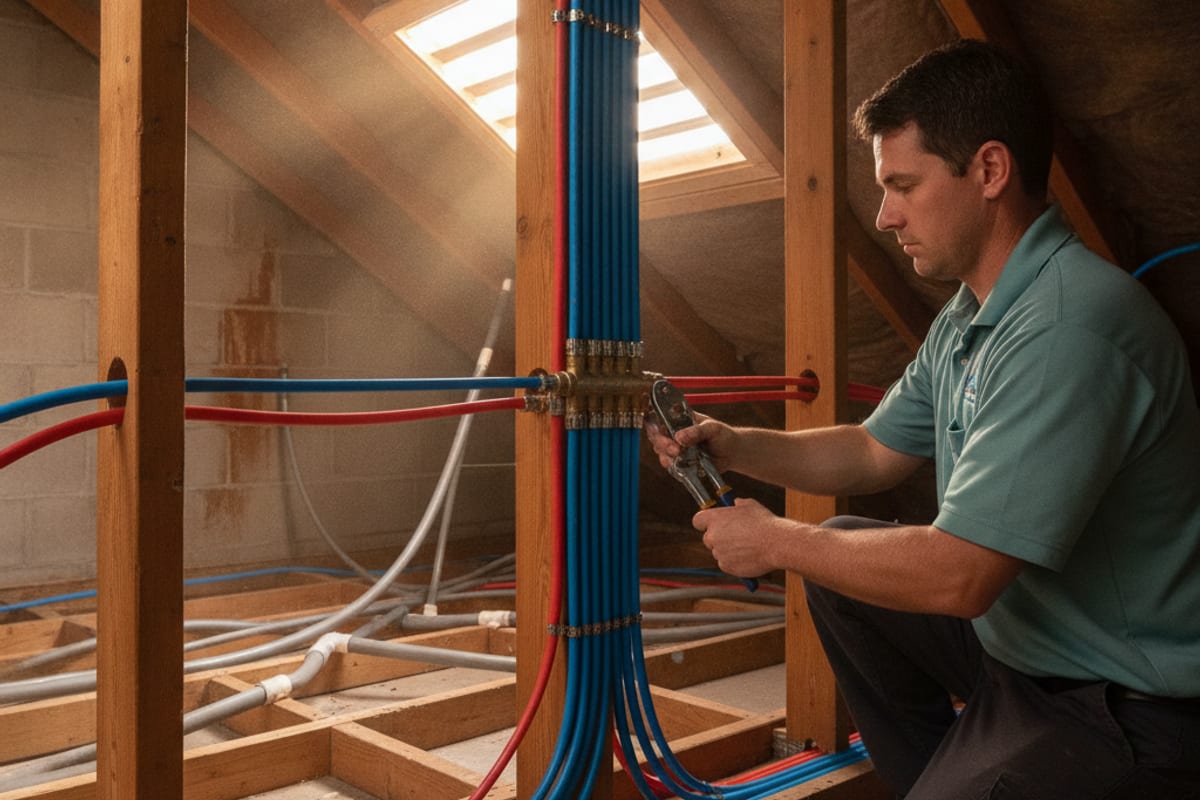
A full repipe means running new supply lines to replace the polybutylene throughout the house, usually with PEX. The work goes through existing chases, attics, and crawlspaces wherever possible to limit how much drywall has to come down, and fixtures get reconnected one at a time so most of the house keeps water access through the job. Expect small, targeted access points near fixtures rather than open trenches or torn-out ceilings. A single-story home in the 1,500 to 2,500 square foot range typically wraps in two to four days. Larger homes, or ones with more finished walls to work around, run longer.
What polybutylene repiping costs in Tampa Bay
For a standard single-story home in that same 1,500 to 2,500 square foot range, a full PEX repipe generally runs $4,000 to $10,000. Larger homes, homes with multiple bathrooms far apart from each other, or copper repipes instead of PEX can push that number to $12,000 or $15,000. A few things move the price within that range: how many fixtures need reconnecting, how much drywall access the layout requires, and whether the crew has to work around finished flooring like tile or hardwood that needs careful patching afterward.
Two-story homes and homes with a second-floor bathroom often run toward the higher end, since vertical runs through finished walls take more time to access cleanly than a single-story slab home with attic access above every fixture.
PEX or copper for the replacement
Most Tampa Bay homeowners choose PEX over copper for a poly-b repipe, and there are practical reasons beyond price. PEX resists the mineral scaling that Tampa’s hard water causes in copper over years, and it handles the ground movement and temperature swings common here better than rigid pipe. It also costs meaningfully less installed. Copper still has a place, particularly for homeowners focused on resale perception in higher-end neighborhoods, but it comes at a real premium over PEX for the same scope of work.
Hiring for a repipe: what to check first
A repipe is a big enough job that it’s worth confirming who you’re hiring before work starts. Verify any contractor’s CFC plumbing license directly at myfloridalicense.com before signing a contract or putting down a deposit. Ask for a written scope that spells out which walls need access points, get a firm price rather than a rough phone estimate, and ask whether the crew will provide documentation of completed work for your insurance company, since that paperwork is often what gets a lapsed or declined policy reinstated.
If a poly pipe fails before you’ve had a chance to repipe
Polybutylene doesn’t usually give warning before it splits. If a line lets go while you’re waiting on a repipe quote or scheduling the work, shutting off the main water valve is the first move, and getting water stopped fast matters more than anything else in that moment. Our emergency plumbing team runs calls across Hillsborough, Pinellas, and Pasco for exactly this situation, day or night, since a burst poly line left running even a short time can do real damage to flooring and drywall.
How do I know if my Tampa Bay home has polybutylene pipe?
Look for dull gray, flexible plastic pipe near the water heater connection, where the main line enters the house, or in an accessible crawlspace or attic. It’s sometimes stamped “PB2110.” Homes built between 1978 and 1995 anywhere in Hillsborough, Pinellas, or Pasco are the ones to check, especially in Carrollwood, Town ‘n’ Country, and New Tampa.
How much does polybutylene repiping cost in Tampa?
Most single-story homes in the 1,500 to 2,500 square foot range run $4,000 to $10,000 for a full PEX repipe. Larger homes or copper repipes can run up to $15,000. The final number depends on square footage, fixture count, and how much drywall access the layout requires.
Will my insurance company really drop me over polybutylene pipe?
Yes, and it’s become common practice across Florida insurers in recent years. Many decline to renew or write new policies once poly pipe is identified during underwriting, and some require proof of a completed repipe before issuing coverage at all.
Can I stay in my house during a polybutylene repipe?
Most homeowners do. The work moves room by room, and water typically only shuts off for short windows at whichever fixture is actively being worked on rather than the entire house.
Is it worth repiping if only part of my house has leaked so far?
If the rest of the plumbing is the same age and material, a spot repair on one failed section usually just delays the next failure rather than solving the underlying problem. Given that polybutylene fails without warning and insurers are increasingly strict about it, most homeowners in this position end up doing a full repipe anyway, just on a schedule of their choosing instead of an emergency’s.
Get a straight answer for your home
Every poly-b home is a little different, and the real number depends on layout, fixture count, and how much access the crew needs to work cleanly. See our full repipe page for what the process looks like from first walkthrough to final patch, or call Tampa Plumbing Pro at (813) 590-0625 and we’ll walk your home, confirm what you’re actually working with, and give you a firm, written price before anything gets scheduled.