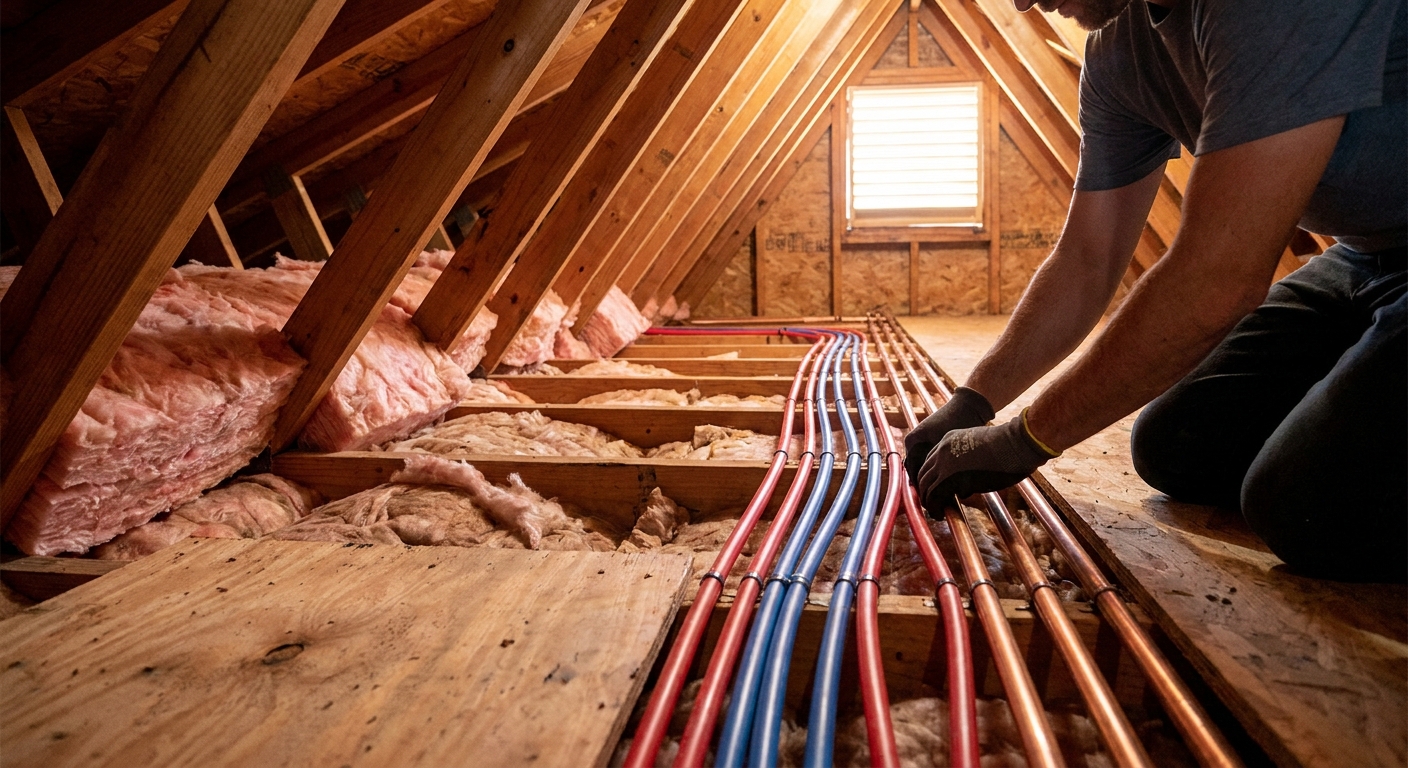
If you own a home built between 1978 and 1995 anywhere in Hillsborough, Pinellas, or Pasco County, there’s a good chance you’re sitting on polybutylene piping, and there’s a good chance your insurance company has already started asking questions about it. Polybutylene was a cheap, easy-to-install plastic pipe that turned out to react badly with the chlorine used to treat municipal water, causing it to become brittle and fail from the inside out, often with no warning. Insurers across Florida have gotten aggressive about non-renewal on homes with known poly pipe, which is why we get so many repipe calls from Carrollwood, Town ‘n’ Country, and New Tampa specifically, all poly hotspots from that building boom.
When it’s time to repipe, the real decision is PEX or copper. Both are solid materials. The right choice depends on your budget, your home’s layout, and how long you plan to stay in it.
What a repipe actually involves
A whole-home repipe means removing the old supply lines (the pipes bringing water in, not the drain lines) and running new ones to every fixture in the house: sinks, toilets, showers, washing machine, water heater, ice maker, outdoor spigots. On a slab-on-grade home, which describes the vast majority of Tampa Bay housing stock, this usually means running new lines through the attic and down interior walls rather than tearing up the slab, since accessing under-slab lines is far more invasive and expensive, closer to slab leak repair territory than a standard repipe.
Most repipes take two to four days for a typical 3-bedroom, 2-bath home, with drywall patching as a separate follow-up step. We coordinate closely on that timeline because nobody wants to be without running water longer than necessary.
PEX: the modern standard
PEX (cross-linked polyethylene) has become the default choice for most residential repipes, and for good reason. It’s flexible, which means fewer joints and fittings, which means fewer potential leak points. It doesn’t corrode, doesn’t react to our hard water the way older materials did, and it handles the freeze-thaw cycles we occasionally get during a rare Tampa cold snap better than rigid pipe.
Cost-wise, PEX repipes for a typical 3-bed, 2-bath single story home in Tampa Bay run roughly $4,000 to $8,000, depending on square footage, number of fixtures, and how accessible your attic and walls are. Two-story homes and larger houses in areas like FishHawk or Riverview with more bathrooms will land toward the higher end or above it.
PEX has one real weakness worth knowing about: it’s not UV-stable, so any exposed PEX outdoors needs to be protected or it degrades over time. It also shouldn’t run in direct contact with harsh chemical residues sometimes present in the soil or walls of older homes, so we plan routing around that before installation.
Copper: the traditional standard
Copper has been the gold standard for water lines for decades, and it’s still what a lot of homeowners in Hyde Park, Palma Ceia, and other historic South Tampa neighborhoods request, partly out of familiarity and partly because it holds resale value perception with buyers who distrust plastic pipe on principle.
Copper costs more, typically running $8,000 to $15,000 or more for the same 3-bed, 2-bath home, because copper material costs significantly more than PEX and installation takes longer since every joint has to be soldered rather than crimped or expanded. Copper also has a real vulnerability that matters specifically in Tampa Bay: our water is very hard, averaging 11.7 grains per gallon and climbing to 17-plus in dry season, and hard water combined with certain soil chemistry can accelerate pinhole leaks in copper over a couple decades. If you’ve already found one, here’s how to tell whether a pinhole leak in copper pipe is a section repair or the start of a repipe. We see this more often in older copper installations in St. Petersburg’s pre-1970s neighborhoods than in newer copper work, but it’s a real factor.
Copper does have advantages: it’s more resistant to physical damage and UV exposure, and some homeowners simply prefer having a fully rigid, traditional system for insurance or resale documentation purposes.
What we actually recommend
For most Tampa Bay homeowners doing a polybutylene repipe, we recommend PEX. It costs roughly half of what copper does, installs faster with less drywall disruption, and performs well against our specific water chemistry. The exceptions are historic homes where a buyer or insurance underwriter may specifically want copper documented, and homes where a whole-home water softener isn’t in the plan and hard water resistance matters more.
Either way, we always recommend pairing a repipe with a water softener installation if you don’t already have one. Hard water is hard on any pipe material over enough decades, and it’s a much smaller add-on cost when your walls are already open.
Financing and insurance timing
A lot of our repipe calls come in because an insurance company flagged poly pipe during a 4-point inspection at renewal and gave the homeowner a 30 to 60 day window to fix it or lose coverage. If you’re in that spot, call us as soon as you get that letter, not the week before your deadline. We can usually get a straightforward single-story repipe scheduled and completed inside two to three weeks depending on our board, but that window shrinks fast during storm season when emergency calls take priority.
Get a real number for your house
Every home is different, and the only way to give you an accurate number is to walk your attic, count your fixtures, and look at your wall access. Call Tampa Plumbing Pro at (813) 590-0625 and we’ll get out to your home, give you a straight PEX and copper comparison for your specific house, and help you get ahead of an insurance deadline before it becomes a crisis.
What about a partial repipe?
Not every home needs a full whole-house repipe right away. If only certain sections show poly failure, or your insurer’s letter names specific runs, a partial repipe targeting just those lines can buy time and cost less upfront. The tradeoff is that you’re likely back for the rest of the house within a few years as the remaining poly ages further, so we’ll always give you the honest math on partial versus full before you decide. If your home runs galvanized steel rather than poly, the pricing works differently, and our guide to galvanized pipe replacement cost in Tampa Bay covers that job on its own.