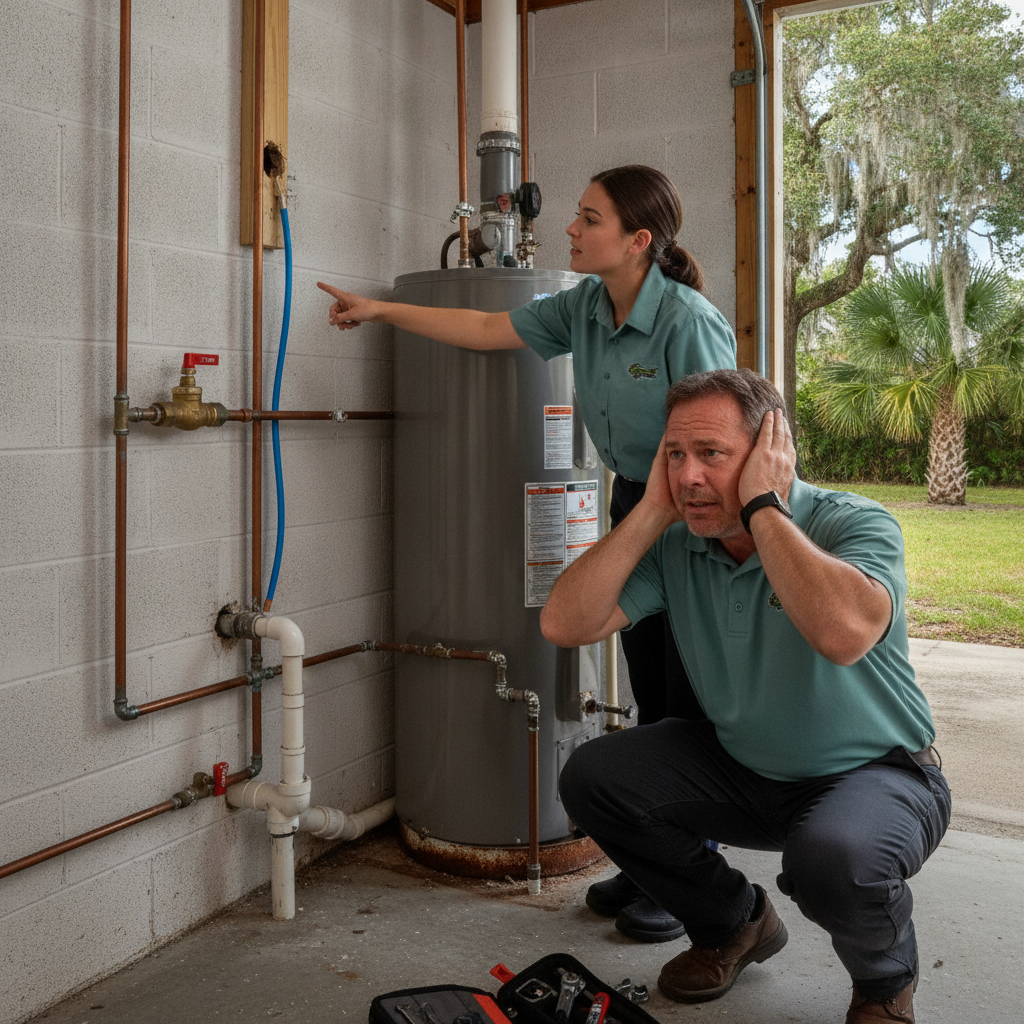
The washer in a Brandon ranch clicks off and the wall behind it knocks like a mallet hit the studs. That knock is water hammer, a pressure wave that forms when moving water is forced to stop in a hurry. Quick-closing valves on washers, dishwashers, ice makers, and newer toilets do it every day in Tampa Bay. The bang is not a clog, and it does not clear itself.
What water hammer is doing in the pipes
Water is heavy and it does not compress. While a faucet is open, a column of water is moving through copper, PEX, or old galvanized at whatever pressure your street or well is pushing. When a solenoid valve slams shut, that column still wants to keep going. The energy has nowhere to go, so it reflects as a shock wave. You hear it as a single bang or a short burst of knocks. You may feel the pipe jump in a garage bay or a laundry closet.
The wave travels the supply, not the drain. A washing machine that also overflows into a tub is a separate drain problem. That backup is a washing machine drain issue, and clearing it is drain cleaning, not a shock absorber. Water hammer lives in the hot and cold lines feeding the machine. In a Pinellas Park bungalow the sound often traces to a pipe that has been slapping a stud for years. The wood is dented. The hanger is loose. The fitting at the next elbow is the one that will weep first.
Older air chambers, those short capped tees above a fixture, used to cushion the hit with a pocket of air. They work until the air dissolves into the water. Then the bang comes back, often in a house that never did that before. A new washer with a faster valve can start the same noise in a 2000s FishHawk slab home that stayed quiet with the old machine. A dishwasher in a Carrollwood kitchen, or a fill valve on a toilet in a Dunedin ranch, can do it too. The pipes did not fail overnight. The stop got quicker.
The shock is worse on long, straight runs and at the far end of the house. A second-floor bath in South Tampa, or a laundry at the back of a Valrico ranch, gives the water more distance to pick up speed before the valve closes. Rigid galvanized, common in pre-1975 St. Petersburg, Seminole Heights, and Hyde Park stock, transmits the hit into every joint. Those lines are already thinning from the inside on Tampa Bay hard water. PEX flexes a little and can hide the sound, which is not the same as being safe. If a joint is already tired, the wave still loads it.
One bang rarely splits a good pipe. A season of them is how a slow leak starts inside a wall or under a slab. Florida’s plumbing code treats quick-closing valves as a reason to install a water-hammer arrestor, not as a noise complaint. That is the honest reading of the harm: repeated spikes fatigue fittings, appliance valves, and soldered or threaded joints until something weeps.
Arrestors, PRVs, and loose straps
Arrestors, a pressure-reducing valve, and tight pipe straps are the three fixes, and they are not interchangeable. Florida’s plumbing code requires a water-hammer arrestor where quick-closing valves are used, and those arrestors have to conform to ASSE 1010. An arrestor is a short, sealed chamber with a piston or a gas charge. When the valve slams, the piston moves and the shock dumps into the chamber instead of the pipe wall. The plumbers we send install them at the fixture that closes fast: the washer box, the dishwasher stop, sometimes the ice maker line. They can sit at any angle. They do not fix a pipe that is flopping in the bay. If the supply is loose, leftover energy still slaps the wood.
A pressure-reducing valve is a different tool. Florida’s plumbing code requires one inside a building when static pressure exceeds 80 psi, with a strainer, built to ASSE 1003 or CSA B356. The valve has to be designed to stay open if it fails, so a tired PRV can dump full street pressure into the house. That shows up as banging pipes, a suddenly noisy water heater, or a spike in pressure rather than a drop. Most Tampa Bay utilities deliver somewhere around 45 to 60 psi at the meter under normal use, so a lot of older homes never had a PRV. Most newer Tampa Bay construction on city water has one installed near the main shutoff. Hose bibs and outside hydrants are allowed to sit outside that valve.
If the house already has a PRV, a storage water heater needs a thermal expansion device on the cold supply downstream of that valve. The hammer bang at a washer is not the same as a heater that rumbles or a temperature-and-pressure valve that drips. Both can show up in the same week when a PRV has failed open. The plumbers we send sort that on a pressure gauge at a hose bib, not by guessing from the sound. High pressure inside the house is covered in more depth in our high water pressure guide, and a noisy tank often turns into a water heater repair visit once the gauge confirms the spike.
Loose straps are the third piece. Salt air on St. Pete Beach and Pass-a-Grille eats hangers. A slab-on-grade house in Seffner or Brandon can have a run that was never clipped well in the first place. An arrestor that is doing its job still needs the pipe held still. Tightening a visible strap in an open garage is simple. Opening a finished wall or chasing a line under a slab is licensed plumber work.
| Fix | What it changes | Where it belongs |
|---|---|---|
| Water-hammer arrestor | Absorbs the shock at a quick-closing valve | Washer, dishwasher, ice maker, and similar solenoids |
| Pressure-reducing valve | Lowers static pressure inside the house to 80 psi or below | Near the main shutoff when street or well pressure is high |
| Pipe straps and hangers | Keeps the pipe from slapping wood, block, or slab | Exposed runs in laundry closets, garages, and chases |
A whole-home repipe is not the first move for a bang at one washer. It becomes the conversation when galvanized is already thinning, joints are weeping in more than one spot, or the shock is the latest symptom of a system that is past its life. You can confirm a plumber is licensed through the Florida DBPR license search before anyone opens a wall.
Why a well or high municipal pressure makes it worse
A well pump that cuts out hard, or street pressure that has crept past what the house was built for, makes the same slam louder. The state rule on drinking-water systems sets a floor of 20 psi at the customer’s connection and does not set a ceiling. The 80 psi cap lives in the building code, inside the house. That split matters on a well in Land O’ Lakes, Odessa, or Wesley Chapel as much as it does on city water in central Tampa.
A private well uses a pump and a pressure tank. When the pump cuts out or a pressure switch slams, flow can stop as hard as a washer valve. If the tank is waterlogged, every fixture start and stop hits like a hammer. The plumbers we send treat that as well-side work. Well pump repair is how that visit is scoped. Do not open a control box yourself. Capacitors hold a charge, and the electrical half belongs to the technician.
High municipal pressure does the same thing without a well. A PRV that has failed open, or a house that never had one on a hotter-than-usual feed, raises the speed of the water. Faster water, same sudden stop, louder bang. Do not assume your utility runs high because a neighbor said so. Measure at a hose bib with a gauge. The City of Tampa’s water-pressure page talks about low pressure, not high. Pinellas County’s water FAQ does the same. Once the water is inside the building, high pressure is a house-side problem.
A manufactured home is designed for an inlet of 80 psi. Where the feed is higher than that, a reducing valve belongs on the home. That is a common setup in Town ‘n’ Country and other Tampa Bay parks, and the bang after a washer cycle is often the first clue the valve is tired.
A failed-open PRV also beats on the water heater. Tampa Bay water already runs 11 to 17 grains per gallon depending on season and source. Scale stresses tanks. Add a pressure spike and the tank, the relief valve, and the repair visit arrive together. That is the same pressure showing up in two rooms, not two separate mysteries.
How do you fix water hammer?
A licensed plumber stops water hammer by absorbing the shock at the valve that slams, then checking pressure and pipe support. Arrestors go at the quick-closing fixture. A PRV gets tested or added when static pressure inside the house is over 80 psi. Loose hangers get secured so the pipe cannot slap a stud. On a Pasco well, the pressure tank and switch get checked before anyone blames the washer. Access, the number of fixtures, and whether a PRV or a well tank is part of the job all change the work, so the plumber quotes after the gauge reading.
Does water hammer go away on its own?
Water hammer does not fade on its own. An old air chamber can go quiet for a while after the system is drained, then fill with water again and bang the next month. Stopping the washer hides the noise. It does not take the shock out of the pipe. The durable fix is an ASSE 1010 arrestor at the valve that closes fast, plus a house that is not running over 80 psi inside.
Why did water hammer start all of a sudden?
The pipes usually did not change overnight. The stop did. A new washer, dishwasher, or toilet fill valve closes faster than the one it replaced. An air chamber finally fills with water. A PRV fails open and street pressure hits the fixtures. A well tank waterlogs. A hanger rusts through in salt air and a pipe that used to be clipped starts to swing. Any one of those can make a quiet house loud in a single afternoon.
Is water hammer harmful?
Repeated water hammer can open joints and fatigue valves even when the first bang looks harmless. The risk is a slow leak in a wall, a slab, or at an appliance, not a pipe burst on day one. Galvanized joints in a 1950s St. Petersburg bungalow are already the weak point. Give them a season of shocks and they weep. That is when the conversation shifts from an arrestor to a larger repair.
When to call us
Call when the bang happens at every shutoff, when you can see a pipe jump, when a joint has started to weep, or when the water heater got noisy in the same week the washer started knocking. The plumbers we send are licensed and insured, and they will measure pressure before they open a wall. Call us at (813) 590-0625.