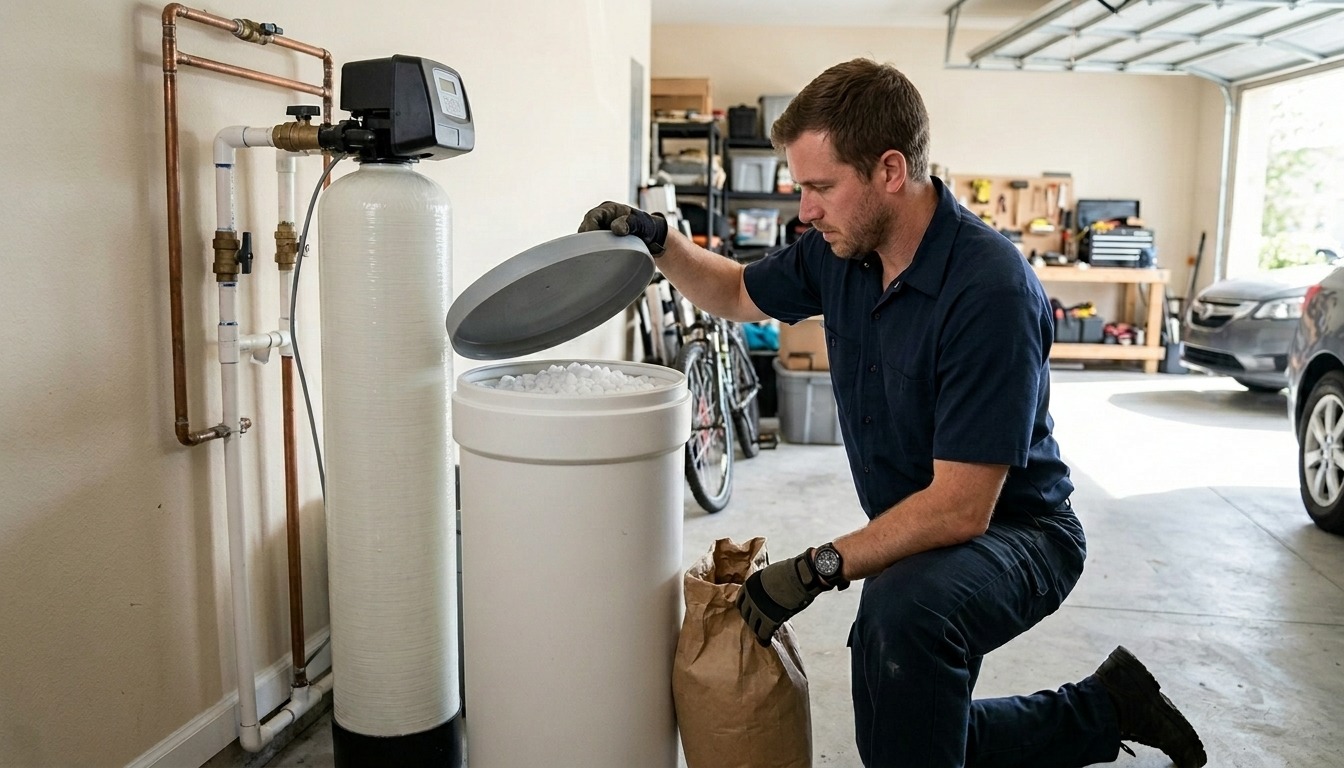
A Tampa Bay water softener needs its salt checked every 4 to 6 weeks and one professional service visit a year to inspect the resin bed and check the brine tank for salt bridging. That much is the standard baseline. What’s different here is the water itself. The City of Tampa and Pinellas County both switch disinfectants on a schedule, moving from chloramine to straight chlorine and back, and that switch changes what your softener’s resin is exposed to. National maintenance guides don’t account for that calendar. This one does.
How often does a water softener need maintenance in Tampa Bay?
Check the salt level every 4 to 6 weeks, and refill before the tank runs empty rather than after. The exact interval depends on household size and how hard your water is running that month. Beyond salt, a softener needs one professional visit a year covering three things: inspecting the resin bed, checking the brine tank for bridging, and confirming the unit is actually softening water to the level it should, not just running its regeneration cycle on schedule. A professional water softener service visit is also when a plumber walks you through the salt and maintenance schedule for your specific unit, since tank size and water use both change the interval. Staying current on both protects more than the softener itself. A unit that falls behind lets scale through, and that scale is part of what shortens a water heater’s working life in Tampa Bay’s hard water.
What is a salt bridge, and how do you know if you have one?
A salt bridge is a hard, crusted layer of salt that forms above an empty gap inside the brine tank, so the tank looks full from the top while there’s open space underneath. That crust blocks water from reaching the salt below it, which means no brine gets made and none reaches the resin during regeneration. The tank can look completely stocked while your water quietly goes hard again, because the salt level was never the problem, the crust sitting on top of it was. Morton’s own softener support says bridges are usually caused by high humidity or by using the wrong type of salt, and a Florida garage supplies the humidity half of that reliably. Overfilling the tank contributes too. If your water turns hard but the tank still looks full, check for a bridge before assuming the unit itself has failed. Morton’s instruction is to push a broom handle straight down into the salt, and if you feel something hard, work the handle into it in several places to break it up. Pellets or coarse solar salt bridge less readily than fine salt.
Why does water softener maintenance in Tampa Bay differ from the national advice?
National water softener maintenance guides assume a single, steady disinfectant, and Tampa Bay’s water doesn’t work that way. The City of Tampa’s water department says it primarily uses chloramine, ammonia added to chlorine, but switches to straight chlorine disinfection several times a year, usually in winter and summer, for three weeks at a time. Chlorine, the city says, is a strong disinfectant that keeps water safe as it travels through the mains to your tap. Pinellas County runs the same kind of program, temporarily converting chloramine to chlorine once or twice a year across all Pinellas County Utilities customers plus the Belleair, Clearwater, Safety Harbor, and Pinellas Park systems. Pinellas publishes its dates. The 2026 windows are May 18 through June 6, and September 21 through October 10. The county says residents may notice a slight taste or smell difference during a conversion, and that this is normal and carries no negative health effects. So if your water tastes like a pool for a few weeks in the fall, that’s the schedule, not your plumbing. What it means for your softener is that the disinfectant its resin sees isn’t constant. Most of the year it’s chloramine. Several weeks a year, it’s straight chlorine instead, and those are two different chemistries with two different effects on resin.
Does a carbon pre-filter actually protect the resin here?
Partially, and that’s the honest answer. Standard national advice says a carbon pre-filter protects your resin from chlorine, and that’s not wrong, just incomplete for a chloraminated supply like Tampa Bay’s. DuPont’s technical bulletin on resin oxidation stability states it directly: chloramines used for disinfection of drinking water are only partially removed by activated carbon, and can damage ion exchange resins. The bulletin adds that only sodium bisulfite or dithionite de-chlorinate efficiently in that case, and neither is what a standard carbon cartridge does. So for most of the year, when chloramine is the primary disinfectant, a carbon pre-filter reduces the resin’s oxidant exposure without eliminating it. During the chlorine conversion weeks carbon works harder for you, since the same bulletin says an activated carbon filter can remove excess chlorine. One thing worth knowing plainly: the numbers in that bulletin, 0.2 to 0.5 mg/L depending on resin type, are for free chlorine only, and they’re stated at 68°F. DuPont publishes no equivalent limit for chloramine, only the warning that it does damage. So a specific chloramine threshold isn’t a figure the resin makers have put a number to, whatever a guide tells you. The bulletin also notes that tolerance falls as temperature rises, roughly by half at 86°F and to virtually zero above 104°F, so a unit fed warmer water has less headroom than that table suggests. A carbon pre-filter is worth having, it just isn’t the complete answer national guides present it as. See water filter vs. water softener in a Tampa Bay home for the full split between what each device removes.
Why is my water softener not working?
Start with what you can check yourself. Check the salt level and look for a salt bridge, since both stop brine from reaching the resin. Check the bypass valve too, since if it’s turned to bypass, water skips the softener entirely and runs to your fixtures untreated. Those two are homeowner-fixable in minutes. Past that, it’s a plumber’s job. A failed regeneration clock or control valve stops the whole cycle, and diagnosing that means testing the valve, not guessing. A fouled or oxidized resin bed, from mineral buildup or cumulative oxidant exposure, softens water less effectively even when every mechanical part still works, and that’s not something a homeowner can inspect without opening the tank. Left unresolved, unsoftened water starts scaling everything downstream again, including the water heater, covered in more detail on our water heater repair page.
What does water softener repair cost, and when is it repair versus replacement?
There’s no honest flat repair price without seeing the unit, because cost depends entirely on which part failed. A stuck bypass valve, a failed control valve, a cracked brine tank, and a fouled resin bed are four different repairs at four different price points, and any number quoted sight unseen is a guess dressed up as a quote. What we can give you is the replace-side comparison: a new whole-home softener runs $1,800 to $3,500 installed in Tampa Bay, higher with well-water filtration added, and the full breakdown lives in what a water softener costs in Tampa. That range becomes the relevant comparison once a unit is old enough, or its resin damaged enough, that repair stops making financial sense. If the resin bed itself has failed, from age, oxidative exposure, or both, replacing the unit often beats rebuilding an old tank around new resin. The licensed plumbers in our network diagnose which category your unit falls into before recommending either path.
What about homes on private wells?
Well water adds a second oxidant risk. DuPont’s bulletin notes that elevated temperature and the presence of iron or heavy metals can have a catalytic effect and increase oxidative damage to the resin. Iron is common in private wells across rural Pasco County, so a softener on well water can be fighting mineral fouling and accelerated oxidative wear at once, a different situation from a straightforward hardness problem, covered in full in well water treatment in Pasco County. Iron-heavy, untreated water is also hard on the well pump itself over time, a wear pattern covered separately on our well pump repair page.
Frequently asked questions
How much salt does a water softener need each month?
Most Tampa Bay softeners need salt refilled every 4 to 6 weeks, though the exact interval depends on household size and how hard your water is running. Households using more water, or facing especially hard water, refill sooner than that range. Checking on a schedule, rather than waiting until the tank looks low, is the more reliable habit.
What causes a salt bridge, and how do I prevent one?
Morton’s softener support attributes bridging mainly to high humidity or the wrong type of salt, and overfilling the tank adds to it. Using pellets or coarse solar salt rather than fine salt helps, as does not packing the tank to the top. Checking the tank at each refill, rather than only when the water feels hard, catches a bridge early.
Does Tampa’s water utility really switch disinfectants during the year?
Yes. The City of Tampa’s water department states it primarily uses chloramine but switches to straight chlorine disinfection several times a year, usually in winter and summer, for three weeks at a time. Pinellas County runs a similar program on published dates, with a chlorine conversion window scheduled for September 21 through October 10, 2026.
Will a carbon pre-filter fully protect my softener’s resin from Tampa’s water?
No, not completely. DuPont’s technical bulletin on resin oxidation states that chloramine is only partially removed by activated carbon and can still damage ion exchange resin. A carbon pre-filter reduces the resin’s oxidant exposure during the months chloramine is the primary disinfectant, but it isn’t the full solution it would be against chlorine alone.
How long do water softeners last in Tampa Bay?
There’s no single verified number, and the resin makers say so themselves. DuPont’s bulletin states plainly that it is not possible to accurately predict resin life once other factors are considered, and it describes the effect of free chlorine as additive, meaning exposure accumulates rather than resetting. A softener with salt checked on schedule and an annual professional resin inspection holds up better than one running unmonitored. Anyone quoting you a firm lifespan without knowing your water and your unit’s history is guessing.
Should I repair my water softener or replace it?
That depends on which part failed and how old the unit is, and there’s no honest answer without a plumber looking at the system. A stuck valve is often a straightforward repair. A resin bed that’s fouled or oxidatively damaged usually favors replacement, especially once repair costs approach the $1,800 to $3,500 a new unit runs installed.
Get your softener checked around a conversion window
Both utilities repeat these conversions year after year, and Pinellas posts its dates ahead of time, so it’s worth checking your own utility’s notices rather than working from a date in an article. Either side of a conversion is a sensible time to book the annual check your softener is probably already due for: resin inspection, brine tank check, and confirmation the unit is actually softening to the level it should. We connect Tampa Bay homeowners with licensed plumbers who install and service whole-home softeners, and who set the maintenance schedule around your household and your water rather than a generic interval. Call Tampa Plumbing Pro at (813) 590-0625 to get your softener checked.