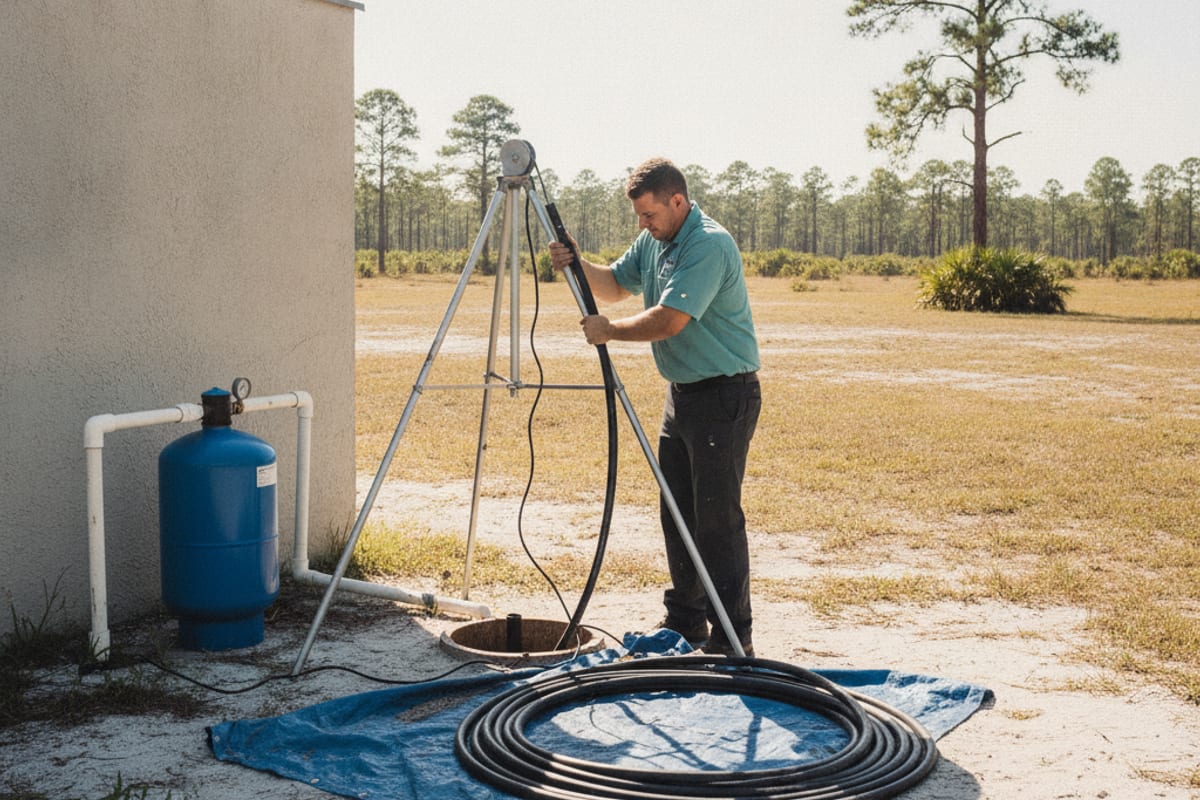
A well that loses pressure or water is not automatically a failed submersible pump. A pressure switch or a waterlogged pressure tank gets mistaken for a failed pump constantly. Getting the right diagnosis first is what keeps a homeowner from paying pump prices to fix a tank problem.
Tampa Plumbing Pro matches you with a licensed plumber who brings pressure and electrical-draw testing equipment to a well call across Pasco and rural Hillsborough. The assigned plumber quotes after the fault is found. This site does not publish a well pump, pressure tank, or pressure switch price.
What does well pump replacement cost?
A full submersible well pump replacement covers the pump itself, pulling and replacing the drop pipe and wiring that run down the well casing, and reconnecting the system to your existing pressure tank. Deeper wells cost more because pulling and reinstalling pipe from further down takes more time and, on some jobs, specialized equipment to handle the added weight and length. The plumber we send prices that after measuring the well and confirming the pump is the failed part.
Why is a pump problem often really a tank problem?
Short cycling, a pump kicking on and off frequently even with no water running, is one of the most common well complaints, and it’s usually not the pump at all. A waterlogged pressure tank loses its internal air cushion, and once that happens the pump has to run far more often to maintain household pressure, wearing it out faster in the process. Fixing the tank or the pressure switch is a different, usually smaller job than a pump replacement, and it’s always worth ruling out before assuming the pump itself has failed.
What drives the price up or down?
Well depth is the single biggest factor, since a deeper well means more drop pipe and wire to pull and reinstall, and more labor time regardless of which pump goes back in. Pump size and horsepower matter too, sized to your household’s water demand and well output, with larger homes or properties running irrigation off the same well needing a higher-capacity pump that costs more. Access also plays a role. A well with a straightforward wellhead is a faster job than one buried under landscaping or requiring extra work to reach.
How well depth changes the number
Properties around Odessa, Land O’ Lakes, and Shady Hills often draw from wells at meaningfully different depths depending on the local aquifer conditions, and depth alone can change the quote substantially. A shallower well is a more straightforward pull than one going much farther down, where the added pipe, wire, and time add up. This site does not publish a typical Tampa Bay well depth. The plumber we send measures your actual well depth before quoting rather than assuming based on a neighboring property, since depth can vary block to block even in the same subdivision.
Signs you need a pump replacement, not just a repair
A few symptoms point more clearly toward the pump itself rather than the pressure tank or switch. No water at all, rather than reduced pressure, often means a pump motor has failed outright. Water that sputters or runs with visibly reduced flow at every fixture, not just one, suggests the pump isn’t delivering the volume it used to. Unusually high electric bills with no other explanation can mean a failing motor is drawing more current to do the same work. And a pump already past 8 to 15 years, especially on a well with high sediment or iron content common in this region, is statistically closer to replacement than repair territory. The plumber we send tests the pump’s actual electrical draw against its rated specs to confirm which one it is rather than guessing from symptoms alone.
Submersible pump versus jet pump: does it change the cost?
Most residential wells in this area use submersible pumps, which sit down in the well itself, since they handle the depths common to Pasco and rural Hillsborough wells more efficiently than a jet pump mounted above ground. Submersible replacement cost follows well depth, pump size, and access, quoted after diagnosis. Jet pumps, more common on very shallow wells, are less frequently the replacement out here, and pricing depends on the specific setup if that’s what your property has.
What a replacement day actually looks like
The plumber we send starts by testing system pressure and the pump’s electrical draw to confirm the pump itself is the problem rather than the tank or switch. Once confirmed, the pump, drop pipe, and wiring get pulled, the new pump is installed sized to your well depth and household demand, and pressure and flow are tested at multiple fixtures before the job is called done. How long the pull takes depends on depth, access, and whether the pump is the actual failed part. The assigned plumber confirms the schedule after diagnosis.
What else to check while a pump is being replaced
A pump replacement is a natural point to look at the rest of your well system while the equipment is already open. High iron or sediment content accelerates pump wear, and if your well water tests hard on top of that, pairing the new pump with water softener or filtration protects the investment instead of running the same conditions that shortened the last pump’s life. Most well-water properties out here also sit on a septic tank rather than municipal sewer. That tank is a separate system. If it is due for service, we can match you with a licensed and registered septic contractor. It is not part of the well-pump quote. Before any pump work begins, confirm the crew’s CFC plumbing license at myfloridalicense.com, the same two-minute check worth doing for any plumbing job.
Frequently asked questions
How much does well pump replacement cost?
This site does not publish a well pump, pressure tank, or pressure switch price. A submersible pump replacement is quoted after the plumber confirms well depth, pump size, and that the pump itself is the failed part. A pressure tank or switch repair is a separate job, and it is often the actual culprit behind pump-like symptoms.
Why does well depth affect the price so much?
Deeper wells require pulling more drop pipe and wiring to access and reinstall the pump, which adds direct labor time regardless of the pump itself. Properties in this region can vary meaningfully in well depth even within the same neighborhood.
How do I know if it’s the pump or the pressure tank?
The most reliable way is testing, checking system pressure at the tank and at a fixture, then testing the pump’s actual electrical draw against its rated specs. Short cycling in particular is more often a waterlogged pressure tank than a failing pump.
Can I replace a well pump myself?
It’s not a typical DIY job. Pulling drop pipe and wiring from depth requires equipment most homeowners don’t have, and improperly sized replacement pumps or incorrect wiring create real safety and equipment risks. Diagnosis alone, confirming pump versus tank, also requires testing equipment most homeowners don’t own.
How long does a well pump replacement take?
The assigned plumber confirms how long the job will take after testing pressure and draw and confirming the pump is the actual problem. This site does not publish a same-day diagnosis or a set hour count.
How long do well pumps typically last before needing replacement?
A quality submersible pump typically lasts 8 to 15 years, though wells with higher sediment or iron content, common across Pasco and rural Hillsborough, tend toward the shorter end because of added wear on internal components.
Get a real diagnosis before you pay for a pump
Call Tampa Plumbing Pro at (813) 590-0625 and we’ll match you with a licensed plumber who can test your system on-site, tell you honestly whether it’s the pump, the tank, or the switch, and give you real pricing before any work starts. We cover well-water properties across Land O’ Lakes, Odessa, and the rest of Pasco County and rural Hillsborough. If your water quality itself is the issue rather than pressure, our guide to well water treatment in Pasco County covers iron, sulfur, and hardness separately.