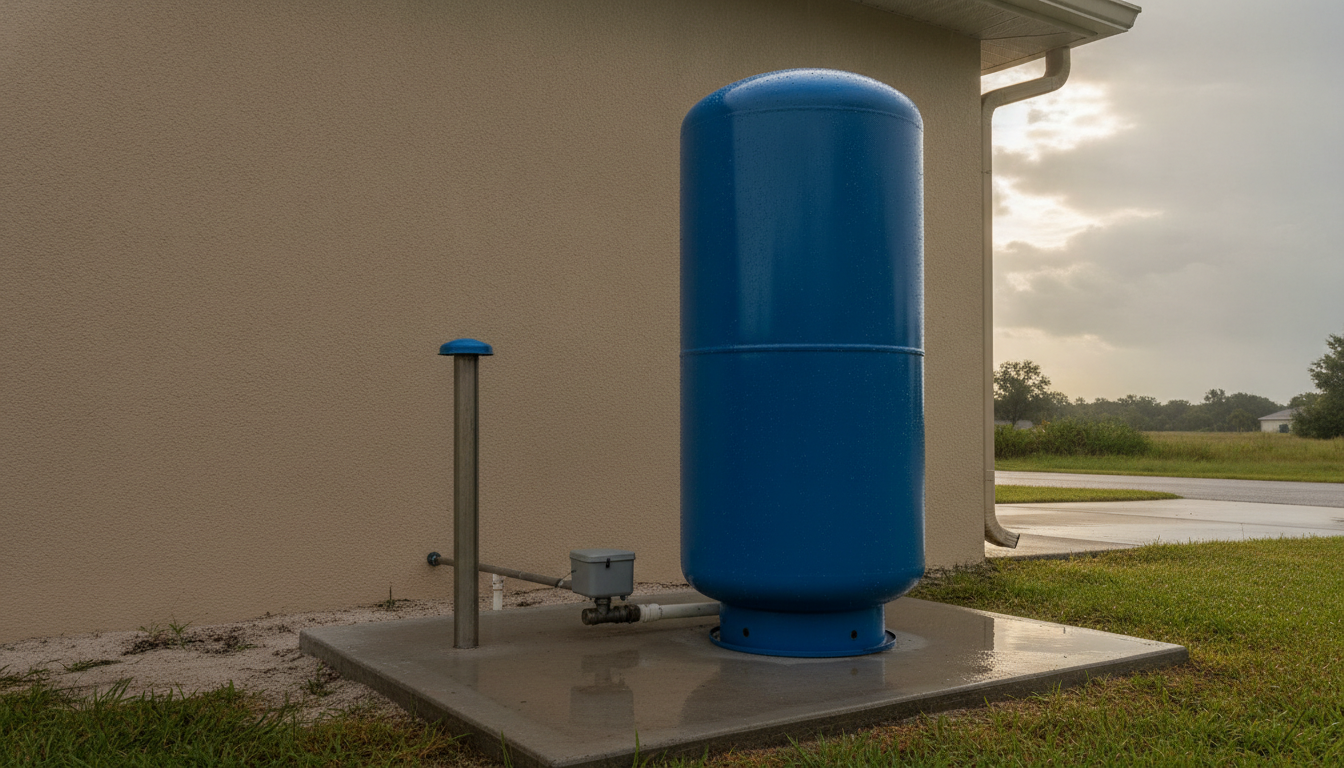
When a well quits after a lightning storm, start at the wellhead, not at the pump down the hole. The control box, pressure switch, wiring and pressure tank all sit above ground, and they can be tested without pulling anything out of the well. In Florida the failed part also decides which license the repair falls under, because section 373.303 excludes pumping equipment from water well construction and stops its definition of well repair at the ground surface.
What actually fails when lightning hits a well system?
A residential well runs on an unbroken chain of electrical and plumbing parts. An electrical surge can break that chain without leaving a mark you can see from the driveway.
Power has to reach the controls before the motor will start. The pump then has to push water into a system that can build and hold pressure. Break one link and every faucet in the house goes dry.
Here’s what a technician checks:
- An outdoor control box can lose a relay or a capacitor, so the pump never gets the signal to start.
- A pressure switch can stop calling for the pump, or stop passing power along to it.
- Wiring and connections above ground can be damaged even when the enclosure looks perfectly normal.
- The submersible motor or the pump itself can fail while the wellhead above it looks untouched.
- A damaged pipe or a bad check-valve can bleed off pressure as fast as the pump makes it.
The symptom won’t name the failed part on its own. A dry faucet could be the power supply, the controls, the pump, or the plumbing. That’s why swapping the pump before testing the whole chain can miss what actually broke.
A well pump repair pro can separate those possibilities without guessing. If water’s escaping somewhere between the well and the house, leak detection becomes part of the job too.
How can you tell lightning damage from an ordinary well pump failure?
Timing is a good lead, but it isn’t proof. A system that dies right after a close flash, a power flicker or a neighborhood outage shows a pattern consistent with storm damage. It doesn’t confirm it.
Ordinary wear produces the same no-water symptom. A pressure switch can stick on a clear afternoon. A connection can corrode for years and then let go on the next pump cycle. A buried pipe can leak while the pump keeps running.
What the system did before the storm narrows things down fast. Steady pressure right up to the outage is a different story from a system that had been cycling, sputtering or fading for days.
A technician splits the system into separate questions. Is power reaching the controls? Are the controls responding to pressure? Is the motor drawing current? Is water reaching the pressure tank? Will the plumbing hold the pressure the pump makes?
Those answers matter more than a scorch mark. Electrical damage can hide inside closed components with nothing showing on the outside. A burned enclosure is a reason to stop and call someone, but a clean one doesn’t clear the system.
If the trouble started before the storm, our low water pressure guide covers the wider set of causes. This page is about the sudden failure that lines up with the storm.
Who is licensed to fix lightning damage to a well pump in Florida?
No single license covers every fault a well system can throw in Florida. State law separates water well construction from pumping equipment, above-ground plumbing and electrical work, and it does it in writing.
Florida Statutes section 373.303 defines the water well program’s boundaries:
(2) “Construction of water wells” means all parts necessary to obtain groundwater by wells, including the location and excavation of the well, but excluding the installation of pumps and pumping equipment.
The same statute defines repair this way:
(5) “Repair” means any action which involves the physical alteration or replacement of any part of a well, but does not include the alteration or replacement of any portion of a well which is above ground surface.
Read those two carefully, because they’re easy to get backwards. They don’t make pump work unlicensed or unregulated. Plumbing licensure, electrical licensure and local permitting all still apply. What they mean is that the Chapter 373 water well contractor program isn’t the whole answer for a failed pump, control box, pressure switch or above-ground tank.
Chapter 489 supplies another part of the answer. Section 489.105(3)(m) states:
A plumbing contractor may install, maintain, repair, alter, extend, or, if not prohibited by law, design the following without obtaining an additional local regulatory license, certificate, or registration: sanitary drainage or storm drainage facilities, water and sewer plants and substations, venting systems, public or private water supply systems, septic tanks, drainage and supply wells, swimming pool piping, irrigation systems, and solar heating water systems and all appurtenances, apparatus, or equipment used in connection therewith
Note what that phrase is actually about. “Without obtaining an additional local regulatory license” speaks to local licenses, and it doesn’t touch Florida’s water well contractor program at all. A plumbing license never becomes permission to drill, construct, repair or abandon a well inside the Chapter 373 scope.
Electrical work keeps its own boundary. A licensed electrician handles the service, the wiring, the disconnect and anything else on the electrical side. Nobody should open a control box or test a capacitor without the training and the tools for it. Capacitors hold a charge after the power is off.
Tampa Plumbing Pro matches you with a licensed plumber for the plumbing side. If the diagnosis crosses into electrical work or into well construction, that part goes to the trade it belongs to.
When does the job belong to a licensed water well contractor instead?
A licensed water well contractor belongs on the job when the work reaches the well itself, inside Florida’s statutory construction or repair definitions. That’s construction, physical alteration or abandonment of the well, not service to the pumping equipment.
It isn’t a clean above-ground versus below-ground split, either. A submersible pump sits well below grade, and section 373.303 still excludes pumps and pumping equipment from water well construction by name. The failed component decides the scope, not the depth.
Under Chapter 62-531 F.A.C., the Department of Environmental Protection’s water well rules, it’s the water management districts that accept water well contractor license applications. Tampa Bay sits inside the Southwest Florida Water Management District.
The District’s well construction page puts it plainly: “A Well Construction Permit is required prior to installation of a water well within the District.” That sentence is about installing a well. It does not say that replacing a pump, a pressure tank, a pressure switch or a control box needs a District well construction permit, and you shouldn’t read it that way.
A real diagnosis keeps the licensing question from turning into a guess. If testing points at pumping equipment, plumbing or electrical controls, that trade handles it. If it points at the well structure inside the Chapter 373 definition, the licensed water well contractor takes that piece.
What can you safely check yourself before calling anyone?
You can document the failure without touching a single piece of energized equipment. Good notes help us send the right trade the first time, and they help the technician start in the right place.
- Check whether the rest of the house has normal power, without opening any electrical enclosure.
- Note whether the water stopped during the storm, during the outage, or after the power came back.
- Write down whether the faucets are bone dry, sputtering, or just weak and inconsistent.
- Look from a safe distance for smoke, scorching, fallen limbs, standing water or a damaged enclosure.
- Photograph what you can see, without touching the wellhead, the wiring, the control box or anything wet.
- Stop running fixtures if the pump keeps running but the system won’t build pressure.
Don’t pull a control-box cover, don’t test a capacitor, and don’t probe wiring. Don’t touch equipment that’s standing in water. Those steps belong to a licensed electrician or a qualified pump technician, and that’s a safety line rather than a preference.
Smoke, a burning smell, exposed conductors or damaged service equipment needs attention right now. Our emergency plumbing line can route the plumbing side while the electrical hazard goes to a licensed electrician.
Does surge protection help a well pump?
Surge protection can cut a system’s exposure to transient voltage, but it can’t promise survival through every electrical event. It also can’t tell you what’s already broken.
A surge protective device gives excess voltage a controlled path away from the equipment it’s protecting. How well that works depends on the home’s electrical system, the device you pick, how it’s installed, and the route the disturbance took to get there.
A licensed electrician can look at both service-level and equipment-level options for the well circuit, and check the grounding and supply while they’re there. That’s their scope, not a plumber’s.
Treat surge protection as equipment that lowers risk, not as proof against damage. Nothing you install replaces a diagnosis once the system has already stopped.
Well homes need an outage plan too, because a healthy pump is still useless without power. Our well pump guide covers outages and generator planning, and the Tampa Bay hurricane plumbing checklist covers named-storm prep.
Why does this come up so often in Tampa Bay?
Past the suburban edge of Tampa Bay, plenty of properties have no municipal water connection at all. On one of those, a storm-related outage is an electrical problem and a water problem in the same moment.
Geography drives it. An acreage home in Odessa can run its whole water supply off a private well, a pressure tank, a softener and a septic system. Out in San Antonio, private wells are close to universal.
That changes what a power disturbance costs you. A city-water home can lose power and still have water at the meter. A well home loses the water the moment the pump system stops.
The surrounding equipment changes the diagnostic path as well. The well can be perfectly sound while a control above ground has failed. The pump can be fine while a damaged pipe keeps pressure from reaching the house. Somebody has to find the failed part before anyone can say who repairs it.
Tampa Plumbing Pro covers Hillsborough, Pinellas and Pasco counties around the clock. We match homeowners with licensed local plumbers, and when a problem crosses trades we point it at the right one.
Frequently asked questions
Can lightning damage a well pump without a direct strike?
Yes. A nearby electrical disturbance can reach the equipment through the home’s power system, and you don’t need a direct strike at the wellhead to see a surge-related failure pattern.
A pump that quits after a storm still has to be tested. The timing is consistent with lightning or surge damage. It doesn’t prove the cause, and it doesn’t name the broken part.
Why did my water stay off after the house power returned?
The house can come back while a well control or a dedicated electrical component is still faulted. The control box, the pressure switch, the wiring, the pumping equipment and the plumbing are all still on the list.
Don’t assume the buried pump is the problem. Testing starts with the whole chain: power, controls, pressure, then water delivery.
Should I call a plumber, electrician, or water well contractor first?
Start with the trade that matches what you can actually see. A plumbing or pump pro can diagnose the water-delivery and pressure equipment, and a licensed electrician handles supply and wiring faults.
You need a licensed water well contractor when the work falls inside Florida’s definition of well construction, repair or abandonment. If it isn’t clear which one you’re looking at, we’ll help route it.
How much does lightning-related well pump repair cost?
The failed part and the trade it needs set the quote. A control fault, damaged wiring, a leaking pipe, a pressure problem and a dead pump are five different jobs.
Our well pump replacement cost guide walks through what drives pump pricing. Diagnosis comes first, because replacing the wrong part doesn’t bring the water back.
Does homeowners insurance cover lightning damage to a well pump?
Take that one to your carrier and read your own policy, because forms and endorsements vary. Our homeowners insurance and plumbing guide covers how to approach a coverage question. It won’t decide your claim.
Keep the photographs, the technician’s findings and the repair paperwork together. That’s a clean record of what was found and what got done about it.
When to call us
Call when your well stops making water after a Tampa Bay storm, especially if the power’s back but the pressure isn’t. We’ll match you with a licensed local plumber, and we’ll tell you straight when the job actually needs an electrician or a licensed water well contractor instead. Reach us at (813) 590-0625.