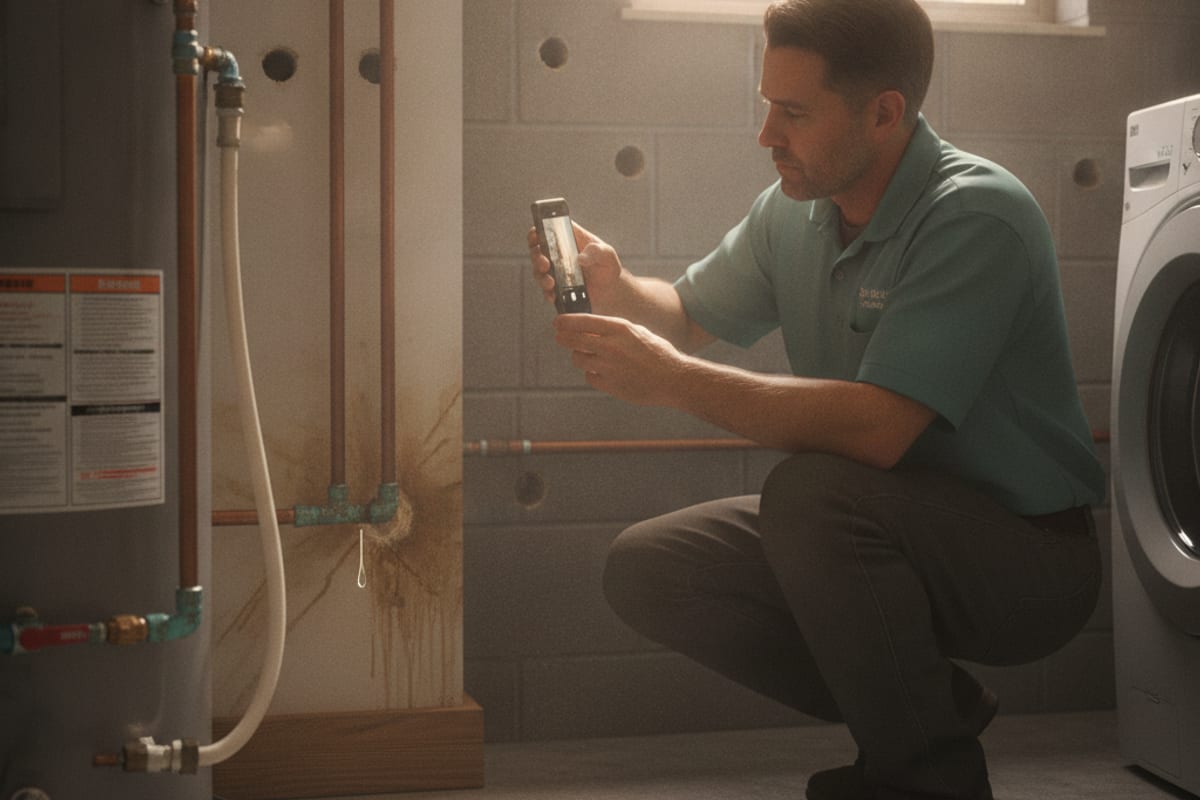
Almost every plumbing insurance question in Florida comes down to one distinction: was the failure sudden and accidental, or did it happen gradually over time? Sudden failures are generally covered. Gradual ones generally aren’t. Nearly everything else follows from that single line.
Florida adds its own complications on top, and they’ve gotten sharper over the last few years. Here’s how it actually works.
This is general information, not coverage advice. Your policy language is what governs, and policies in this state vary more than most.
The rule that decides most claims
Standard homeowners policies cover water damage that is sudden and accidental. A supply line bursts, a water heater lets go, a pipe cracks behind a wall over a weekend. The resulting damage to your floors, drywall, cabinets, and belongings is typically covered.
What’s typically not covered is damage from a leak that developed slowly. A drip that stained a subfloor over two years, corrosion that finally opened a hole after a decade, a fixture that seeped until the cabinet rotted. Insurers treat those as maintenance, and the reasoning is that a reasonable homeowner would have caught it.
This is why the same amount of water damage can be paid in one house and denied in another. The claim turns on how the failure happened, not how much it cost.
The pipe itself is usually your problem
Here’s the part that surprises people most. When a pipe bursts and floods a room, the policy generally pays to dry the house, replace the flooring, and repair the drywall. It generally does not pay to replace the pipe that failed.
The damage is the covered loss. The failed component is considered a repair you owe.
There’s one important exception worth knowing, often called tear-out or access coverage. If the broken pipe is inside a wall or under a slab, many policies will pay the cost of opening up the wall or breaking the concrete to reach it, and then closing it back up. You still buy the pipe and the plumbing labor, but the demolition and restoration around it may be covered.
That distinction matters a lot on slab leak repair, where the concrete work can exceed the plumbing work. Ask your adjuster about access coverage specifically, by name, because it isn’t always volunteered.
What Florida changes
Three things make this state different.
Flood is never covered by a homeowners policy. Not reduced, not sublimited. Excluded. Flood means rising external water, including storm surge, and it requires a separate NFIP or private flood policy. In Tampa Bay this is not an abstraction. Large parts of Pinellas, South Tampa, Apollo Beach, and the coastal stretches of Pasco sit in mapped flood zones.
The practical trap is that water in your house after a storm can have two different sources with two different outcomes. A pipe that broke because wind opened your roof is usually a homeowners claim. Water that came in over the threshold from the bay is a flood claim. If both happened, you may need both policies, and the adjusters will argue about which water did which damage. Photograph everything before anyone cleans up.
Hurricane deductibles are separate and percentage-based. Florida policies carry a distinct windstorm or hurricane deductible calculated as a percentage of your dwelling coverage rather than a flat dollar figure. On a named storm claim it’s frequently several thousand dollars before anything pays. Your ordinary all-other-perils deductible does not apply to that claim.
Water damage coverage has tightened. Florida’s insurance market has been under real pressure, and carriers have responded by narrowing water coverage. Limited water damage endorsements that cap the payout well below your dwelling limit are now common. Read yours. Many homeowners here discover the cap at claim time.
Cast iron and polybutylene are their own category
If your Tampa Bay home was built before about 1975, it likely has cast iron drain lines. If it was built between roughly 1978 and 1995, it may have polybutylene supply lines. Both are known failure classes, and Florida carriers know it.
Expect one of these outcomes on an older home:
- The carrier asks about plumbing material and age during underwriting
- Coverage is offered with those materials excluded or sublimited
- A policy is declined until the house is repiped
- A renewal is non-renewed after a water claim
Because these are known-failure materials, insurers frequently argue that a resulting leak was gradual and therefore not covered. Corroded cast iron in particular fails from the inside over years, which fits the gradual definition almost by definition.
The practical read: on a pre-1975 house, don’t assume a drain line failure will be paid. And if you’re weighing a whole-home repipe purely on cost, factor in what it does for insurability and renewal, not just the plumbing. That’s often the larger number. Our breakdown of repipe cost in Tampa, PEX versus copper covers the plumbing side.
For slab leaks specifically, we go deeper in slab leak insurance coverage in Florida.
What’s generally covered, and what generally isn’t
Commonly covered:
- A burst supply line and the resulting water damage
- A water heater that fails suddenly and floods a garage or closet
- A pipe cracking behind a wall without warning
- Accidental overflow from an appliance or fixture
- Tear-out and restoration to reach a covered failure
- Additional living expenses if the house becomes uninhabitable
Commonly not covered:
- The failed pipe, fixture, or appliance itself
- Slow leaks and long-term seepage
- Corrosion, rust, and general wear
- Mold arising from an unaddressed leak, or mold above a low policy cap
- Sewer or drain backup, unless you bought that endorsement
- Anything from external flooding or storm surge
- Damage worsened because you delayed repair
That last one has teeth. Policies impose a duty to mitigate. If you knew about a leak and left it, the carrier can reduce or deny what it would otherwise have paid.
How to protect the claim
What you do in the first hour matters as much as your coverage.
Photograph before you touch anything. Wide shots and close shots, every affected room, standing water included. Video narrating what you see is even better.
Stop the water, then mitigate. Shut off the supply, get water extracted, get air movers running. Save receipts for all of it. Mitigation costs are usually reimbursable and failing to mitigate is a common denial reason.
Keep the failed part. The section of pipe, the burst hose, the failed valve. It’s physical evidence of a sudden failure. Do not let anyone haul it off.
Report promptly. Florida policies carry notice deadlines, and late reporting is a clean reason to deny. Call it in the same day when you can.
Get an independent repair estimate. The adjuster’s number is an opening position, not a final one.
Write down every conversation. Date, name, what was said. If a denial gets appealed, that record is what you have.
When the adjuster’s number seems low
Read the denial or estimate against your actual policy language rather than against what you expected. Common gaps are a water damage endorsement cap you didn’t know about, a hurricane deductible applied to a claim you thought was ordinary, or a gradual-damage finding.
If you disagree, you can request the specific policy provision the decision relies on, get your own contractor estimate, ask for reinspection, or bring in a licensed public adjuster who works for you rather than the carrier. Florida also offers a consumer complaint process through the state’s insurance regulator.
The short version
Sudden failures get covered. Gradual ones don’t. The pipe is usually yours either way. Flood needs its own policy, hurricanes have their own deductible, and older Tampa Bay homes with cast iron or polybutylene face real coverage limits that are worth understanding before something breaks rather than after.
If you need a leak found and documented properly, we connect Tampa Bay homeowners with experienced local crews who can produce the written diagnosis a claim needs. Reach us at (813) 590-0625 for leak detection or emergency plumbing.
Whoever does the work, verify their CFC plumbing license at myfloridalicense.com first. Carriers sometimes ask, and it’s public record.