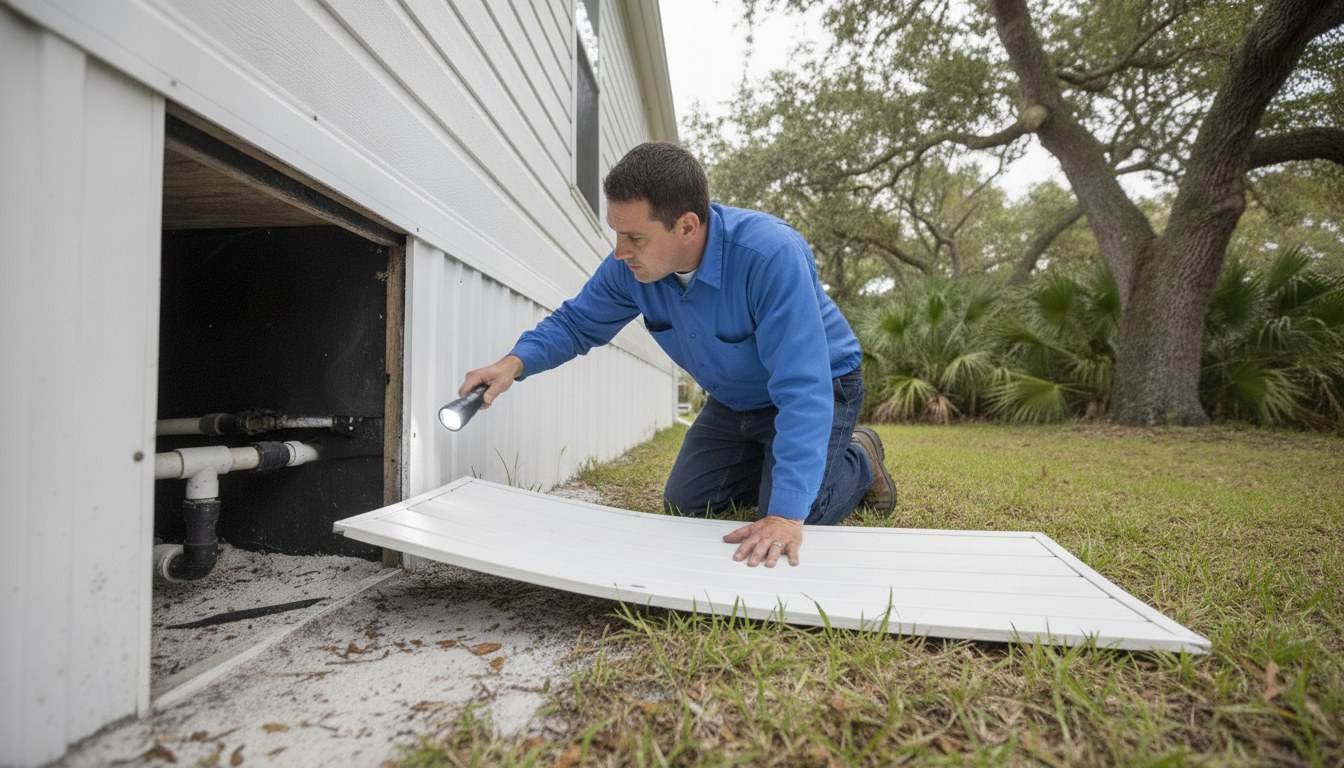
Mobile home plumbing problems in Tampa Bay involve different standards, parts, and access than plumbing inside a block house. The pipes often run beneath the floor inside belly-wrap insulation. Supply lines may use smaller diameters and mobile-home-specific fittings. Those differences affect how a leak is found, how the repair is designed, and what the job costs.
Why are mobile home plumbing problems different?
The difference begins with the standard used when the home was manufactured. Manufactured-home plumbing falls under the federal Manufactured Home Construction and Safety Standards, published as 24 CFR Part 3280.
Subpart G of 24 CFR Part 3280 covers the home’s plumbing. Section 3280.601 states:
“Subpart G of this standard covers the plumbing materials, fixtures, and equipment installed within or on manufactured homes.”
That federal standard took effect June 15, 1976. Homes built before that date weren’t built to it. The manufacturing date therefore gives a plumber a starting point for identifying the original pipe, fittings, and installation method.
This distinction matters across Tampa Bay, because mobile and manufactured homes make up a real share of the housing in communities like Gibsonton, Town ‘n’ Country, and Seffner.
Florida also has a separate repair rule for these homes. Rule 15C-2.0081, F.A.C., opens with this direction:
“These guidelines shall be used to assure safe and livable housing and shall not be more stringent than the standard to which the home was originally constructed.”
Its plumbing subsection, 15C-2.0081(3), adds:
“Plumbing repairs and replacements shall require the use of material and design equivalent to the original construction.”
The statute behind that rule, Florida Statute 320.8232(2), sets the same limit:
“The Mobile and Manufactured Home Repair and Remodeling Code must be a uniform code, must ensure safe and livable housing, and may not be more stringent than those standards required to be met in the manufacture of mobile homes.”
That runs opposite to treating every repair as an automatic current-code upgrade. The mobile-home rule points the plumber back toward material and design equivalent to the original construction.
This helps explain why a plumber focused on block houses may decline the job. Mobile-home fittings, pipe sizes, belly access, and original construction methods require different preparation.
The rule sets the repair standard, but it doesn’t establish one permit path for every Tampa Bay county. Confirm the process with your county building department before work starts.
Which plumbing clues can you check outside the home?
The water heater relief drain offers the clearest visual check. Section 3280.609(c)(1)(iii) says:
“The discharge from the relief valve must be piped full size separately to the exterior of the manufactured home, not underneath the home, or to an indirect waste receptor located inside the manufactured home. Exterior relief drains shall be directed down and shall terminate between 6″ and 24″ above finished grade.”
The same section requires the drain’s end to remain visible for inspection. A relief line terminating beneath the home doesn’t match that routing requirement. Discharged water beneath the floor can also soak the belly wrap.
The next subsection allows certain piping beneath the home to be assembled on site. It doesn’t permit the discharge to terminate there. If water is appearing near the heater, start by tracing the water heater leak to its source.
The fresh-water inlet is another useful landmark. Section 3280.609(b)(1) specifies a 3/4-inch threaded connection marked “Fresh Water Connection” or “Fresh Water Fill.” Finding that inlet helps a plumber separate the park or property supply from the home’s plumbing.
| What you find | What it can mean | Where the repair starts |
|---|---|---|
| A relief drain ending beneath the floor | The discharge routing doesn’t match the federal standard. | Inspect the valve, drain, and exterior termination. |
| Wet or sagging belly wrap | Water has collected inside or above the insulation. | Trace the leak before opening more wrap. |
| Weak flow throughout the home | The restriction may be near the inlet, regulator, or main supply line. | Test pressure at the inlet and farther downstream. |
| One weak fixture | The restriction may be inside that fixture or its branch line. | Isolate the affected branch before changing the main line. |
| A mismatched coupling beneath the home | A previous repair may have joined unlike materials incorrectly. | Identify both pipe materials before selecting a fitting. |
A wet belly wrap identifies an affected area, not the source. Water can travel along insulation before collecting at a seam. Under-home leak detection can narrow the opening and protect more of the existing wrap.
What can fail beneath a manufactured home?
Under-home supply lines can leak at fittings, transitions, and damaged pipe sections. The belly wrap may conceal the first drip until the insulation becomes heavy or stained.
Access changes the repair. Skirting must be opened without damaging nearby panels, and the plumber may have limited working room beneath the floor. A small visible opening doesn’t show how far water has traveled inside the wrap.
Pipe material matters too. A manufactured home built from 1978 through 1995 can contain polybutylene supply pipe. Our guide to polybutylene pipes in Tampa Bay explains how to identify that material and why the connections deserve attention.
Drain lines create a different problem. A low section can retain wastewater and paper instead of carrying them toward the outlet. The symptom may appear as a recurring slow drain, while the actual low spot sits beneath another room.
Park homes add pedestal connections to the layout. The home’s tagged inlet, its under-floor piping, the sewer connection, and the park’s utility system aren’t one continuous responsibility. The lot agreement determines where that line sits.
A widespread supply failure may make a mobile-home repipe more practical than repeated isolated repairs. The plumber still needs to identify the original design and select equivalent materials for the repair.
How do pressure and fittings change the repair?
Pressure testing separates an active leak from a restriction or fixture problem. Section 3280.609(a)(1) says the manufacturer’s instructions must state that the home “has been designed for an inlet water pressure of 80 psi.” When the supply exceeds 80 psi, those instructions must say that “a pressure reducing valve should be installed.”
High inlet pressure and low fixture pressure can exist together. A restricted valve, clogged fixture, or undersized branch can reduce flow after water enters the home. Our low water pressure guide explains how pressure and flow produce different symptoms.
The federal standard also controls accepted materials. Section 3280.609(d)(1) lists the water pipe a manufactured home may use: standard weight brass, several galvanized options, Type K, L or M copper tubing, and approved or listed plastic or other approved or listed material.
Plastic water piping and fittings must be listed for hot-water use. That condition matters inside a tight utility closet, where the hot outlet may sit close to the wall or floor penetration.
The completed system also has a defined pressure test. Section 3280.612(a) states:
“The test must be made by subjecting the system to air or water at 80 psi + or − 5 psi for 15 minutes without loss of pressure.”
That test gives the plumber a pass-or-fail result after replacing pipe or fittings. It also helps expose a hidden connection that still leaks under pressure.
Exterior hose bibbs and laundry sink hose connections need listed, nonremovable backflow prevention devices. The federal standard makes exceptions for washing machine connections with built-in backflow prevention and water heater drain valves.
How much do mobile home plumbing repairs cost?
Local prices move with access, pipe length, material, and repair scope. A visible fitting beside an open skirting panel takes different work than a wet supply line buried inside damaged belly wrap.
In Largo, mobile-home supply line repairs run $300 to $900, depending on access. In Town ‘n’ Country, mobile-home repipes and belly-pipe repairs run $1,800 to $4,500, depending on the home’s size and failure extent.
In Gibsonton, mobile-home repairs and replacements run $150 to $2,500. That scope runs from a simple line repair to a full repipe beneath the home.
A mobile-home water heater replacement runs from $1,200 to $2,600, depending on the unit and how tight the closet is. The exact amount also depends on the city and access. The water heater pros we send can inspect the connections, relief drain, footprint, and replacement path before quoting the work.
These city-specific ranges shouldn’t be blended into one flat Tampa Bay price. A plumber needs to see where the failure sits and how the home was constructed.
Who pays for plumbing in a rented-lot park?
Responsibility depends on the lot rental agreement and park prospectus. Florida Statute 723.022 requires a park owner to:
“Maintain utility connections and systems for which the park owner is responsible in proper operating condition.”
The qualifier controls the answer. That language doesn’t assign every pipe to the park owner. It requires maintenance of the systems for which the owner is already responsible.
Read the prospectus and lot rental agreement before authorizing work. Look for the point where the park’s utility system ends and the home’s connection begins. Photograph the leak location, nearby pedestal, tagged inlet, and affected skirting so each party sees the same problem.
What should you do when a leak starts?
An active supply leak needs the water isolated before diagnosis. If you know the home’s correct shutoff, close it and note whether the flow stops.
Don’t assume the lowest wet spot is the broken connection. Water can travel inside belly insulation or along a pipe before it drips. Record the affected fixtures, pressure changes, and where water first appears.
Give the plumber the home’s manufacturing date if it is available. That date helps identify which construction standard governed the original plumbing. It also narrows the likely materials and fitting types before the skirting is opened.
Frequently asked questions
Are mobile and manufactured home plumbing systems the same?
Homes manufactured on or after June 15, 1976 fall under the federal Manufactured Home Construction and Safety Standards. Homes built before that date weren’t built to the same federal standard. The home’s manufacturing date therefore matters during diagnosis and repair planning.
Why might a plumber decline a mobile-home repair?
A plumber may decline when their work is limited to site-built houses. Florida’s mobile-home repair rule requires material and design equivalent to the original construction. Mobile-home-specific fittings, smaller supply lines, belly access, and tight utility closets can change the job.
Can a water heater relief pipe end beneath the home?
No. The federal standard requires the relief valve discharge to run separately outside the home or to an indoor indirect waste receptor. An exterior drain must point downward, end between 6 and 24 inches above grade, and remain visible.
How can I tell if a pipe is leaking inside the belly wrap?
Wet, sagging, or stained belly material identifies an affected area. It doesn’t identify the broken fitting because water can travel through the insulation. A plumber can isolate sections and test the system before opening more wrap.
Does the mobile home park have to repair my water line?
The statute doesn’t assign every water line to the park owner. It requires the owner to maintain the utility systems for which the owner is responsible. Your prospectus and lot rental agreement determine where that responsibility changes.
When to call us
A spreading under-home leak, damaged belly pipe, or tight-closet water heater repair needs a licensed plumber who handles manufactured homes. We’ll match you with a licensed local pro who can identify the original system and plan the repair.
Call us at (813) 590-0625.