A toilet that gurgles while the shower is running is not a sink clog. Sewer drain repair in Tampa starts with knowing whether you have a blockage, a cracked or offset pipe, or a clay or cast-iron run that has already given out. The licensed plumbers we send put a camera in the line before anyone cuts the yard, because a $150 to $500 scope is how you tell a $150 to $350 fixture clearing from a $2,500 to $6,000 spot repair or a $6,000 to $15,000 replacement.
Sewer drain repair: clog vs break vs collapsed clay
One slow bathroom sink is usually local. Several fixtures backing up at once, especially the lowest ones, points at the main. In a Seminole Heights bungalow or a pre-1975 St. Petersburg cottage, that main is often original cast iron, thinning from the inside for decades. In older laterals with clay, the joints are short and brittle. Roots find those joints, then the pipe itself.
A clog is material sitting in a pipe that is still round. Grease, wipes, scale, and root hairs catch on a rough bore. Drain cleaning with a cable or hydro-jetting can restore flow when the wall is intact. A standard single-fixture clearing runs $150 to $350 depending on access and severity. Main-line hydro-jetting runs $350 to $700. A main that needs clearing more than once in a year is usually telling you the pipe, not the debris, is the problem.
A break is a crack, a separated joint, or a hole. Waste leaves the pipe before it reaches the city main. That is the wet stripe or the oddly lush patch over a Hyde Park side yard in a dry week. A collapsed clay run is different again: the camera shows a flattened oval, a missing invert, or a pile of shards. You cannot jet a collapse back into a pipe.
City of Tampa wastewater customers often have two cleanouts, one near the foundation and one at or near the property line. The City’s own blocked-drain guidance is simple. Water in the house-side cleanout with a dry property-line cleanout usually means the stop is in the house plumbing. Water in the property-line cleanout often means the City’s line. City crews do not work on private property between the right-of-way and the house. That stretch is the homeowner’s lateral, and it is the job this page is about.
A puddle around a tank in the garage is water heater repair, not a sewer line. Sewage at a floor drain next to that tank is the main.
Pasco and rural Hillsborough (Land O’ Lakes, Odessa, Thonotosassa, Wimauma) add a fork the inner neighborhoods do not have. If the house is on a tank and drain field, the backup may be the onsite system, not a city lateral. That work goes to a licensed and registered septic contractor, not a city-sewer crew. August rain on sandy soil saturates a field that looked fine in March. Pinellas Park, on city sewer, does not have that problem.
| What you have | What the line is doing | Usual next step |
|---|---|---|
| Clog in a sound pipe | Flow is blocked, the wall is still round | Cable or hydro-jet, then a camera to confirm |
| Break or offset joint | Waste is leaving the pipe at one spot | Targeted repair on that section |
| Collapsed clay or spent cast iron | The pipe has failed along a run | Replacement or trenchless rebuild, not another snake |
What a camera run shows before anyone cuts a yard
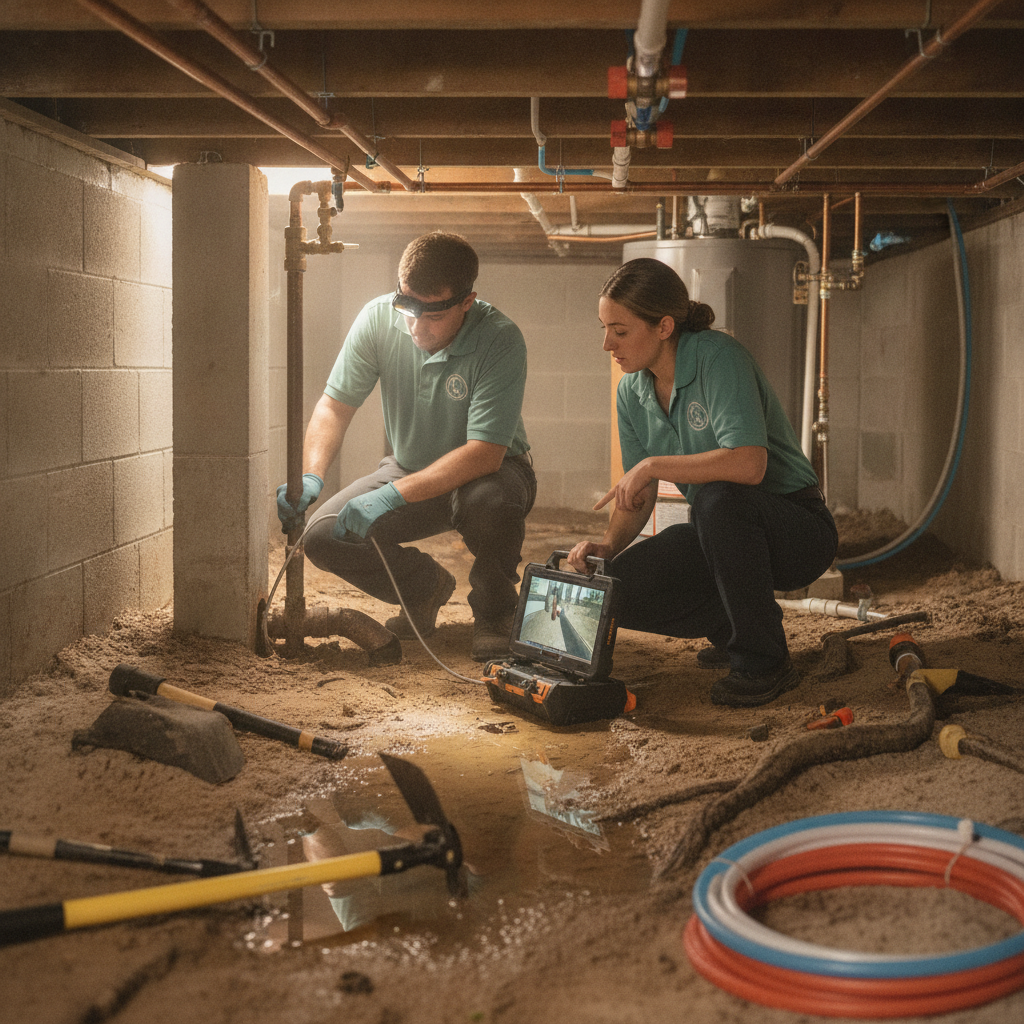
Symptoms do not price a lateral. A camera does. The plumbers we send feed a head from a cleanout, or from a toilet flange if that is the only access, and record the material, the joints, the offsets, the roots, and every defect by distance. That footage is what separates a one-section repair from a line that has failed along its length.
A standalone or bundled sewer camera inspection on this site runs $150 to $500, depending on whether the scope is bought on its own or folded into other work. That range is the cost of not guessing. A quote for a full replacement with no video is a sales pitch, not a diagnosis. The same camera pass after the repair is how you see that the joint is closed and the bore is open.
Older Tampa houses often have no usable cleanout. Florida’s plumbing code requires cleanouts at set intervals and at the junction of the building drain and the building sewer on work that is permitted and inspected. It is not a retroactive order on a 1950s bungalow. The honest result is that the first job on some laterals is creating access, which is why a cable cleaning through an open cleanout sits in the low hundreds and a buried line with no access does not.
A Florida home inspection is a limited visual exam of readily accessible systems. A buried lateral is not that. Many inspectors will sell a sewer scope as an add-on, and they are allowed to. The standard inspection does not replace one. If you are buying in Ybor, Tampa Heights, or an inner St. Pete block, the scope belongs on the inspection calendar, not after closing. Details and the same $150 to $500 band live on our sewer scope inspection cost page.
The camera also tells you what not to open. A long run under a Valrico or Brandon slab-on-grade driveway is a different surface cost than a shallow line under a Land O’ Lakes lawn. Depth, length, and what has to be cut and put back are what move the number, not a flat “sewer price.”
Repair paths on Tampa slab and older laterals
Once the footage is in, the choice is usually a clear, a spot repair, a trenchless section, or a full replacement. The licensed plumbers we send pick the path from the pipe, not from a menu.
A targeted trenchless repair on one section publishes on this site at $2,500 to $6,000. Full replacement publishes at $6,000 to $15,000, the same band we use for a full lateral in an older Tampa neighborhood. Trenchless (lining or pipe bursting) works through access pits instead of a full trench. It is the right conversation when the line runs under a driveway, a patio, or a slab you would rather not saw. It is not always available. A collapse, a severe offset, or a belly that has lost grade can take lining off the table. Open-cut is blunt and it works in any geometry. The trade-off is the surface: lawn is cheaper to restore than concrete.
East Hillsborough subdivisions from the 1980s through the 2000s sit on slab. A leaking under-slab sewer washes sand out from under the floor. Cracks or settlement above the run are worth a camera, not a patch on the tile. That job is sewer line repair, and the slab mechanics are the same family as under-slab plumbing failure.
The same 1950s bungalow with thinning cast iron drains often still has galvanized supply. That is a whole-home repipe conversation, separate from the sewer. Do not let a supply leak and a sewer backup get quoted as one mystery job.
Pinellas County Utilities customers on a private sewer lateral have a published rebate: 100 percent of a qualifying inspection up to $350, and 50 percent of qualifying repair, replacement, or lining up to $3,500, first come first served until funds run out. The customer hires a Pinellas County Construction Licensing Board certified or registered plumber and submits a complete application within 90 days of the work. The stated scope is the lateral. It does not say the rebate pays for a new cleanout or a grinder pump. Confirm eligibility with the county before you budget that money. Verify the plumber at Florida’s license search.
City of Tampa residential plumbing (general) permits are $120.00, plus the Florida Building Permit surcharge of 2.5 percent of permit value or a $4.00 minimum. Unincorporated Hillsborough County residential plumbing (general) is $130.00 on the Phase 2 schedule effective Oct. 5, 2024. Plumbing work on a single-family home is carved out of Florida’s under-$7,500 permit exemption, so a lateral job is not “under the cap, skip the permit.” Fees are paid to the building department, not to us.
South Shore streets in Apollo Beach, Ruskin, and Gibsonton sit low. Where fixtures sit below the next upstream manhole, Florida’s plumbing code requires a backwater valve so city flow cannot push back into the house. Installed, that valve typically runs $600 to $1,500 depending on access to the line. It is not a substitute for repairing a broken lateral. It is the device that keeps a storm-swollen main from using your tub as a relief.
Citizens Property Insurance HO-3 Coverage Worksheet lists water backup of sewers and drains as not covered, and it cannot be added on that form. Citizens is the state-created insurer Florida homeowners land on when private carriers will not write the home. Some private Florida policies include a small backup limit; many do not. A National Flood Insurance Program policy covers sewer backup only when general flood conditions are the proximate cause. Read the backup question on sewer backup insurance in Tampa Bay rather than assuming the claim will pay for the pipe.
| Path | When it fits | What you are buying |
|---|---|---|
| Clear and camera | Sound pipe, debris or light roots | $150 to $350 a fixture, $350 to $700 to jet the main |
| Trenchless section | Localized damage, usable host pipe | $2,500 to $6,000 on one section, smaller pits |
| Open-cut replacement | Collapse, lost grade, or a spent run | $6,000 to $15,000 for a full lateral, more surface work |
How much should a sewer line repair cost?
On this site, a camera is $150 to $500, a trenchless section is $2,500 to $6,000, and a full replacement is $6,000 to $15,000. Length, depth, pipe material, and whether the run sits under lawn or slab are what push a job toward the high end. A longer run under a slab means more concrete to open and close. Nobody can quote the job honestly without the footage.
Will homeowners insurance cover sewer line repair?
Citizens’ HO-3 worksheet does not cover water backup of sewers and drains, and that form does not let you add it. A few private carriers build a small backup limit into the policy. Flood insurance helps only when the area is flooding, not because your clay joint opened on a dry Tuesday. The pipe itself is often on you. Read your own policy’s water-backup line, then call the carrier with the camera report in hand.
Can you repair a sewer line without digging it up?
Often, if the camera shows a host pipe that can still take a liner or a bursting head. Trenchless still needs access pits. A collapse, a sharp offset, or a belly that has lost fall can force open-cut. The footage decides, not a brochure.
Can you fix a sewer line yourself?
A buried lateral is licensed plumbing, not a weekend trench. You can note which fixtures back up, look at the cleanouts without pulling buried caps at random, and call. Cutting a main, opening a slab, or working a septic tank is how a small backup becomes a sewage spill in the yard. When DIY stops is the line for this work.
When to call us
Call when more than one fixture is slow, when sewage is in a yard or a floor drain, or when a line that was snaked last season is backing up again. The plumbers we send camera first, then repair or replace what the pipe actually needs. Call us at (813) 590-0625.