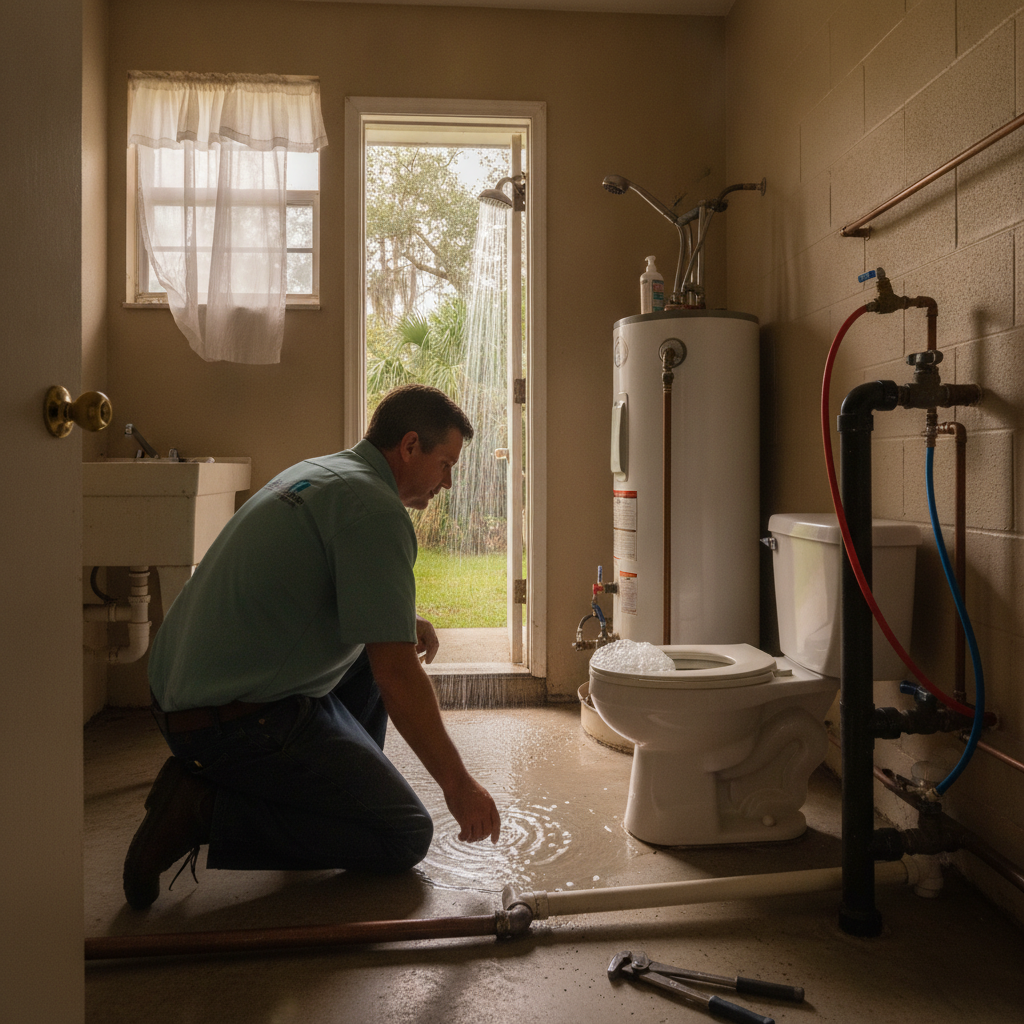
The shower is on, and the toilet starts to burp. Not a drip. A gulp, then a cluster of bubbles in the bowl. A toilet bubbling when shower runs is air being forced the wrong way through the trap, because the drain cannot take the shower’s water and the vent cannot replace the air that water displaces. It is a pressure problem, not a cracked bowl.
In a 1950s St. Petersburg bungalow the usual suspect is thinning cast iron. In a Land O’ Lakes ranch after an August storm, it may be a septic field sitting in a high water table. Same noise. Different pipe.
Why a toilet bubbling when shower runs is a vent story
Every drain needs air behind the water. The roof stack is how the system breathes. When the shower dumps several gallons down a shared bathroom line, that slug of water is supposed to pull air from the vent, not from the toilet. If leaves, a wasp nest, or a flattened screen choke the stack, the moving water steals air from the nearest trap. The toilet is that trap. The bowl water jumps, then settles, and you hear the gurgle.
That is why the noise often shows up only while the shower runs. The toilet is idle. The shower is the fixture moving volume. A bathroom sink trickle rarely moves enough water to pull the trap. A shower does. A washing machine dump can do the same thing on the other side of the house, which is why a bubbling hall toilet during a rinse cycle is the same air story with a different trigger.
On a tight lot in Gulfport or a Hyde Park cottage, the wet vent for the hall bath is a short, old run. One blockage at the roof and the whole room shares the air shortage. You may also smell sewer after the shower, because the trap seal got yanked thin. That smell is gas crossing a weakened water seal, not a dirty bowl. If the odor hangs around after the bubbles stop, our sewer smell in the house guide covers the trap and vent side of that odor.
A rumble from the garage while you run hot water is a different sound. Scale in a Tampa Bay tank pops as it heats. That belongs on a water heater repair visit, not this one.
A vent clog does not fill the yard with sewage. The house still drains, just noisily. Other bathrooms may be quiet. The kitchen may be fine. Bubbles in one bath and nowhere else is the vent pattern. North Pinellas stock in Dunedin, Palm Harbor, and Tarpon Springs is mostly city sewer and older suburban piping, so a single-bath gurgle there is often a shared wet vent or a hair-packed tub line, not a field in the yard.
Do not send a ladder up a metal roof in September sun to fish the stack. Height and pitch are how people get hurt. The plumbers we send have the gear to look down the vent from the roof or to test it from below.
When it is a partially blocked sewer instead
Shower water that cannot leave the house has to push air somewhere. The toilet is the biggest open path. Bubbles then are not a thirsty vent. They are displaced air from a line that is already holding water.
Hair and soap in the tub branch can do a small version of this. The shower slows, the toilet in the same bath talks, and the kitchen is innocent. That is a fixture-line clog, and drain cleaning through the tub or a nearby cleanout usually ends it. A standard single-fixture clearing on this site runs $150 to $350 depending on access and severity. Caustic crystals sit in a trap and etch finish. They do not climb a roof vent, and they do not chew through a building drain.
When the clothes washer, the hall toilet, and the shower all complain, the restriction is lower. Roots through a clay or cast iron joint, grease in a belly, a sag under a slab in Brandon, a wipe that never belonged in the pipe. The building drain or the lateral is the pinch. Main-line hydro-jetting on this site is published at $350 to $700. Jetting uses water to cut sludge, soap, and grease and to flush the debris, which is why it is the tool for a lined-with-gunk run rather than a single wad of paper. Not every pipe should be jetted. Age and material decide that. A camera after the cleaning is how the plumber sees what is left. A sewer camera inspection here is published at $150 to $500, bundled or bought on its own. Snaking versus hydro-jetting is the comparison if you want the tool choice in more detail.
A gurgling toilet does not, by itself, mean the sewer is broken. It means flow and air are fighting. Broken is a later finding: a belly, an offset joint, a collapsed cast iron section under a Seminole Heights floor. Those are sewer line repair jobs. A targeted trenchless section on this site is published at $2,500 to $6,000. A full replacement in an older Tampa neighborhood is published at $6,000 to $15,000. Those numbers move with depth, slab, and how much yard or driveway has to come up. The quote after the camera is the real number, not a neighbor’s memory of a different street.
On septic, the same bubbles can be a tank or a field that cannot take more water. Sandy soil in Pasco and rural Hillsborough lets solids move through a drain field faster than they should, and a heavy summer rain saturates the field so a tank that was fine in March talks back in August. Thonotosassa, Dover, Wimauma, Balm, Land O’ Lakes, Wesley Chapel, Odessa, and Carrollwood are the septic-served names this site already uses. We do not pump tanks. We’ll get a licensed and registered septic contractor out, and the Florida DEP onsite sewage program is the state authority behind that credential. After a flood, cut household water use and leave the tank closed until the yard dries. Opening a saturated system just pulls groundwater in. Septic backups after heavy rain is the deeper read for that pattern.
If the bubbling started after a hurricane-season week of rain and the lowest shower stall is holding dirty water, stop using water. That is a backup, not a vent. Signs you need sewer line repair walks the rest of that list.
| What you notice | More like a vent | More like a sewer or septic line |
|---|---|---|
| Only the bathroom toilet burps when that shower drains | Shared wet vent starving for air | Unlikely if the rest of the house is quiet |
| Several fixtures gurgle, or a tub holds water | Possible if the roof stack is fully blocked | Partial clog in the building drain or the lateral |
| Water sitting in a yard cleanout | Vent clogs do not fill the cleanout | Waste is stacked in the line |
| Sewer smell in the bath after a shower | Thin trap seal from negative pressure | Backup pushing gas and water toward the bowl |
| Fine after a dry week, worse after a Pasco downpour | Roof debris can worsen in storms | Saturated drain field, or infiltration in old clay or cast iron |
What to check on a Tampa slab house before anyone opens a wall
On a Tampa slab house the first useful fact is at grade, not in drywall. Most of East Hillsborough, South Shore, and the 1980s-to-2000s belt in Brandon, Valrico, Seffner, and FishHawk sit slab-on-grade. The drain is in or under the concrete. Cutting a wall to hunt the vent is how a small air problem becomes a finished-bath repair.
City of Tampa wastewater tells its own customers that many homes have two cleanouts: one near the foundation, one at or near the property line. No water in the house cleanout points to a blockage in the house plumbing. Water in the property-line cleanout points toward the City sewer. City crews do not work on private property between the right-of-way and the house. That two-cleanout test is Tampa’s. It is not Hillsborough County’s script, and it is not Pinellas’. If your bill names a different utility, use that utility’s guidance and treat the cleanout as your access, not theirs.
Look. Do not start unscrewing caps for sport, and do not feed a store snake into a main you cannot see. Older bungalows in Seminole Heights, Ybor, and Hyde Park, and pre-1975 St. Pete stock, often lack a usable cleanout because the current code rule was not the rule when the house was piped. Florida’s plumbing code now wants cleanouts along horizontal runs and at the junction of the building drain and the sewer, and it wants them brought to grade, not buried. That is what new work has to provide. It is not a retroactive order on a 1952 cottage, and it is not a fine. It is why the plumber may add access before anyone talks about opening a slab. There is no honest published install price for that access on this site. Depth, run length, and the surface that has to come up and go back down are what move the quote.
A whole-home repipe is the job for brittle or galvanized supply lines, the polybutylene in a late-1970s-to-mid-1990s Valrico subdivision, the weak second-floor pressure in a South Tampa walk-up. It will not quiet a bubbling bowl. Supply and drain are different pipes. Mixing them up is how people spend money on the quiet half of the house.
If several fixtures are already slow, skip the plunger theater. A flange plunger can clear a toilet that only misbehaves after it is flushed. When the shower is the trigger, the clog is downstream of the bowl. The toilet unclog walkthrough is for a packed trap, not this.
Does a gurgling toilet mean a broken sewer line?
No. Gurgling means air and water are out of balance. A broken or collapsed line is one cause among others: a vent stack choked at the roof, a hair clog in the shower branch, a partial main-line restriction, a septic field sitting in a wet August. A camera is what turns a guess into a picture of the joint, the belly, or the clear pipe.
How do you fix a toilet that bubbles when the shower runs?
You fix the path that is starving for air or holding water. A local branch clog is a cleaning. A blocked vent is a vent clearing. A restricted lateral is a cleaning, a lining, or a replacement, depending on what the camera shows. There is no bowl part to swap that solves a shared-line pressure problem. Look the plumber up on the Florida DBPR licensee search before anyone opens a line.
Should you call a plumber for a gurgling toilet?
Yes, once the noise repeats or a second fixture joins in. A one-time gurgle after a long shower in a quiet house can be a single slug of water. Repeated bubbling is the system asking for a licensed plumber, not another bottle from the hardware aisle.
When to call us
Call when the toilet bubbles every time the shower runs, when more than one drain talks, or when you can see water in a cleanout. The plumbers we send diagnose vents and drains. If the home is on a tank, we’ll line you up with a licensed and registered septic contractor. Call us at (813) 590-0625.