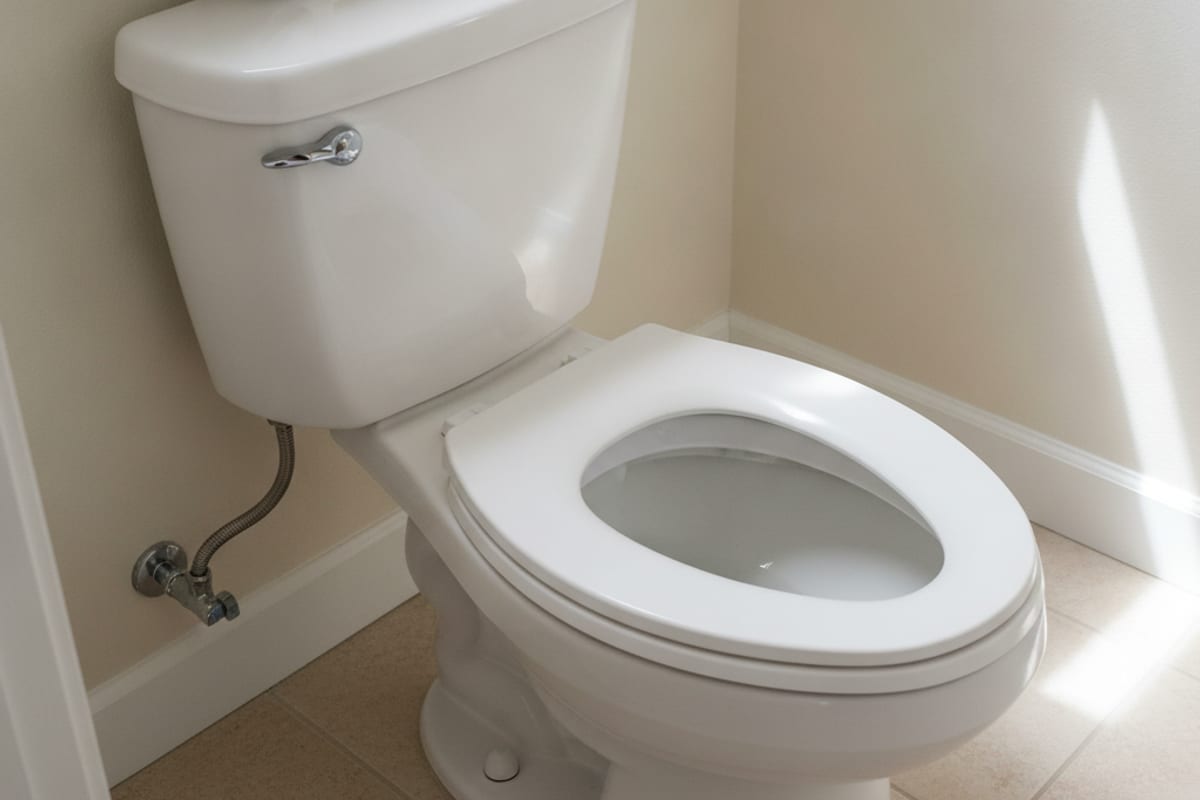
“Toilet repair” covers six or seven completely different jobs, and they don’t cost the same, take the same time, or end the same way. Some are a fifteen-minute part swap. One or two mean the toilet has reached the end of its life and the honest answer is a replacement. A few aren’t the toilet at all, they’re the drain it sits on. Naming which one you have before you pick up the phone is most of the work.
Name the failure, not the fix
Homeowners usually call and say the toilet is broken. Plumbers hear that and start asking about symptoms, because the symptom is what tells you which of these you have.
- It runs, hisses, or refills on its own. Tank problem. Almost always a flapper or a fill valve, and it’s the cheapest repair on this list. We break it down in why your toilet won’t stop running.
- Water shows up at the base, or the toilet rocks. Not a tank problem. That’s the wax ring or, more often in Florida, the flange underneath it. See toilet flange problems.
- It clogs constantly. Could be the toilet, could be what’s downstream of it. How to unclog a toilet covers the first part.
- It gurgles or bubbles when a shower or washer runs. That is a venting or drain signal, not a toilet fault. A toilet bubbling when the shower runs explains why.
- The flush is weak, or it takes two flushes to clear. This is the one nobody diagnoses correctly, and it gets its own section below.
- The tank or bowl is cracked, or the flush valve is corroded through. The toilet is done. Skip to the replacement section.
Those six cover the overwhelming majority of calls. The reason it’s worth sorting them yourself is that three of them are homeowner-fixable and three of them aren’t, and the difference is not obvious from the bathroom floor.
The failures that really are a parts swap
Everything inside the tank is a wear part. Flappers, fill valves, tank-to-bowl gaskets and supply lines are all designed to be replaced, and replacing one on a toilet that’s otherwise sound is the right call every time.
The EPA’s WaterSense program puts the most common one plainly. On its residential toilets page it says “Most toilet leaks are due to old or worn-out toilet flappers (e.g., valve seal),” and describes the flapper as “an inexpensive part, typically made from rubber, plastic, or silicone, that controls the flow of water to the toilet bowl.” It adds that “Replacing one is quick and easy.”
That’s true, and it’s also where homeowners get stuck the second time. A flapper seals against a flush valve seat. If the seat is pitted or scaled, a brand-new flapper will seep across it just like the old one did, and you’ll be back inside the tank in a month convinced you bought a bad part. The toilet repair pros we send check the seat with the tank open before fitting anything to it.
The same logic applies to the shutoff valve behind the toilet. An angle stop that won’t turn, or that weeps once you do turn it, is its own small job and it has nothing to do with why you called. It’s worth handling while someone is already there, because the next time you need to stop water at that fixture you will need it to work.
Why a Tampa toilet loses its flush without ever clogging
This is the failure that gets misdiagnosed most often, and it’s more common on this coast than most.
A toilet does not flush by dropping water into the bowl. It flushes by moving water fast enough through a ring of small holes under the rim and, on most designs, one larger jet at the bottom of the bowl, to start a siphon. Those openings are narrow by design. Mineral-laden water leaves scale in narrow openings.
To put a figure on the local water, Tampa’s 2025 Water Quality Report, published in 2026, put the average total hardness of the city’s finished water at 211 mg/L or 12.3 grains per gallon. That is a City of Tampa number for City of Tampa customers, and the county utilities publish their own. Wherever your water comes from in Tampa Bay, it is not gentle on small orifices.
What that looks like in a bathroom: the bowl empties slowly, the swirl is lazy instead of aggressive, and you start flushing twice out of habit without ever noticing when it started. Nothing is clogged. The drain is fine. The toilet is just no longer moving water fast enough to start a proper siphon, because the passages it uses are partly closed.
It’s the same mechanism that shortens tank life on water heaters here, which is why hard water and Tampa water heaters is a live topic on this coast and not on softer ones.
The practical point is that a weak flush is worth having looked at before anyone starts snaking a drain that was never blocked. If the passages can be cleared, that’s a repair. If the toilet is old and the internal glazing has gone rough, it usually isn’t, and this is one of the failure modes that pushes an otherwise intact toilet into the replacement column.
When the toilet is finished
There are a few conditions that no part fixes.
A cracked tank or a cracked bowl is one. Porcelain does not get repaired, and a hairline crack in a tank is a slow leak that becomes a fast one on a schedule nobody can predict. A flush valve corroded through at its base is another, since on many toilets the valve is not a serviceable part. A bowl that needs two flushes after the passages have been cleared is the third.
Age is a fourth, and it’s the one with actual money attached. The EPA notes that “Older, inefficient toilets that use as much as 6 gallons per flush also happen to be a major source of wasted water in many homes,” and that toilets are “by far the main source of water use in the home, accounting for nearly 30 percent of an average home’s indoor water consumption.” Pouring repair money into a six-gallon toilet that also leaks means paying twice, once for the part and again every month on the bill.
That’s also the case where the math can flip in your favor rather than against it. Several Tampa Bay utilities pay a rebate to swap an old high-volume toilet for an efficient one, and the amount usually turns on how old the toilet is. Our breakdown of toilet rebates in Tampa Bay covers which utilities run a program and what decides the amount.
Read the stamp inside your own tank
Before you decide anything, take the lid off and look inside. There is more information printed in there than most homeowners realize.
Florida Water Star, the water-efficiency certification program run under the Southwest Florida Water Management District, tells its own inspectors exactly this. Its technical manual says “The Inspector must field-verify the performance label for each toilet” and that “A stamp with the performance values is located inside the toilet tank.” What you are looking for is the gallons-per-flush rating and, on most tanks, a date of manufacture.
The same manual is useful on what a replacement should be. It states that “The Energy Policy Act (EPAct) of 1992 and Florida Building Code requires that both residential and commercial toilets not exceed 1.6 gallons per flush (gpf),” which matches the Florida Building Code, Plumbing, Section 604.4 and its Table 604.4, where the maximum for a water closet is listed as 1.6 gallons per flushing cycle. That is the legal ceiling for anything installed new, so it is not a choice you get to make.
Where you do get a choice is performance, and Florida Water Star names the measure. For its own Silver and Gold certification it requires that “All toilets shall be high efficiency (1.28 gallons/flush with a UNAR MaP rating above 350 grams/flush),” and it adds that “Toilets with MaP rates above 600 grams per flush may offer better performance.” Those thresholds are that program’s certification criteria, not a rule that applies to your bathroom. But MaP is a published flush-performance score, and knowing it exists is the difference between buying a toilet on looks and buying one that clears the bowl in a single flush for the next twenty years.
The old fear about efficient toilets, that less water means more clogs, is worth answering honestly rather than dismissing. It is not imaginary in every setting. Florida Water Star’s own manual notes that utilities have raised concerns about high-efficiency fixtures in commercial buildings, specifically about whether there is enough volume to carry waste through long drain lines in buildings that lack showers or other higher-volume uses. That is a commercial drain-line concern, not a verdict on a house. In a typical Tampa home, a well-rated 1.28-gallon toilet is not the reason a drain backs up.
When the problem was never the toilet
A toilet that gurgles, backs up at the rim, or comes back within days of being cleared is reporting on the line beneath it. So is one that acts up only when the washing machine drains.
That’s a drain question, and it’s worth treating as one before spending another dollar inside the tank. Drain cleaning is the right first move when more than one fixture is involved. If water is actively rising out of the bowl or backing into a tub, that’s an emergency plumbing call, not a Monday-morning one.
There’s a related check worth running when the bill is what prompted all this. Shut off the toilet’s supply, use no water anywhere in the house for two hours, and read the meter at the start and the end. If the meter moved, the toilet was never the leak. Our guide to a high water bill in Tampa Bay covers what to do with that result.
Frequently asked questions
Is toilet repair a job I can do myself?
Some of it. A flapper, a fill valve, a flush handle and a supply line are all genuinely homeowner-level work on an accessible toilet. Pulling the toilet to get at a wax ring or a flange is not, mostly because what’s underneath is often worse than expected and because setting a toilet back down wrong creates a leak you can’t see. Anything involving the drain line below the floor is a licensed plumber’s job.
My toilet flushes weakly but nothing is clogged. What is it?
Usually mineral buildup closing down the rim holes under the bowl’s edge and the siphon jet at the bottom. Those passages are narrow on purpose, and hard water scales them over years, so the flush weakens gradually enough that you adjust to it. It is not a clog and snaking will not fix it.
How do I know how old my toilet is?
Take the tank lid off and look inside. Most tanks carry a date stamp along with the flush-volume rating. Florida Water Star’s technical manual confirms the location, noting that a stamp with the performance values sits inside the toilet tank. The date matters for rebate eligibility as well as for deciding whether a repair is worth it.
Should I repair or replace a toilet that keeps having problems?
Repair anything that is a wear part on a toilet that’s otherwise sound. Replace once the porcelain is cracked, the flush valve is corroded, the bowl needs two flushes after the passages are cleared, or the toilet is an old high-volume model that’s also leaking. In that last case a rebate can cover part of the swap.
Will a new low-flow toilet clog more than my old one?
In a typical house, no. Modern 1.28-gallon toilets are tested for flush performance, and the MaP score published for each model tells you how much waste it clears in a single flush. The concern that shows up in the literature is about long drain lines in commercial buildings with little other water use, which is not the situation in a Tampa home.
Does a leaking toilet actually cost much on a Tampa water bill?
Enough to notice. The EPA publishes that household leaks can waste 180 gallons per week and that toilets are often the culprit, and that figure is a household one rather than a per-toilet measurement. On a metered Tampa bill you pay for that water twice, once as water and once as wastewater.
When to call us
Call a licensed plumber when the tank keeps running after you’ve replaced the flapper, when there’s water at the base of the toilet or the toilet rocks, when the flush is weak and nothing is clogged, when the shutoff valve behind the toilet won’t turn, or when more than one fixture is acting up at the same time. We’ll match you with a licensed local plumber who covers your part of Hillsborough, Pinellas or Pasco.
Call us at (813) 590-0625.