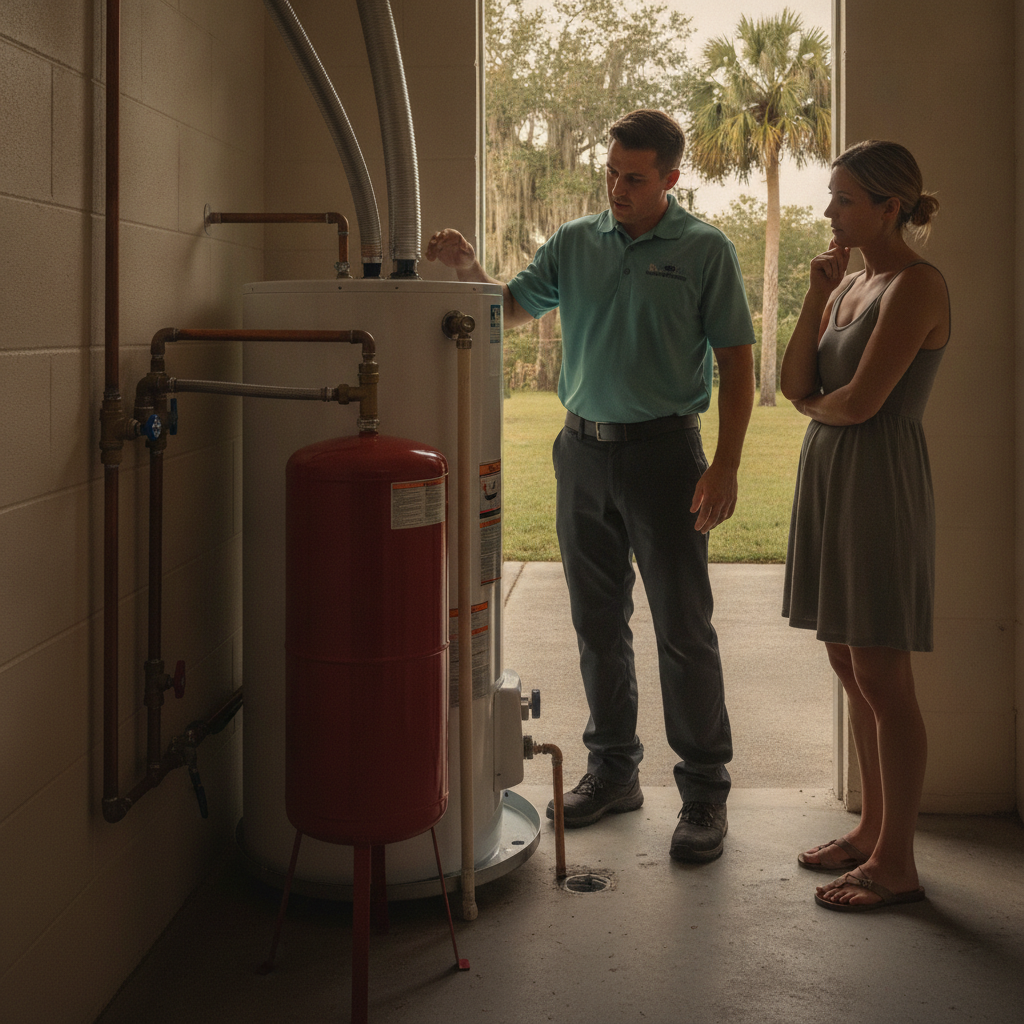
The T and P valve on a garage heater in Brandon starts weeping after a long recovery cycle. That drip is often the heater asking for a water heater expansion tank, not a new relief valve. On a closed Tampa Bay system, heated water has nowhere to push, so pressure climbs until the relief valve lets go.
Why a closed system needs a water heater expansion tank
Water expands when it heats. It does not compress. In an older Seminole Heights or Hyde Park house, that extra volume used to shove back through the meter into the city main. That path is an open system. The street took the swell, and the heater never saw a sharp spike.
Most Tampa Bay city-water homes are not open anymore. A pressure-reducing valve, a check valve, or a backflow preventer sits on the incoming line and blocks that pushback. Florida’s plumbing code, 8th Edition (2023), Section 607.3, requires a thermal expansion control device on the cold supply of a storage water heater whenever that cold water has already passed through a check valve, a pressure-reducing valve, or a backflow preventer. The device has to sit downstream of all of those. A bladder-type expansion tank is the usual device. The rule is written for a storage heater. It does not extend to tankless.
Most newer construction on city water already has a pressure-reducing valve near the main shutoff. That is common in Brandon, Valrico, FishHawk, and the rest of the 1980s-to-2000s East Hillsborough belt. The valve is there because Section 604.8 requires one when static pressure inside the building exceeds 80 psi. Hose bibs and outside hydrants are the exception. They do not have to sit behind that valve. Most Tampa Bay utilities deliver somewhere around 45 to 60 psi at the meter under normal use. The 80 psi ceiling lives inside the building, not at the plant. The state drinking-water rule only sets a floor of 20 psi at the point of connection.
Once that PRV, check, or backflow preventer is in place, the heater is on a closed loop. Heat a 40- or 50-gallon tank after a round of showers in a Carrollwood ranch, and the extra volume has to go somewhere. The expansion tank is a small steel vessel with air on one side of a bladder and potable water on the other. The air cushion takes the swell. House pressure stays put. Fixtures, supply lines, and the heater tank itself stop taking that spike.
A well house in Land O’ Lakes, Odessa, or Wesley Chapel already has a pressure tank at the pump. That tank is for pump cycling. It is not a thermal expansion tank. A check valve on a well system can still close the heater off, so the heater can still need its own tank on the cold line.
| Setup | Where expanded water goes | Typical Tampa Bay example |
|---|---|---|
| Open to the street | Back into the public main | Older inner-neighborhood houses before a check valve or meter check |
| Closed by a PRV, check valve, or backflow preventer | Into a dedicated expansion tank on the cold line | Newer East Hillsborough subdivisions and most city-water homes with a PRV near the shutoff |
| Well with a pump pressure tank | The well tank handles pump cycling, not heater expansion | Land O’ Lakes, Odessa, Wesley Chapel, Thonotosassa, Wimauma |
If a PRV fails, the code wants that valve designed to stay open so water still flows. Full street pressure then hits the house. That shows up as banging pipes, a suddenly noisy water heater, or a spike rather than a drop. That is a high water pressure problem, and it stacks on top of thermal expansion instead of replacing it.
The T&P valve that drips when this tank is waterlogged
The temperature and pressure relief valve is the last safety on the tank. It lifts when temperature or pressure goes past its setting. A short drip during a heat cycle is often thermal expansion, not a dead valve.
Replacing the T and P first is the usual wrong turn. The new valve weeps too, because the closed system is still climbing. The expansion tank is missing, too small, or waterlogged. Waterlogged means the bladder has failed or the air charge is gone, so the little tank is a solid bottle of water. A working tank sounds hollow on the air side. A dead one sounds dull and full.
A.O. Smith’s residential gas manual, document 326940-001, tells owners to check that the T and P valve is in operating condition at least once a year. That is one manufacturer’s instruction for its own gas tank line, not a city rule. Checking the valve is not the same as swapping it. On a closed system, the plumber we send tests house pressure, then watches whether that pressure rises while the heater is firing. If it rises, the system is closed and the expansion tank is not doing its job.
Tampa’s 2025 water quality report put finished-water hardness at 211 mg/L, or 12.3 grains per gallon. Hard water leaves scale on the T and P seat the same way it crusts a Brandon shower head after a year. A weeping valve can be scale, expansion, or both. The hard-water heater page owns that chemistry. Here the tell is timing. A drip that tracks the heating cycle points at expansion. A drip that never stops points at a valve that cannot reseat, or at a tank that is overheating.
The discharge tube should dump where you can see it. In a manufactured home, the relief discharge has to run full size to the exterior, not under the home, and finish between 6 and 24 inches above finished grade so the end stays visible. Town ‘n’ Country, Seffner, Gibsonton, and Zephyrhills have a lot of that housing. A wet patch in the grass under that pipe is the same story as a wet pan in a South Tampa garage.
Water in the pan is not always the heater. If the T and P line dumps to a floor drain and that drain is slow, the garage puddle is a drain cleaning job. A tank that is actually leaking is a different failure, covered in our leaking water heater guide.
Repeated spikes also beat on old pipe. Polybutylene in a late-1970s-to-mid-1990s Valrico subdivision, and galvanized in a pre-1975 St. Petersburg bungalow, do not like pressure cycling. Clustered leaks are when the talk turns to a whole-home repipe.
How a plumber sizes and places one on a Tampa heater
The plumber we send measures static pressure at a hose bib, then watches that gauge through a heat cycle. Size follows three things: how many gallons the storage heater holds, what the incoming pressure actually is, and how tightly closed the system is. There is no single tank that fits every 40-gallon gas heater in Tampa. A 50-gallon tank in a two-story Hyde Park house at the high end of street pressure needs more cushion than a small bungalow already sitting near 45 psi. The installer matches the tank to those readings, and goes larger when two sizes sit on the line.
Placement is on the cold-water pipe, downstream of the PRV, check valve, and any backflow preventer, per Section 607.3. That is usually a tee above the heater in a garage or closet. The tank can hang on that cold line elsewhere in the house if no valve sits between it and the heater. Air charge is set to the home’s static pressure before the tank is opened to the system. Too little air and the bladder is already collapsed. Too much air and the tank takes almost no water.
This is licensed plumbing, not a hang-it-yourself Saturday job. The cold line is under pressure. The heater may be gas, with a flue and a discharge tube that has to stay correct. You can confirm a plumbing contractor’s license before anyone opens that line. Permit questions for heater work live on our water heater permit page, because the local building department is who answers that for a given address.
If the heater itself is at the end of its life, a standard 40 to 50-gallon tank replacement runs $1,400 to $2,600 installed. The expansion tank is part of making that install right on a closed city-water system. Standalone expansion-tank work is quoted after the pressure test, because access, hanging hardware, and whether the PRV also needs attention all move the number. Most water heater repairs on this site run $150 to $450 depending on the part. That published range is for heater repairs. It is not a sticker price for an expansion tank.
An expansion tank is not a water-hammer arrestor. Arrestors sit at quick-closing valves and follow a different code section. Banging at a washing machine is a different page: water hammer in Tampa.
Do I really need an expansion tank on my water heater?
You need one on a storage water heater when the cold water already passes through a check valve, a pressure-reducing valve, or a backflow preventer. That is the closed-system case Section 607.3 describes. An older house that still pushes freely back into the main may not show a pressure climb during a heat cycle. Add a PRV or a backflow preventer later, and the same heater needs the tank.
What size expansion tank do I need for a 40 gallon gas water heater?
Size follows heater volume, measured static pressure, and how closed the system is. A plumber sets it from those readings, not from a single 40-gallon rule. Two homes with the same heater can need different tanks if one sits behind a tight PRV and the other does not.
Can I replace my expansion tank myself?
This belongs to a licensed plumber. The tank hangs on a pressurized cold line, often next to a gas heater, and the air charge has to match house pressure before the tank is opened to the system. The plumbers we send are licensed and insured, and they will test the heat cycle before they pick a size.
How often do you change an expansion tank on a water heater?
There is no calendar interval. You change it when the bladder fails or the air charge is gone and pressure climbs again during a heat cycle. A tank that still takes the swell, and still sounds hollow on the air side, stays in service.
When to call us
Call when the T and P weeps on a heat cycle, when a new heater went in without an expansion tank on a home that already has a PRV, or when pressure jumps at the hose bib while the burner or elements are on. The plumbers we send will test the system before they hang a tank. Call us at (813) 590-0625.