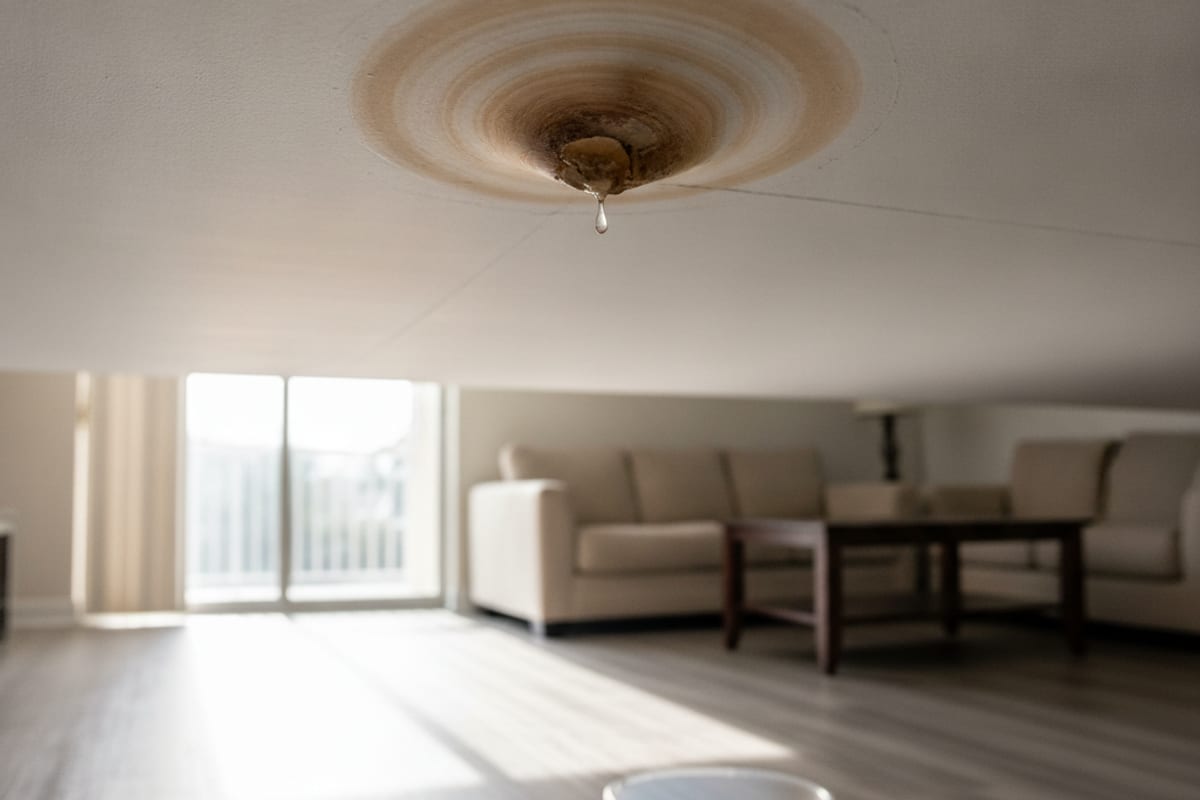
When water shows up in a Florida condo, everyone reaches for the same question, which is who pays. That single question is really three, and they have different answers. Who has to insure the damaged thing, who has to repair it, and who eats the cost. Florida law sets the insurance floor for every residential condominium in the state. On maintenance it names a default and then hands the exception to your declaration. The third question depends on whether the leak was an insurable event and whether anyone was negligent.
The three questions people blur together
A neighbor’s supply line lets go on a Sunday. By Monday the ceiling in the unit below is sagging and two owners are arguing about a restoration bill neither of them has seen yet.
The argument usually happens because both sides are answering different questions with the same word. Coverage is not the same as maintenance, and neither one is the same as financial responsibility for a specific loss. Florida’s condominium statute treats them separately, so it helps to take them apart before you call anybody.
One thing to set aside first. This is a plumbing explainer, not legal advice, and no article can read your declaration for you. What it can do is tell you which document answers which question, so you know what to pull up and what to ask.
What the association’s policy has to cover
Florida Statute 718.111(11) sets a floor, and its own scope sentence says it “applies to every residential condominium in the state, regardless of the date of its declaration of condominium.” Under (11)(f), the association’s property policy has to provide primary coverage for “All portions of the condominium property as originally installed or replacement of like kind and quality, in accordance with the original plans and specifications.”
Then (11)(f)3 carves out a list, and the list is the part worth memorizing. The association’s coverage “must exclude all personal property within the unit or limited common elements, and floor, wall, and ceiling coverings, electrical fixtures, appliances, water heaters, water filters, built-in cabinets and countertops, and window treatments, including curtains, drapes, blinds, hardware, and similar window treatment components, or replacements of any of the foregoing which are located within the boundaries of the unit and serve only such unit. Such property and any insurance thereupon is the responsibility of the unit owner.”
Read that list against what actually fails in a condo and the picture gets concrete. Your water heater is on it by name. So is your water filter. So is the flooring the water ruined and the cabinet it soaked into. Pipe isn’t on that list at all, which is exactly why it causes so many arguments. Whether a line inside a wall is yours depends on where your declaration draws the unit boundary and who it assigns the upkeep to.
Maintenance is a separate document
Coverage and upkeep are not the same duty. Florida Statute 718.113(1) puts it plainly: “Maintenance of the common elements is the responsibility of the association, except for any maintenance responsibility for limited common elements assigned to the unit owner by the declaration.”
That exception is where the declaration does the deciding. Limited common elements are a defined category in your declaration, and your declaration is allowed to hand their upkeep to you. The same section says the declaration “may provide that certain limited common elements shall be maintained by those entitled to use the limited common elements or that the association shall provide the maintenance, either as a common expense or with the cost shared only by those entitled to use the limited common elements.”
So when a branch line inside a chase fails, the answer is not in the statute. It’s in your declaration’s boundary description and its maintenance article. Find those two sections before the first phone call and you’ll have a much shorter conversation.
Insurable event, or just a leak
Here is the distinction that surprises people. Florida Statute 718.111(11)(j) says any portion of the condominium property the association must insure “which is damaged by an insurable event shall be reconstructed, repaired, or replaced as necessary by the association as a common expense.”
Then it turns around: “In the absence of an insurable event, the association or the unit owners shall be responsible for the reconstruction, repair, or replacement as determined by the maintenance provisions of the declaration or bylaws.”
Whether a given leak is an insurable event turns on the association’s policy, not on the statute, which leaves the term to the policy. As a general matter, gradual deterioration is commonly excluded by property policies. That’s why a slow leak can land back on the declaration. We walk through the same gradual versus sudden line on the homeowner side in what homeowners insurance covers for plumbing.
Negligence moves the bill
Florida Statute 718.111(11)(j)1 names an exception, and it’s worth quoting because it names you and your guests: “A unit owner is responsible for the costs of repair or replacement of any portion of the condominium property not paid by insurance proceeds if such damage is caused by intentional conduct, negligence, or failure to comply with the terms of the declaration or the rules of the association by a unit owner, the members of his or her family, unit occupants, tenants, guests, or invitees, without compromise of the subrogation rights of the insurer.”
There’s a reporting trap two subparagraphs down. Florida Statute 718.111(11)(j)4 says the association isn’t obligated to pay for reconstruction or repairs of property losses as a common expense “if the property losses were known or should have been known to a unit owner and were not reported to the association until after the insurance claim of the association for that property was settled or resolved with finality, or denied because it was untimely filed.”
That’s the practical reason to report water the day you see it, even when you think it’s nothing. A written report gives you a record of when you told them, which is the fact the provision turns on. What the provision turns on is whether the association knew before its claim was resolved, not how bad the stain looked when you found it.
You may not get to pick your own contractor
A restoration company is an easy first call, and the association an easy second. Florida’s statute runs the other way. Under 718.111(11)(g)1, “All reconstruction work after a property loss must be undertaken by the association except as otherwise authorized in this section.”
An owner can do the work, with a condition attached: “A unit owner may undertake reconstruction work on portions of the unit with the prior written consent of the board of administration.” The board may condition that consent on “the approval of the repair methods, the qualifications of the proposed contractor, or the contract that is used for that purpose”, and the statute adds that the owner “must obtain all required governmental permits and approvals before commencing reconstruction.”
The statute’s reconstruction rule is about rebuilding after a loss. Stopping the water is the step before that, and your declaration and house rules govern what you can do on your own and when you have to call the board first. Our emergency plumbing page covers what a stop-the-leak call looks like.
The loss assessment line in your own policy
If the association assesses owners for a loss, Florida sets a minimum on one line of your own unit owner policy. Florida Statute 627.714(1) says that for policies issued or renewed on or after July 1, 2010, a unit owner’s residential property policy “must include at least $2,000 in property loss assessment coverage for all assessments made as a result of the same direct loss to the property … owned by all members of the association collectively,” applying “if such loss is of the type of loss covered by the unit owner’s residential property insurance policy”, and the statute sets “a deductible of no more than $250 per direct property loss” on that coverage.
That’s a statutory minimum on what the policy has to include, not a cap on what you can buy and not a prediction of what any claim pays. What your policy actually does in a given loss is a question for your agent, so call and ask what your loss assessment limit is before a special assessment ever shows up.
Where condo plumbing fails differently than a house
The legal frame matters more here than in a single family house, because a condo’s plumbing is shared in ways a detached home’s isn’t.
- Vertical cast iron stacks. Cast iron waste stacks corrode from the inside out, and in a stack the lower run carries everything above it. A stack serving multiple units is a different question from a fixture inside one unit, and your declaration is what draws that line. Our piece on cast iron pipe failure around St. Petersburg covers how the material deteriorates.
- Hot water risers and branch lines in chases. Copper in a chase can run for a long stretch and then pinhole with no warning. Locating it means opening a wall that may or may not be yours to open, which is why leak detection comes before demolition.
- Water heaters inside the unit. These are on the statute’s exclusion list by name, and a tank that lets go on an upper floor drains into everything below it. If yours is past its expected life, a leaking water heater is the article to read before it decides for you.
- Angle stops and braided supply lines. The valve and connector under a toilet or sink can fail wide open rather than slowly, which is what turns a fixture into a multi floor problem. Replacing an aging supply line is small work next to that.
One statute puts building plumbing on the board’s own paperwork. 718.112(2)(g) requires a structural integrity reserve study at least every ten years after the condominium’s creation for each condominium building “three stories or higher in height,” and the list of items that study must cover includes roof, structure, fireproofing and fire protection systems, and, in the statute’s own single word, “Plumbing.” The study is based on a visual inspection and has to state the estimated remaining useful life and the estimated replacement cost or deferred maintenance expense of each item. If your board has commissioned one, plumbing is one of the items it had to cover. Asking about it is a reasonable question for the board.
The first hour, in order
Move in this sequence and you protect both the building and your own position.
- Shut the water off. If you don’t know where your valve is, find it now rather than during the flood. Our guide on how to shut off the water in an emergency covers unit-level and building-level shutoffs.
- Photograph everything before anyone dries anything out. Get a wide shot and a close shot of every affected surface, plus the meter reading if you can reach it.
- Notify the association in writing, the same day, with the photos attached. That gives you a record of when they were told.
- Pull up your declaration and find two things: the unit boundary definition and the maintenance article.
- Call your own insurer and ask what your policy covers inside the unit and what your loss assessment limit is.
Frequently asked questions
Does the condo association’s insurance cover my water heater?
No. Florida Statute 718.111(11)(f)3 lists water heaters among the items the association’s policy must exclude when they’re located within the unit boundaries and serve only that unit, and the statute says that property and any insurance on it is the unit owner’s responsibility. Water filters, appliances, and built-in cabinets and countertops are on the same list.
My upstairs neighbor’s leak damaged my ceiling. Do they pay?
Not automatically. Under Florida Statute 718.111(11)(j), damage from an insurable event to property the association must insure gets reconstructed by the association as a common expense. A neighbor becomes responsible for costs not paid by insurance proceeds when the damage was caused by intentional conduct, negligence, or a failure to follow the declaration or rules, by them or by their family, tenants, guests, or invitees. Whether that applies is a factual question about the specific leak.
Can I hire my own contractor to fix the damage?
Only with permission. Florida Statute 718.111(11)(g)1 says all reconstruction work after a property loss must be undertaken by the association except as otherwise authorized, and that a unit owner may do reconstruction work on portions of the unit with the prior written consent of the board. The board can condition that consent on the repair method, the contractor’s qualifications, or the contract, and required permits have to be pulled before work starts.
Who is responsible for a pipe inside the wall?
That depends on your declaration, not on the statute alone. Maintenance of common elements is the association’s responsibility, except for limited common element maintenance the declaration assigns to the unit owner. The two sections to read are the unit boundary description and the maintenance article. A stack that serves multiple units is a different question from a branch line that serves only yours.
Should I report a small stain if I’m not sure it’s a leak?
Yes, in writing. Florida Statute 718.111(11)(j)4 relieves the association of the obligation to pay for reconstruction or repairs of property losses as a common expense when a loss was known or should have been known to the owner and wasn’t reported until after the association’s claim was settled with finality or denied as untimely. A dated report about a stain costs you nothing and preserves the option.
When you need someone to look at the pipe
The paperwork question and the plumbing question are separate, and only one of them stops the water. If something is actively leaking, get it shut off and get eyes on it, then work out the responsibility question with the association once the damage stops growing. Before you hire anyone for condo work, confirm with your board what approvals the building requires.
When you’re ready for someone to look at the pipe, call (813) 590-0625 and we’ll connect you with experienced, insured local crews. Verify any contractor’s CFC plumbing license at myfloridalicense.com before work begins.