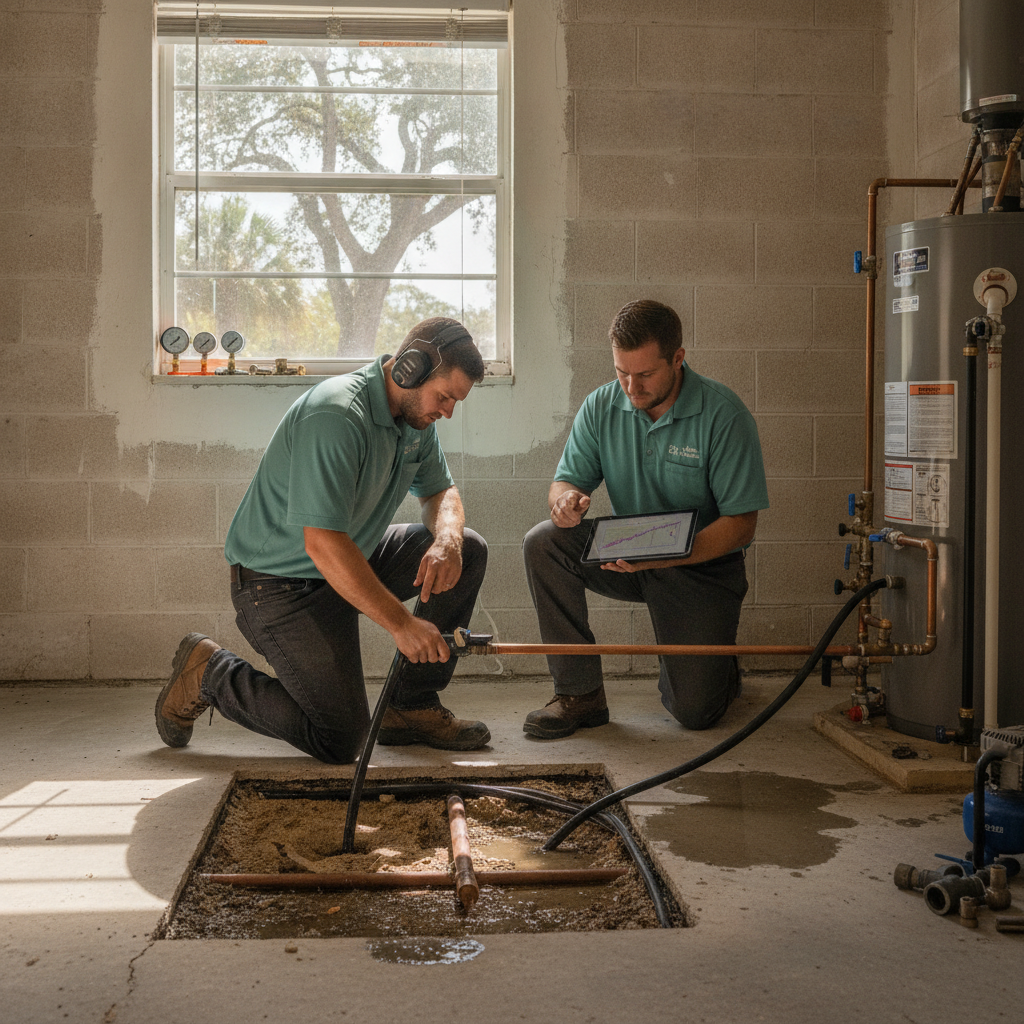
A warm patch of tile in a Brandon great room, a water bill that jumped with no extra guests, a hiss under a Seminole Heights ranch: that is usually when a homeowner needs slab leak detection. The visit is not a guess and it is not a jackhammer. Licensed plumbers isolate the line, listen or heat-map the slab, and mark the leak before anyone opens concrete.
What a slab leak detection visit includes
A detection visit answers one question: is pressurized water leaving a pipe under the slab, and where. The plumber starts at the meter and the main shutoff, not at the wet carpet.
The EPA’s leak guidance is the same first move Tampa Bay utilities teach. With every tap, ice maker, softener, and sprinkler off, the meter should sit still. If it still ticks, water is leaving the system somewhere. That reading is a leak flag. It is not a map of the slab. A stuck irrigation valve, a toilet flapper, or a water heater tank can move the meter the same way a broken copper line under the living room does.
Pasco County’s own leak walk-through adds the house-valve test that splits those cases. Close the valve on the side of the house and watch the meter again. If it stops, the waste is inside the walls or fixtures. If it keeps moving, the loss is between the meter and that valve, which on a slab-on-grade house in Valrico or FishHawk often means the line under the concrete. Hillsborough County’s version is a two-hour sit with no water use: the two readings should match. They will not, on a true underground leak.
Hot versus cold comes next. The plumber caps or isolates one side and pressure-tests the other. A hot-only loss often sits in the run from the heater to the far bath. A cold-only loss can be the main under the slab or a branch to a hose bib. Both sides dropping usually means the problem is upstream of the water heater, not a failing tank.
Site-published leak detection on this work runs $250 to $450, applied toward the repair when you stay with the same job. That fee is the locate, the isolation, and the mark on the floor. It is not the concrete cut, the pipe repair, or the tile patch.
A useful visit also rules things out. A drain line under the slab that is backing up is a different test, usually a camera in the cleanout, because a sewer does not spin the water meter. A tank that is rusting from the inside shows up as rusty water on the hot side only. The detection appointment is there to stop you from opening the wrong floor.
If the meter is moving, shut the house off at the private valve, typically on the side of the structure, and call. Walking the high-bill steps first still helps, because City of Tampa and Hillsborough both want proof of a repaired leak before they will even review an adjustment. The detection report and the plumber’s invoice are the paperwork those reviews ask for.
Acoustic, thermal, and camera methods on Tampa slabs
Sandy soil under a Tampa Bay slab lets water travel. The wet spot in the hallway is often not the hole in the pipe. That is why a stethoscope on the floor, by itself, misses.
Acoustic detection listens for turbulence. Water leaving a pin-sized hole under pressure makes a hiss the ear cannot place through the slab and a bed of fill. A listening set on the slab, at the meter, and on hose bibs narrows the zone. On a quiet street in Temple Terrace that can be enough. On a busy Gandy corridor, or with a pool pump running, the plumber waits or comes back, because background noise swamps a small leak.
Thermal imaging finds heat, not water. A hot-supply leak under tile in a Lutz ranch shows as a warm bloom on the floor, and Tampa Bay air conditioning makes that contrast sharper than it would be in a house that is not being cooled. A cold-line leak is harder on a camera. The floor may read a degree or two off, or it may look normal while the sand underneath is saturated. That is when the pressure test and the acoustic pass have to agree before anyone marks a cut.
Camera work belongs mostly to drains. A sewer camera through a cleanout can show a cracked hub or a belly in the waste line under the slab. It will not show a pinhole in a copper water line, because that pipe is full and opaque. If the complaint is a toilet that gurgles when the shower runs, you are in drain territory. If the complaint is a spinning meter and a warm floor, you are in supply territory.
The pipe material decides how the leak behaves once it starts. East Hillsborough subdivisions from the late 1970s through the mid-1990s, Brandon, Valrico, Seffner, Plant City, still hide polybutylene under many slabs. That plastic gets brittle and fails at fittings. 1990s copper in Lutz and similar stock is in the age range where pitting and pinhole leaks show up in more than one spot. Older galvanized in Seminole Heights and Hyde Park corrodes from the inside and tends to fail in clusters once the first leak appears. A single mark on the floor does not tell you which of those you have. The cut, or a camera on an accessible run, does.
High street pressure makes every one of those failures faster. Most Tampa Bay utilities deliver somewhere around 45 to 60 psi at the meter under normal use. Florida’s plumbing code requires a pressure-reducing valve on any home where static pressure exceeds 80 psi. A failed valve that is stuck open dumps full street pressure into the slab lines. If the detection visit shows both a leak and a noisy heater or banging pipes, the pressure side is part of the same job.
Repair vs repipe after a confirmed leak
The test marks a spot. The next decision is whether to open that spot or stop putting water through the rest of the run.
A spot repair makes sense when the leak is one hole, the rest of the accessible pipe looks sound, and the line is copper or PEX that is not already pocked. The plumber opens the slab at the mark, repairs or replaces that section, pressure-tests again, then closes the concrete. Flooring, furniture, and how deep the pipe sits in the slab are what move the number, because the plumbing joint is often the smaller half of the mess.
A repipe makes sense when the first hole is a preview. Recurring pinholes, polybutylene still in the slab, or galvanized that has already leaked twice are the usual triggers. Rerouting the new line through the attic or walls keeps you from opening the slab again the next time a leak shows up. Site-published work for a standard single-story home runs $4,000 to $10,000. The sibling cost guide puts PEX for a typical 3-bed, 2-bath single story at roughly $4,000 to $8,000, and copper at $8,000 to $15,000 or more for the same house. Copper costs more because the material and the labor both do.
| After the locate | Spot repair under the slab | Reroute or whole-home repipe |
|---|---|---|
| What you are fixing | The marked hole, then a pressure retest | The failing material, not only this leak |
| When it fits | One leak, remaining pipe still sound | Pinholes in more than one spot, polybutylene, or galvanized that is failing in clusters |
| What you open | A small area of slab and floor at the mark | Walls, attic, or a few access points, with far fewer future slab cuts |
| What moves the cost | Slab thickness, tile or wood finish, how far the pipe sits from the mark | Home size, PEX versus copper, and how much of the old run has to come out |
Plumbing is still a permitted trade on a single-family house in Florida. The 2026 state exemption for work valued under $7,500 does not cover plumbing. City of Tampa’s residential plumbing (general) trade permit is $120.00, plus the Florida Building Permit Surcharge of 2.5% of permit value or a $4.00 minimum. Unincorporated Hillsborough County’s residential plumbing (general) permit is $130.00. Those are the permit lines, not the job. Confirm the current path with the building department that has your address, because Pinellas cities set their own and those schedules were not the ones used here.
Verify the plumber on Florida’s license search before the slab is opened. The pros we send are licensed and insured. The brand matches you with them. It does not hold the license or pour the concrete.
Common questions
How do you detect a leak in a slab?
You prove water is leaving the system first, then you locate the hole. With the house quiet, the meter should not move. If it does, the plumber isolates hot from cold and the house from irrigation, pressure-tests the suspect side, and uses listening gear or a thermal camera to mark the slab. Symptoms such as a warm tile or a musty hallway are clues. The EPA notes they are not a conclusive slab diagnosis on their own, which is why the meter and the pressure test come first.
Will homeowners insurance cover a slab leak?
Coverage is a policy question, not a plumbing one. Read the Definitions and Section I exclusions in your own form, and walk the claim with your carrier. One Florida HO-3 special form (Tower Hill’s TH HO-3 06 13) excludes constant or repeated seepage or leakage of water over a period of time, whether hidden or not, when that seepage leads to rot, fungi, or corrosion. That clause has no 30-day clock. Other forms and endorsements differ, so do not treat that sentence as what your policy says. For the claim-side walkthrough, use does homeowners insurance cover plumbing and slab leak insurance in Florida. On the utility side, City of Tampa will consider a leak adjustment after the repair, and it asks for a copy of the plumber’s repair bill plus its leak-adjustment form, at the City’s high-bill page. Hillsborough County will not review an adjustment until the leak is repaired, usage has been at least twice the last year’s average, and you have not had an adjustment in the past year. None of that is a promise of a credit. It is the paperwork path.
What is the best fix after a confirmed slab leak?
The best fix is the one that matches the pipe, not a single product. One pinhole in otherwise sound copper can be a section repair. A second leak a few months later, polybutylene still in a Valrico slab, or galvanized that is already thinning is a reroute or a whole-home repipe. Leaving the failed material in the slab means the next detection visit is a matter of when. If water has already reached living space, the EPA’s mold guidance is to dry damaged areas within 24 to 48 hours. That is a prevention window, not a timer for when mold appears.
How long can a slab leak go undetected?
Long enough for the sand under the slab to hide it. On a slab-on-grade house in Brandon or Apollo Beach, a slow supply leak often never makes a puddle. The fill drinks the water, the floor feels soft or warm, and the bill is the first hard signal. A faster break shows up in hours: a hiss, a sudden drop in pressure, a wet carpet. There is no safe waiting period. The meter test tells you whether it is still running. The detection visit tells you where. The signs of a Florida slab leak and under-slab plumbing failure pages cover the symptom list in more depth. South Shore homes sit low, so a damp slab after a storm is not automatically a pipe. If the meter is still after two dry hours, you are looking at groundwater or rain, not a supply leak.
When to call us
Call when the meter moves with the house off, when a floor is warm or soft, or when a second leak shows up after a patch. That is licensed plumber work: isolation, detection, and either a marked slab repair or a repipe, not a DIY cut in the wrong room. Call us at (813) 590-0625.