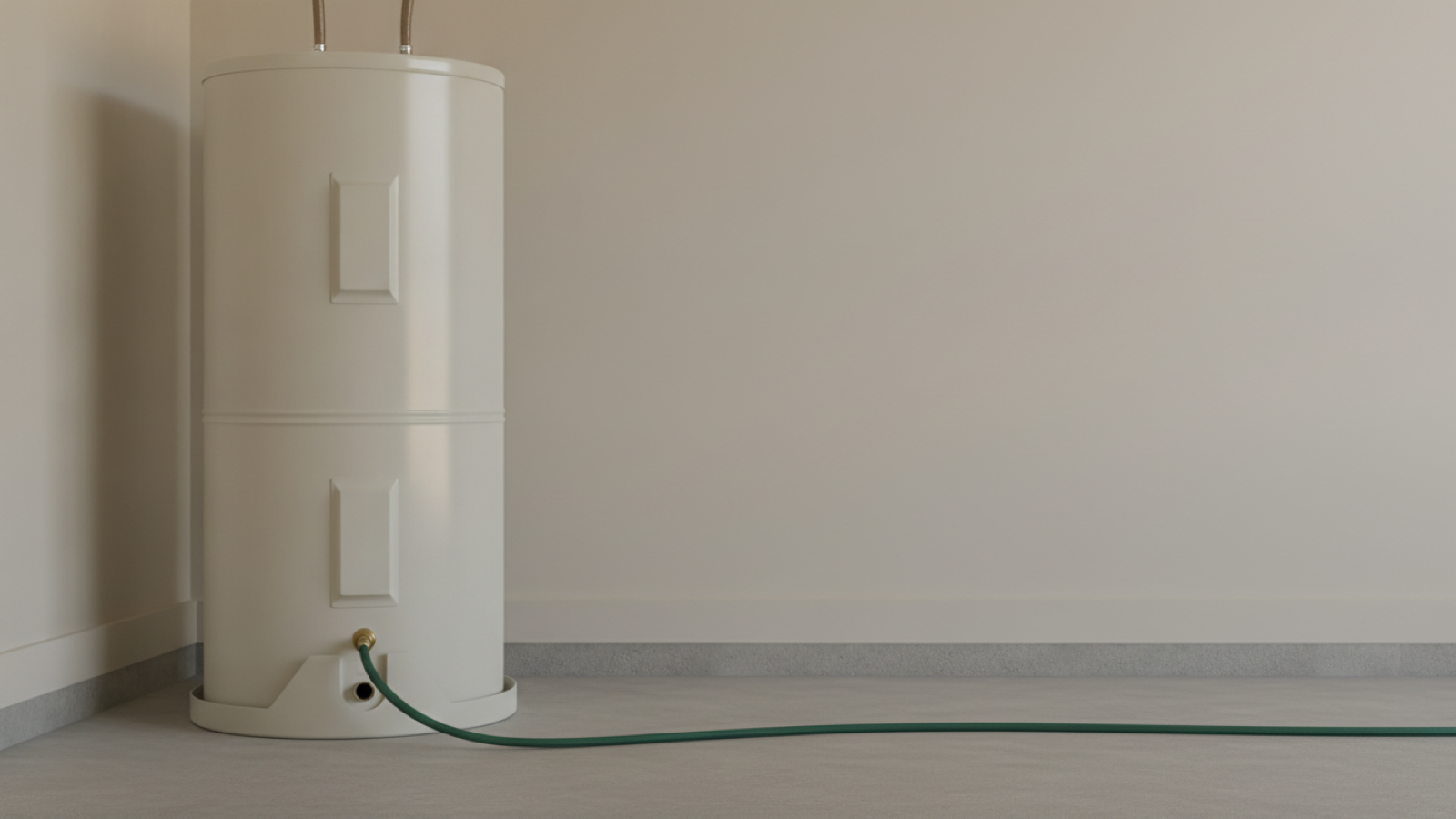
Water heater flush cost in Tampa Bay lands inside the $150 to $450 range Tampa Plumbing Pro publishes for water heater repair. It’s routine service, not a repair, and that range isn’t a flat flush price. The bigger money question is how often, and there’s a real answer to it. A. O. Smith’s residential gas manual tells owners to drain and flush the tank every 6 months. A tankless unit needs a different job entirely.
What does a water heater flush cost in Tampa Bay?
Three things move the quote: what kind of unit you have, how hard it is to get to, and what else gets checked while the plumber is there. Our water heater repair page publishes the range this work sits in. Most repairs run $150 to $450 depending on the part, and a flush falls inside that. Nobody can name your exact number without seeing the setup.
A tank flush is the simpler of the two. Water and loose sediment run out through the drain valve, so the plumber needs room for a hose and somewhere safe to send the water. Our published guidance puts the basic task at 30 to 45 minutes.
Tankless is a different animal. Instead of draining anything, a pump circulates a descaling solution through the heat exchanger for the better part of an hour. That loop connects to service isolation valves. If your installer never put them in, somebody has to add them first, and that’s no longer a maintenance visit.
Then there’s what else you ask for. An anode rod inspection or a relief valve check adds time to the same trip. So does a unit wedged into a closet instead of sitting open in a garage.
| Service detail | Tank water heater | Tankless water heater |
|---|---|---|
| What actually happens | Water and loose sediment drain out through the tank valve. | A pump circulates descaling solution through the heat exchanger. |
| What the plumber needs | The drain valve plus a safe hose route. | Service isolation valves on the hot and cold lines. |
| Typical add-ons | Anode rod inspection, relief valve check. | Valve installation if the unit was never set up for service. |
| What moves the quote | Access to the unit and any extra checks. | Whether the isolation valves are already there. |
If you want a real number, have the model and a photo of how it’s plumbed ready. Homeowners on the east side of the county can start from our Brandon plumber page.
How often should you flush a water heater in Tampa Bay?
Twice a year, if you go by the manufacturer. The A. O. Smith residential gas manual, document 326940-001, says the tank should be “drained and flushed every 6 months to remove sediment which may build up during operation.”
That matters more than it sounds. The usual advice online is once a year, so a Tampa Bay homeowner who’s told twice a year tends to hear an upsell. It isn’t one. A. O. Smith prints that interval for its own tanks nationwide, before anyone brings up Florida water. The number came from the people who built the thing.
Our own published guidance says the same, every six months rather than the annual figure you’ll read elsewhere. What Tampa’s water does inside the tank is covered in our guide to Tampa’s hard water and your water heater, which is the page that owns that story.
Here’s the local water itself. The City of Tampa’s 2025 Water Quality Report, published in 2026, says: “The average total hardness of our finished water was 211 mg/L or 12.3 grains/gallon.” Read that for what it is. It’s an annual average for finished water leaving the City’s treatment, not a reading at your tap.
Pinellas County Utilities publishes total hardness of 210 ppm, in a range of 168 to 252, which its own report equates to a softener setting of roughly 9.8 to 14.7 grains. That report also says of its numbers, “This data is from 2023 and is still representative though it is more than one year old.”
None of that settles how long your unit has left. That’s a separate call, and our guide to how long water heaters last in Tampa Bay makes it.
Is a tankless flush the same job?
No. A tankless flush is a descaling process, and it isn’t a smaller version of draining a tank.
The Rinnai N Series manual, document 100000467, is blunt about why it matters. It says, “Failure to flush the appliance will cause damage to the heat exchanger.” The same manual says, “Damage caused by lime build-up is not covered by the water heater’s warranty.”
Rinnai’s warranty exclusions go further. They list “Improper maintenance (such as but not limited to scale build-up, freeze damage, or vent blockage)” and, separately, “Any damage caused by poor water quality”.
So here’s the finding on a Rinnai unit, said plainly: the descaling is the cheap part, the heat exchanger is the expensive part, and the manual tells you which of the two the warranty stops paying for. Skipping the service to save the service fee puts the wrong component on your bill.
That applies to the Rinnai N Series models this manual covers. It says nothing about what Navien, Rheem, Noritz or anybody else writes into their terms, so read your own unit’s manual. Whether tankless is the right buy in the first place is a different question, and we answer it in our Florida tankless water heater guide.
Does Tampa Bay water exceed what a tankless heater is rated for?
On the published numbers, yes. Rinnai document 100000467 has a table it calls “Water Quality Guidelines”, and the first row lists total hardness at “Up to 200 mg/L” under a column headed “Maximum Level”.
Now put Tampa’s own report next to it. The City publishes 211 mg/L as its 2025 finished-water average. Pinellas publishes 210 ppm, on 2023 data. Both sit above the guideline in Rinnai’s table.
Read the rest of Rinnai’s page before you panic about it. The same manual says that in an area “known to have hard water or that causes scale build-up, the water must be treated and may require a more frequent flushing schedule.” That’s the manufacturer naming the fix, not warning you off.
To be clear, because it would be easy to take this the wrong way: this does not mean a tankless unit can’t be installed in Tampa Bay, and it does not mean anybody’s warranty is automatically void. It means treatment and a tighter service schedule aren’t optional extras here. They’re what the manual asks for in water like ours.
What else should get checked on the same visit?
A drain isn’t an inspection. Two other items have their own schedules, and a basic flush doesn’t automatically include either one.
The anode rod is the first. A. O. Smith’s manual says the rod “should be inspected after a maximum of three years and annually thereafter until the condition of the anode rod dictates its replacement”. It’s a sacrificial part, so it wears out on purpose. If your hot water has started smelling off, that’s a related but separate problem, and we cover it in why hot water smells like rotten eggs.
The second is the relief valve. The same manual says the temperature-pressure relief valve should “be checked to ensure it is in operating condition at least once a year.” It’s a safety device, and it’s cheap to check while somebody already has the unit open.
One honest complication worth knowing about. A. O. Smith’s manual says, “Artificially softened water is exceedingly corrosive because the process substitutes sodium ions for magnesium and calcium ions.” It adds, “The use of a water softener may decrease the life of the water heater tank.” That’s not a reason to skip a water softener, which is still what keeps scale off the heating surfaces in water this hard. It is a reason to keep the anode rod on the schedule the manual asks for rather than forgetting it exists.
Frequently asked questions
How often should a tank water heater be flushed in Tampa Bay?
Every six months, which is A. O. Smith’s own written recommendation for its residential gas tanks. Our published guidance uses the same interval rather than the annual figure most national advice gives.
Does a tankless water heater need flushing too?
Yes, and it’s a different job. Tankless service circulates a descaling solution through the heat exchanger instead of draining a tank, and your unit’s manual sets the procedure and the schedule.
Can I flush a water heater myself?
On a tank, often yes. Draining a few gallons through the bottom valve is a homeowner job when the manual and the installation allow it. What people skip is the anode rod inspection and the relief valve check, and neither happens on its own.
What happens if you never flush a tankless unit?
Rinnai’s N Series manual answers that one directly: “Failure to flush the appliance will cause damage to the heat exchanger.” That statement covers the residential condensing models in document 100000467.
Does a water softener mean I can skip flushing?
No. A softener changes the water reaching the unit, but it doesn’t cancel the maintenance schedule in the manual, and A. O. Smith specifically ties softened water to closer attention on the anode rod.
Why do tank and tankless flush quotes come out different?
Because they’re different procedures with different setup requirements. A tank drains through a valve you already have. Tankless descaling needs service isolation valves, a pump, and solution, and adding those valves is its own job.
When to call us
Missing isolation valves, a unit you can’t reach, or an anode rod nobody has looked at in years are all worth a professional visit rather than a Saturday. We’ll match you with a licensed plumber in our Tampa Bay network who can look at your actual setup and quote the actual scope. Call us at (813) 590-0625.