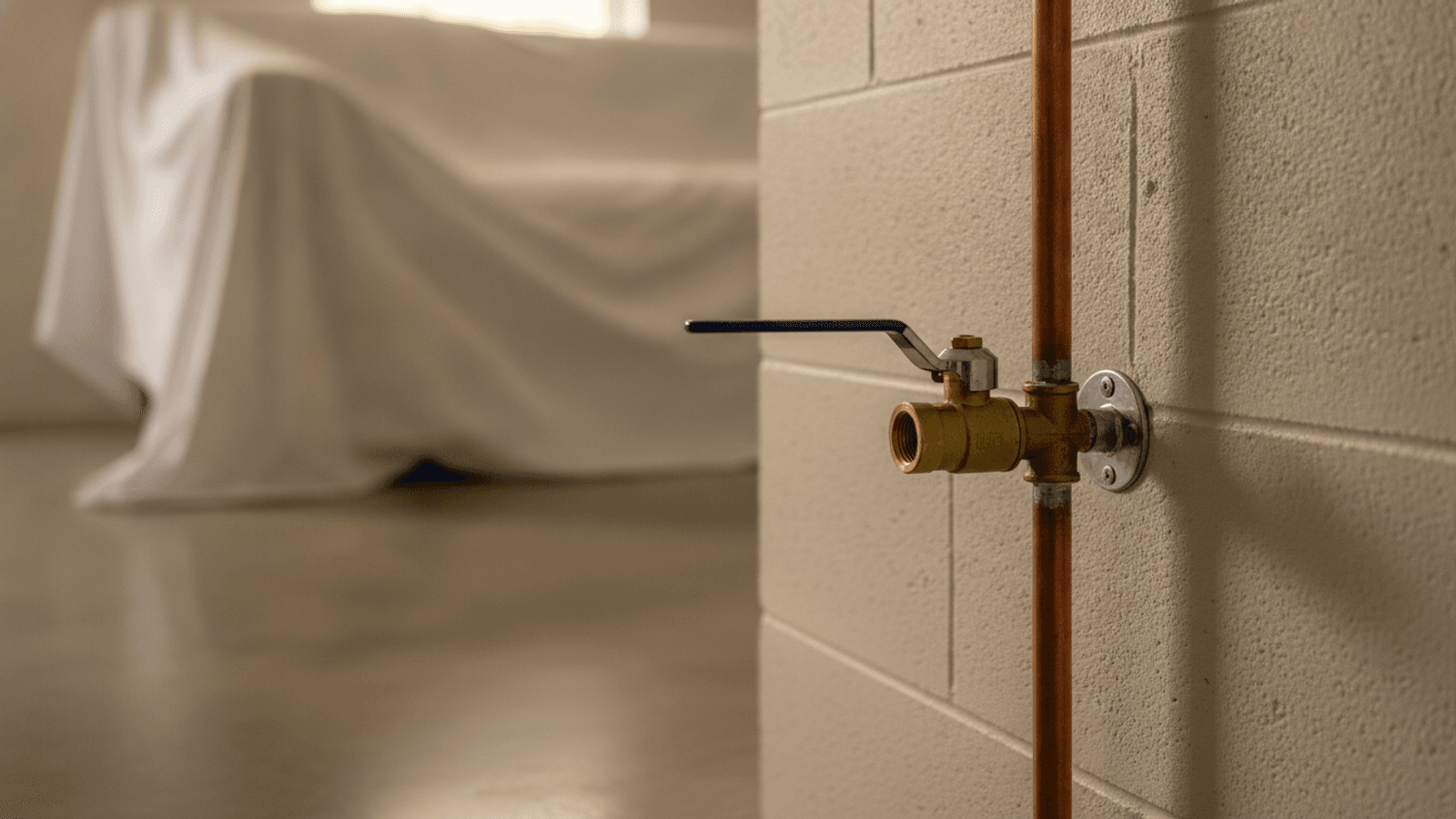
Leaving a home empty for months does put the plumbing on a 30-day clock, but not the one most articles describe: in Tower Hill’s Florida HO-3 form, past 30 consecutive days unoccupied, accidental water discharge stops being covered unless you shut the water off and drain the system. Your policy doesn’t lapse and the other perils stay covered. One exclusion just loses its escape hatch, and the escape hatch is two steps joined by “and,” not one. Forms vary, so read your own.
What does leaving a home empty for months do to the plumbing?
An empty Tampa Bay house still has active plumbing unless you isolate it. An open main keeps the supply piping pressurized. Water sits inside fixtures, branches and the water heater without normal use.
That combination changes the departure plan. A small leak can continue because nobody is there to see it. Standing water also needs a deliberate flushing sequence when you return.
This matters along the coast, where seasonal homes are part of the local plumbing picture. Our Belleair Beach city page addresses seasonal winterization, while Madeira Beach publishes a specific pre-arrival inspection option.
The goal isn’t to strip a furnished home as if it were abandoned. It is to control continuing water, prepare each appliance correctly and arrange a careful restart.
Does homeowners insurance stop covering an empty Florida house after 30 days?
The policy doesn’t stop. One exclusion changes, and it’s the exclusion that covers water. In Tower Hill’s TH HO-3 06 13 form, Section I Exclusion 1.m. removes accidental discharge or overflow of water past 30 consecutive days, and it names two conditions for getting it back:
This Exclusion 1.m. applies only while the dwelling is “vacant” or “unoccupied” for more than 30 consecutive days or being constructed; unless you have used reasonable care to: (1) Shut off the water supply; and (2) Drain the system and appliances of water.
Read the conjunction. It’s “shut off the water supply; and … drain the system and appliances of water.” Both steps, not either one. Closing the main and walking away leaves the second half undone.
That exclusion catches a snowbird house directly, because it names “unoccupied” as well as “vacant,” and the form defines the two differently:
“Unoccupied” means the dwelling is not being inhabited as a residence.
“Vacant” means the dwelling lacks the necessary amenities, adequate furnishings, or utilities and services to permit occupancy as a residence.
A furnished, powered Tampa Bay house is unoccupied while you’re north. It isn’t vacant. That difference is worth knowing, because the form’s other 30-day clocks, the ones for theft or attempted theft and for vandalism or malicious mischief, attach to “vacant” only. It just isn’t an escape from 1.m., which names both.
So the useful reading isn’t that coverage dies at day 30. It’s narrower and more actionable. Everything else stays in force, and the water exclusion turns on whether you did two specific things before you left.
One more caution on the form’s own wording: it says systems and appliances of water “do not include outdoor swimming spas or outdoor irrigation wells.” Those sit outside the exclusion’s scope entirely.
Forms, endorsements and carrier underwriting rules vary, and this is one Florida HO-3 special form. Read your own policy’s Definitions section and Section I exclusions before you decide how to close the house up. Our guide to homeowners insurance and plumbing damage explains the broader sudden-versus-gradual distinction. Questions about renewals and pipe materials belong in the separate guide to insurance and older Florida plumbing.
Why is a slow leak the real problem in an empty house?
Because the exclusion that kills a slow leak has no 30-day clock at all, so there’s no date you get past. Exclusion 1.m. is about a sudden discharge after day 30. Sitting right above it, exclusion 1.l. of the same form removes:
Constant or repeated seepage or leakage of water or steam, or the presence or condensation of humidity, moisture or vapor; which occurs over a period of time, whether hidden or not and results in damage such as wet or dry rot, “fungi,” deterioration, rust, decay or other corrosion.
That one applies whether you’re home or not. An empty house is simply where a weeping fitting gets the months it needs to become “over a period of time.” Nobody hears the drip, nobody sees the stain, and the water bill lands in an inbox you’re not reading.
So the two exclusions pull in the same direction for a seasonal absence, and both point at the same countermeasure: cut off the supply of water, and don’t leave a leak with an audience of nobody.
| Departure choice | What it changes | What it doesn’t solve |
|---|---|---|
| Leave the main open | Nothing. Fixtures and appliances stay pressurized, and a new leak can keep drawing water until someone notices. | Everything below, and past 30 days unoccupied it leaves exclusion 1.m. in force. |
| Close the main only | Piping downstream can’t draw a continuing supply through that valve. | Water already inside the pipes and appliances, and the form’s second condition, draining. |
| Close the main and drain the system | Matches both conditions the form names for reasonable care. | The water heater still needs its own handling, and drains still dry out. |
| Fix an unusable shutoff first | Gives you real control before you go and during an emergency. | Each connected appliance still needs its own manufacturer instructions. |
Our main water shutoff guide shows how to find and work the valve. If you spot unexplained moisture before you leave, professional leak detection can trace it. We publish leak detection at $250 to $450, applied toward the repair.
What should you do to the plumbing before you leave for the season?
Prepare the supply, heater and inspection plan while you can still test them. Rushing through those decisions on departure morning leaves little room for a stuck valve or active drip.
- Read your policy’s Definitions section and Section I exclusions before choosing an absence plan.
- If the plan is to satisfy an exclusion like 1.m., do both halves: shut off the supply and drain the system and appliances. One without the other doesn’t match the wording.
- Confirm which plumbing and equipment the main shutoff controls before closing it.
- Test the shutoff early enough to address a valve that leaks or won’t move normally.
- Inspect exposed connections beneath sinks, behind toilets and around the washing machine and water heater.
- Follow the exact manufacturer instructions for changing your water heater’s operating mode.
- Give a trusted local contact access and show them where the main shutoff is located.
- Keep storm preparation separate by following our Tampa Bay hurricane plumbing guide.
Madeira Beach’s city page publishes a $150 to $300 pre-arrival check covering water-heater function, visible pipe inspection and pressure testing. That service is designed around the local seasonal-home pattern. See the details for plumbing checks in Madeira Beach.
Should you shut off the water heater or leave it running?
Use the instructions for your exact water heater and your chosen water-supply plan. “Vacation” or “VAC” labels don’t provide one dependable temperature or procedure across every unit.
Don’t copy a setting from another brand or model. Find the data plate, locate the correct manual and follow its absence instructions. If the manual is missing or the controls are unclear, leave the setting unchanged until a professional identifies the unit.
The water heater and main shutoff decisions belong together. Changing one without understanding the other can leave you unsure about the restart sequence.
The plumbers we send can inspect the equipment and explain the correct setup. We publish water heater repairs at $150 to $450 depending on the part. Visit the water heater repair service if the unit already has a leak, odor or operating problem.
What should you check on the day you get back?
Inspect first, then restore and flush the plumbing in stages. This gives you a chance to spot moisture before adding a continuing water supply.
- Look beneath sinks, around toilets, beside the water heater and near appliance connections before opening a closed main.
- Leave the main closed and request help if you find active water, wet flooring or a sagging surface.
- If the visible areas are dry, open a faucet and restore the supply slowly while watching exposed connections.
- Operate each fixture and confirm that water enters and drains without appearing elsewhere.
- Follow the manufacturer’s instructions before changing or restarting the water heater.
- Flush outlets methodically instead of opening every fixture and walking away.
- Reinspect the exposed plumbing after the system has returned to normal use.
The CDC’s guidance for buildings after shutdown or reduced operation says stagnant water can lose disinfectant and support Legionella growth. Its building guidance says to flush hot outlets until the water reaches its maximum temperature. Treat that step carefully, because water at a heater’s maximum setting can scald, so keep children and anyone with reduced sensation away from the tap while it runs. The same CDC guidance says people at increased risk of Legionnaires’ disease, such as those with weakened immune systems, should consult a medical provider about taking part in flushing.
That CDC document addresses buildings after shutdown or reduced operation. It isn’t written specifically for Florida houses or seasonal residents. The relevant plumbing mechanism is stagnation inside an unused system.
Call for emergency plumbing help if restoring the supply reveals active leakage. Keep the main closed while waiting when the leak is downstream of that valve.
Why does the water look, smell or taste wrong after months away?
Stagnation can change water inside plumbing that hasn’t been used. The CDC’s guidance for buildings after shutdown or reduced operation says standing water can develop low or undetectable disinfectant levels.
Flush the system before deciding that the utility supply has changed. Persistent discoloration, odor or particles may point to a fixture, water heater or pipe that needs inspection.
A rotten-egg odor limited to hot water can involve a heater that sat unused. The guide to rotten-egg odors in Tampa Bay hot water explains that heater-specific issue.
A sewer odor belongs to the drainage side instead. Our indoor sewer-smell guide covers dry traps and other drain-side causes without assigning an unsupported drying timeline.
Frequently asked questions
Is a furnished snowbird home vacant or unoccupied?
Unoccupied, under Tower Hill form TH HO-3 06 13. It defines unoccupied as not being inhabited as a residence, and vacant as lacking the amenities, furnishings, utilities or services needed for residence. A furnished, powered house is the first, not the second. Your own policy’s definitions control your coverage.
Does homeowners insurance end after 30 days away?
No, and that framing is the common mistake. In the Tower Hill form the policy stays in force; exclusion 1.m. simply removes accidental water discharge past 30 consecutive days unoccupied unless the supply was shut off and the system drained. Separate 30-day clocks for theft and vandalism attach to a vacant dwelling only. Forms and endorsements vary, so read your own.
Is closing the main enough to satisfy that exclusion?
Not on its own. The form’s wording is “shut off the water supply; and … drain the system and appliances of water,” joined by “and.” Closing the main does half of it. Whether draining is practical for your house is worth asking a plumber before you go, not after.
Should I turn off the main water before leaving for months?
Closing the main limits what a new leak can draw, which is the core protection for a long absence. It doesn’t empty the system, and it doesn’t replace your water heater’s manufacturer instructions. Confirm what the valve actually controls before you decide.
How much does a pre-arrival plumbing check cost?
The Madeira Beach city page publishes a $150 to $300 pre-arrival check. It covers water-heater function, visible pipe inspection and pressure testing. The price is scoped to that published service, so other repairs need their own quote.
What if the hot water smells after I return?
Flush according to the reopening plan and identify whether the odor affects hot water only. A hot-side rotten-egg odor can point toward the water heater, while a drain odor follows a different path. Don’t assign the same cause to both.
When to call us
Call when the main shutoff won’t operate, you find moisture, or the water heater doesn’t come back to normal service. At Tampa Plumbing Pro we’ll match you with a licensed local plumber, and we cover Hillsborough, Pinellas and Pasco, so a barrier-island condo and a Pasco house on well water both get someone who works that area. Call us at (813) 590-0625.