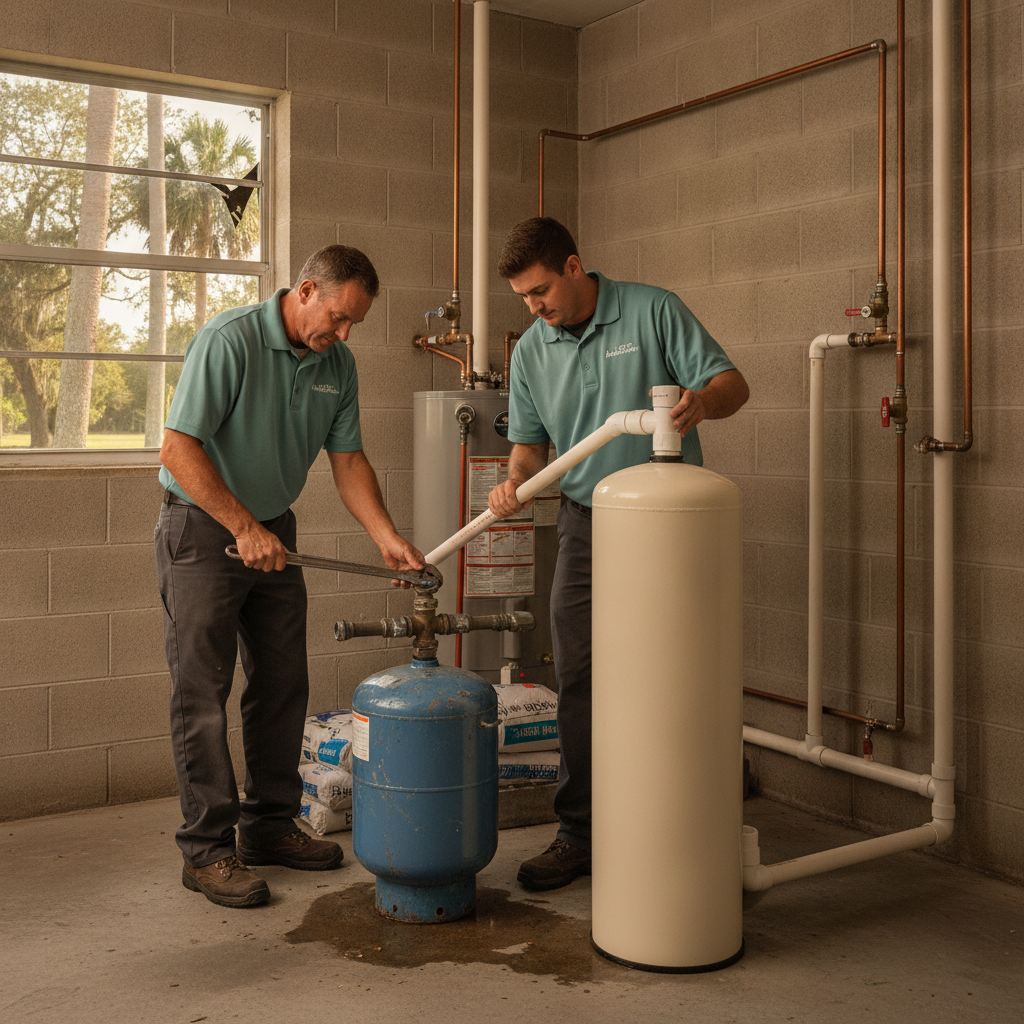
The pump that clicks on and off every few seconds is the reason well pressure tank replacement exists. In Land O’ Lakes, Odessa, Wesley Chapel, and rural Hillsborough towns like Thonotosassa and Wimauma, that tank is the air cushion between your well pump and every faucet in the house. When the bladder fails or the tank waterlogs, the cushion is gone. The motor starts paying for it.
Short-cycling vs a failed bladder
Short-cycling is the pump starting, running a few seconds, and shutting off, then doing it again while a tap is still open. A healthy tank stores a draw of water under compressed air so the pump can rest. Lose the air, and every cup of water is a pump start.
Two failures look similar at the tap. A tank that only lost its air charge is still a tank. The bladder is intact, the shell is dry, and a recharge plus a recheck can put it back in service. A ruptured bladder is finished. Water fills the air side, the tank feels heavy all the way up, and the air valve yields water instead of air when it is tested. That unit does not get patched. It comes out.
You can hear the difference if you know what you are listening for. A working tank sounds hollow toward the top and solid toward the bottom. A waterlogged tank sounds like a drum full of water from the base to the fittings. Pressure at a running faucet will surge and drop instead of holding a band. The pump may click so often that the gauge never settles.
Left alone, that pattern cooks a well pump. The motor is built for a modest number of starts, not a start every time someone rinses a glass. Catching the tank early is how you keep well pump repair from turning into a full pump swap. After a storm, the same short-cycle can show up next to a fried control box. That mix is covered in our note on lightning damage to well pumps.
Land O’ Lakes and Odessa lots often run a well and a septic system on the same sand. The pressure tank is the water side. A soggy drain field after an August storm is the waste side, and that work goes to a licensed and registered septic contractor. A slow drain is not a tank fault.
This is ordinary pumping equipment, not a well-drilling problem. Florida defines well construction as the work that gets groundwater, and it expressly leaves out the installation of pumps and pumping equipment. The pressure tank sits above ground. Swapping it is plumbing work on a private water supply, which is why the plumbers we send handle it.
Tank vs pump vs switch
Three parts share the same pressure. Mixing them up is how people replace the wrong one.
The tank holds the air cushion and the drawdown. The pressure switch tells the pump when to cut in and cut out. The pump is the machine in the well, or at the surface, that actually moves water. A new tank will not raise your pressure. It will hold it steadier. The switch sets the range. If the house is weak at every fixture with a healthy tank and a switch that is already closing at its cut-out, the pump is the conversation. For that side of the diagnosis, see well pump repair in Tampa Bay.
| What failed | What you notice | What gets replaced |
|---|---|---|
| Tank, waterlogged or torn bladder | Pump short-cycles, tank is heavy, water at the air valve | The tank, then air charge and switch set together |
| Pressure switch | Pump will not start, will not stop, or chatters at one reading | The switch, and often the gauge and fittings |
| Pump | No water, or weak flow even with a sound tank and switch | The pump, a separate job from the tank |
A leak on the house side can fake a short-cycle too. The pump fills, pressure falls through a hidden drip, and the switch keeps calling for more. That is why a tank test includes a look at the rest of the system, not just the air valve. If a toilet or a slab line is the real draw, leak detection belongs in the visit.
A pump that short-cycles also hammers the water heater. If the heater starts popping, or the T&P valve drips after weeks of well flutter, that is a separate water heater repair once the well side is stable.
Hard well water in Pasco adds scale and iron to every moving part. A switch gummed with mineral will chatter even with a new tank. Treatment is a different page: well water treatment in Pasco. Do not confuse this tank with the small expansion tank on a city-water heater. That one sits at the heater because a check valve or a pressure-reducing valve traps thermal expansion. A well pressure tank is the well’s air cushion. Our water heater expansion tank explainer is the city-water version.
City Tampa and most of Pinellas sit on municipal lines. The well belt is Pasco and the rural Hillsborough pockets. If you are in a Brandon or Valrico subdivision on city water, cycling fixtures is usually a pressure-reducing valve or a failing heater, not a well tank.
What well pressure tank replacement includes
Replacement starts with a diagnosis, not a parts run. The system gets isolated and drained so the air charge can be read with no water pressure on the tank. That reading is compared with the switch’s cut-in. An intact tank that is only low on air gets recharged and watched. Water at the air valve, a rusted-through shell, or a bladder that will not hold a charge means the tank is done.
Florida humidity rusts steel tanks that sit in a damp well house. A weeping seam or a crust of rust at the base is a tank problem even if the bladder has not split yet. The swap still follows the same test: drain, read the air charge, then decide recharge versus replace.
The new tank is sized to the pump, not to the pad it sits on. Sticker gallons are not drawdown. Drawdown is the water the tank actually delivers between cut-in and cut-out, and that volume is what buys the pump a long enough run. A higher-output pump needs more of it. A house with more bathrooms and a washer that fills fast needs more of it. An undersized replacement is why a new tank waterlogs again in a hurry.
The switch and the tank have to be set as a pair. Air charge is set a little below cut-in so the bladder is not fighting water the instant the pump starts. Guessing that number, or copying the old tank’s faded sticker, is a common way to buy the same failure twice. The plumbers we send plumb the new tank in, fill it slowly, check the fittings, then recheck flow and pressure at a tap so the cycle looks like a cycle again, not a flutter.
Florida does not treat this swap as well construction. The Southwest Florida Water Management District requires a well construction permit before a water well is installed in the District. That permit is for the well, not for a pressure tank, a pressure switch, or a pump sitting above ground. A plumbing contractor may work on private water supply systems and the equipment used with them without picking up an extra local trade license for that scope. Drilling or repairing the well below ground is still water-well-contractor work through the District. The two licenses are not interchangeable. You can confirm a plumber at Florida’s license search.
A tank job does not fix a clogged fixture. If a tub or washer still backs up once pressure is steady, that is drain cleaning. Months of short-cycling also beat on every joint in the house. If fittings start weeping after the well has been hammering, a whole-home repipe is a separate decision from the tank.
Common questions
How much does it cost to replace a well pressure tank?
The number moves with tank size, access, and whether anything else failed with it. A larger tank costs more because the pump’s flow needs more drawdown, not because a bigger shell looks better in the pump house. A tank boxed into a tight well house takes more labor than one standing in the open. If the pressure switch, gauge, and unions go with the tank, that is more of the well stack. If short-cycling already killed the pump, you are no longer on a tank-only job. The honest path is a quote after the air charge and the switch are tested.
Can I replace a well pressure tank myself?
This is licensed plumbing on a private water supply. Florida’s well-construction rules stop at the ground and leave pumping equipment out of that license on purpose. The plumbers we send do the isolation, drain, swap, and the switch-and-air-charge pairing so the pump cycles the way it should. Leave the control box closed. Capacitors hold a charge, and that side of the stack belongs to the pump technician or a licensed electrician. If you are sorting other small leaks around the house, when to call a pro is the wider picture.
How often should a well pressure tank be replaced?
There is no honest calendar date. Tanks come out when the bladder ruptures, the shell rusts through, or the air charge is neglected until the tank waterlogs. An undersized tank, or one set against the wrong cut-in, fails sooner because it cycles more. A tank that only lost air can go back in service after a recharge. One that sprays water at the air valve is done.
Will a new pressure tank raise my water pressure?
It will make pressure steadier. The switch still sets the band the pump runs in. If every fixture is weak with a sound tank, the switch settings and the pump need checking, not a larger shell.
When to call us
Call when the pump short-cycles, the tank is heavy, or water comes out of the air valve. That pattern belongs with a licensed plumber before it takes the motor with it, especially on well systems in Pasco and northern Hillsborough. We match you with licensed local plumbers who work private well equipment.
Call us at (813) 590-0625.